

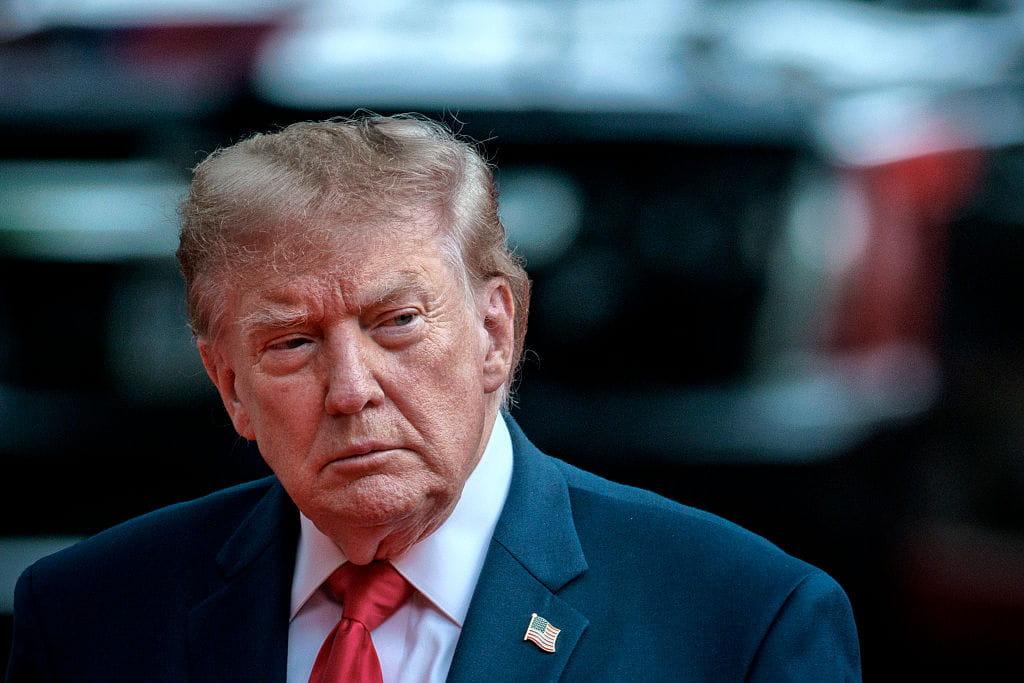

From the moment it became clear that Republicans would suffer a drubbing in midterm elections and lose control of Congress, the battle for not just the 2028 GOP presidential nomination but the very heart and soul of the party kicked into high gear. So many questions abound. How much power and influence will Donald Trump continue to wield as a lame-duck president who took a gut punch in the midterms? Who will fill the potential leadership vacuum as Trump’s days in the White House dwindle and the 2028 election nears? Is MAGA so embedded in the GOP after a dozen years of Trump that a pivot from populism to pure conservatism, neoconservatism, isolationism, globalism, or some other underlying philosophy is possible in the space of less than 24 months?
Trump’s Lone Ranger Populism
What does the Republican Party stand for, anyway? One of the problems with Trump’s Lone Ranger-style populism is that it can be ideologically inconsistent or incoherent as a unified governing philosophy. The inherent contradictions in the 45th and 47th president’s unique governance are effectively captured by Barton Swaim in The Wall Street Journal, who describes Trump as “a strongman who appoints judges who check him, a laissez-faire capitalist with a penchant for state planning and protectionism, an America-first isolationist who nabs foreign dictators and bombs hostile regimes, a pro-billionaire working-class populist. And that’s on a Tuesday.” And he characterizes MAGA not as a unified movement so much as “a loose, baggy amalgam held together by Mr. Trump’s personality.”
Free with the Daily Briefing
85EssaysUnravel the Constitution
Hamilton, Madison & Jay’s complete case for America, free and searchable in the Publius Reader.
Free with the Daily Briefing. Unsubscribe anytime.
Indeed, a coherent, cohesive strategy to persuade voters, so effective for Trump in 2024, was missing in action two years later. While his popularity plummeted, the president kept speaking of a golden age that few have experienced, proclaimed victory in the ongoing, unpopular Iran War while acting defiantly about the cost of living. He kept promising the war was about to end, prices would drop, and a glorious future was on the horizon. This was a trio of misguided messages which, put together, left voters with the sense that Trump had become tone-deaf or so focused on his legacy that he ignored their concerns. Whoever bears the standard of the GOP in 2028 will have to start all over in refreshing, retooling, or rebuilding the Republican brand, no matter how the next two years play out.
And let's not understate the importance of Trump's remaining time in office. If he concludes the war successfully, if not triumphantly, prices at the pump, which are already falling, continue to drop, and economic growth hits expected levels, MAGA, loosely defined, will likely survive mostly intact in 2028. But if things go south, the war rages on, and prices continue to rise, you can expect a resurgence of more traditional forms of Republican and conservative policies to rise to the surface in an open primary.
The Republican Vision
How does the GOP go about defining a vision for the future in the wake of a historically muscular presidency that broke all the rules of politics? It has been proven in the past, most notably in 1994, that when a party pitches a highly specific agenda tailored directly to the express concerns of the public, victory is far more possible than when different candidates pursue conflicting agendas and muddle the message. In the ‘94 “Gingrich Revolution,” Republicans advanced a “Contract With America” in which they promised to bring to a vote a balanced budget requirement, term limits, tort reforms, work requirements for aid recipients, and many other bills. Though much of the agenda never became law because of Democratic opposition, the Republicans’ pledge led to a stinging verdict for then-President Clinton, as they picked up eight seats in the Senate and 54 in the House, a mirror image of the 2026 midterms.
While this type of so-called contract is often considered in midterm elections, though rarely becomes reality due to internal conflicts, why not adopt such a strategy for 2028? In a party with a cloudy future, such specificity would boost the beleaguered Republican brand. The GOP knows it will be standing on the precipice of a Democratic trifecta, so it will be incumbent on Republicans to present a powerful message of unity. It cannot center strictly around scaring voters about the rising threat of socialism on the left – that message did not work in 2026.
From Liberty Nation News, Trivia, Facts, Check Us Out
Stay informed.
Today’s news, the Constitution and American history, written for young readers.
Visit GenerationLiberty.com
Instead, logic dictates that such a pact should center on a fundamental about which all Republicans agree – and many Democrats don’t – the free enterprise system and the boundless opportunities it presents in a robust economy. This type of coherent, party-wide agenda has hardly been possible in the Trump era because this president is such an overpowering figure as to blot out the sun shining over other Republicans. Of course, a free-market argument needs to be supported by basic measures of economic health. The GOP must be able to demonstrate that economic growth, jobs, wages, and the cost of living are all looking better come the fall of 2028. If they don’t, Republicans won’t be able to make a serious economic argument and may have to revert to more emphasis on other issues such as a promise to lower taxes, culture wars, and full-throated anti-socialism.
Perhaps the most attractive part of a contract with the voters would be to sharpen the growing contrast between Republicans and Democrats, who would be forced to respond on widely popular issues – the 80-20 kind on which Trump consistently capitalized as he ran for and won the presidency. In addition, it would put pressure on the Democrats to issue their own manifesto, which they would be unlikely to do given that the party has moved so markedly to the left. As is their wont, they would probably prefer to use safe, vague, poll-tested language and keep the policies they actually intend to implement on the down-low. We heard very little about impeachment from the Democrats during the midterm campaign. They won on pocketbook issues, and then immediately pivoted to investigation and impeachment. Next time around, they must be pinned down on the kitchen-table issues, and the best way for the GOP to accomplish this would be to lay all their cards on the table and dare Democrats to do the same.
Disaster always leads to opportunity. The 2026 midterms were indeed catastrophic for the GOP, but from the ashes will arise an open platform for new voices, intriguing ideas, and vigorous debate. We will be hearing much about JD Vance, Marco Rubio, Ron DeSantis, and other presidential hopefuls in the months ahead. But before the campaign begins in earnest after the new year, it is incumbent on Republicans of all stripes to take a hard look in the mirror, see the reflection with clear eyes, and act accordingly. A blueprint, with policies drawn from both Trump and more traditional Republican and conservative policy prescriptions, would present a unified set of common-sense principles. It would sharpen their messaging, polish their tarnished image, and could well be the way – perhaps the only way – to send a Republican back to the White House.