

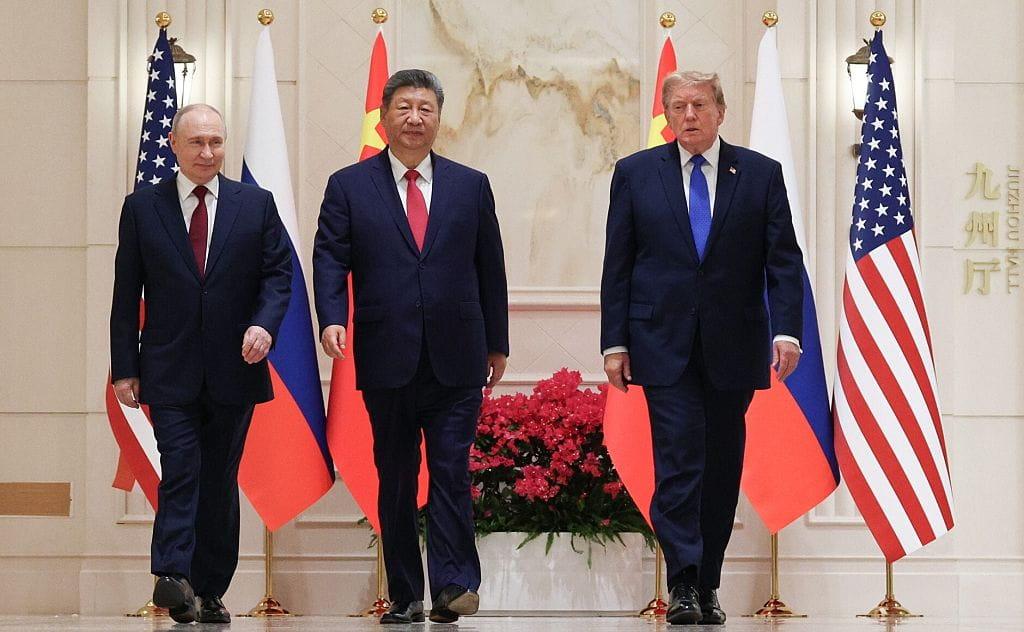
Not since President Franklin Roosevelt, Prime Minister Winston Churchill, and Soviet leader Joseph Stalin met at Yalta in 1945 have such geopolitical luminaries met to discuss issues that shape global affairs. Consequently, the meeting between US President Donald Trump, Russian President Vladimir Putin, and China’s President Xi Jinping is a noteworthy event. The three leaders met at the Asia-Pacific Economic Cooperation (APEC) Summit in Shenzhen, China, on November 18–19; however, their meetings overshadowed the APEC agenda. There are three major takeaways from the discussions.
The US, Russia, and China Trilateral Meeting Makes History
The historic nature of the meetings and the topics covered are the immediate takeaways. As the first trilateral meeting between US, Russian, and Chinese leaders, these discussions are unprecedented. Trump, Putin, and Xi talked for about 90 minutes, seated at a large round table. President Trump opened the meeting by explaining:
“This trip has also given us the opportunity for this first-ever trilateral meeting between the leaders of the United States, Russia, and China… As presidents of three of the largest countries, we have a special responsibility to maintain open, respectful, and productive dialogue on issues impacting not just our people but the entire planet… No peace was ever forged by declining opportunities for engagement.”
One key discussion item was the opportunity to reduce the number of nuclear weapons. Trump maintained that, as the three “largest nuclear powers,” the countries are “uniquely positioned to discuss how to reduce the number of nuclear weapons on Earth.” At the end of the discussions, the leaders released a four-point “China-Russia-U.S. Heads of State Declaration toward Peace.”
The fourth point “reaffirmed that a nuclear war cannot be won and must never be fought. The three countries will conduct a dialogue on reducing nuclear risks and preventing the proliferation of nuclear weapons.” China has steadfastly refused to enter into nuclear arms reduction talks, perhaps because it is in the process of building its nuclear arsenal. Agreeing on nuclear arms may be a small step toward getting China to at least discuss a reduction.
Practical Agreements
A second takeaway is that the declaration also included practical agreements on energy flows, the International Criminal Court, and United Nations reform. The four-point agreement committed the permanent members of the UN Security Council “to reform the UN so that the UN can respond more effectively to global challenges and conform to its fundamental mission of international peace and security.” Another of the four points was that the three countries “plan to increase the production and supply of refined petroleum products for the benefit of all nations. They reaffirmed the importance of stable energy flows.”
Additionally, the three took on the International Criminal Court, agreeing that the court, as well as other similar international bodies, cannot “abuse their jurisdiction.” These agreements may be modest; however, they show a willingness to align on broader geopolitical competition, such as superintelligence and the proliferation of high-end semiconductors.
The third takeaway is the failure to substantively address the conflicts in Iran and Ukraine, despite opportunities for bilateral discussions between Trump and Putin and Trump and Xi. If there was an expectation of concrete progress toward resolving either war, those expectations went unrealized. The four-point declaration made no mention of the conflicts.
Ukraine Security Guarantees
There appeared to be a turnaround in Putin’s position on security guarantees for Ukraine. According to the Associated Press, “Russia is ‘comfortable’ with NATO-like security guarantees for Ukraine to end the war as it nears the five-year mark, U.S. envoy Jared Kushner said on Thursday, hours after U.S. President Donald Trump wrapped rare three-way talks with Russian President Vladimir Putin and Chinese President Xi Jinping.” This reversal seems to be the result of Trump’s bilateral meeting with Putin.
Free with the Daily Briefing
85EssaysUnravel the Constitution
Hamilton, Madison & Jay’s complete case for America, free and searchable in the Publius Reader.
Free with the Daily Briefing. Unsubscribe anytime.
Some interesting optics came from the more personal interactions during the meetings. In an unusual demonstration of diplomatic courtesy, President Xi met President Trump at the airport and greeted him with a handshake and a brief hug. Continuing the theme of collegiality, Trump said he and Vladimir Putin had a “great relationship for many years” and that “a lot of wonderful things can come out of this, or at least start,” according to a Fox News video clip.
There was another noteworthy aspect of the trilateral meeting. One consequence of Russia’s unprovoked invasion of Ukraine has been a concerted effort by Western nations to isolate Russia. This meeting somewhat curtailed that effort. Furthermore, being included alongside the US and China significantly increased Russia’s geopolitical standing on the world stage. Russia was clearly included as one of the three most powerful nations.
For those expecting another Yalta-like moment where global dynamics would change significantly, that didn’t happen. However, as President Trump explained, problems don’t get solved by ignoring them. As trust builds, more trilateral meetings may happen in the future, hopefully with more positive results.
~
The views expressed are those of the author and not of any other affiliate.