
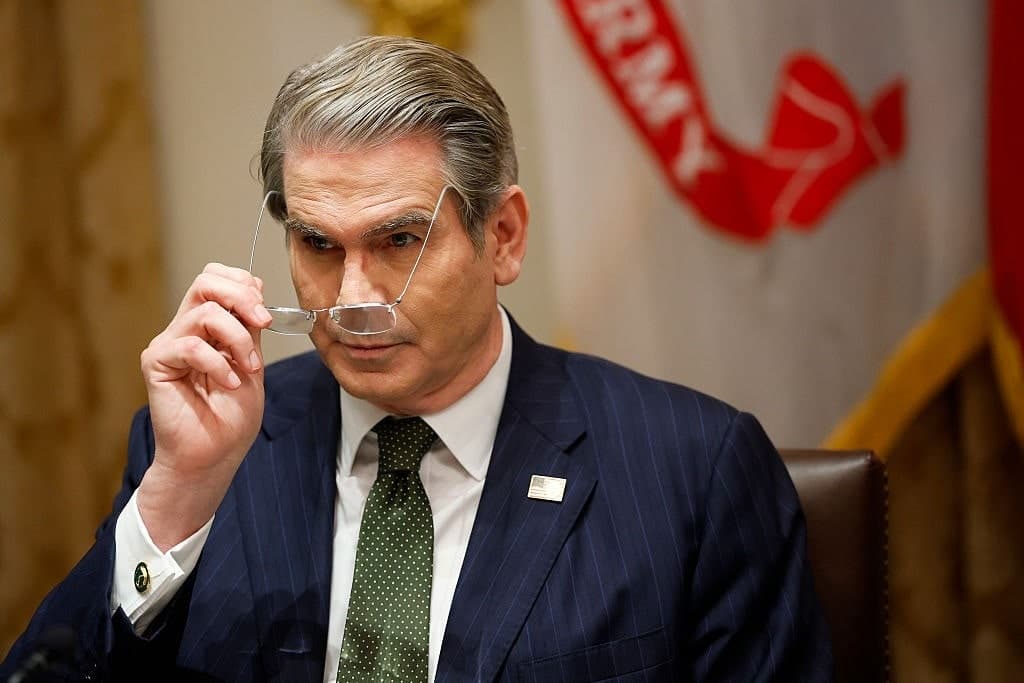

In an exchange with a reporter at an October 15 news conference, Treasury Secretary Scott Bessent told the individual, who claimed to be a lawyer, that he would not say the one thing that he agreed with Vladimir Lenin on. What did the communist pontificate exactly? Lenin wrote in 1914: "The bourgeois intelligentsia, including the lawyers, are the most cowardly, the most narrow-minded, the most hypocritical of all." Based on recent actions and proposals, the administration may also support certain socialist principles, including government ownership and price controls.
Price Controls Coming to America?
Bessent, the busiest man in Washington, appeared at CNBC’s “Invest in America Forum” on October 16 for a wide-ranging conversation with network host Sara Eisen. They touched upon gold, the Federal Reserve, and the budget deficit. But, of course, China was the primary focus in their tete-a-tete.

At about halfway through their talk, Bessent revealed that the current administration is considering installing price floors across various industries to push back against "a nonmarket economy like China." According to the senior administration official, the United States must "exercise industrial policy" to prevent Beijing from undercutting US firms.
He used rare earths as an example. While the Chinese regime price controls 70% of global rare earths mining, it dominates roughly 95% of processing and refining. "And for 20 years, anytime anyone in a market-based economy stood up a processor refiner, China came in, cut prices, and put them out of business. So, we’re going to set price floors and the forward buying to make sure that this doesn’t happen again. And we’re going to do it across a range of industries," Bessent said.
Put simply, the United States has to fight socialism with socialism.
Now, Bessent's remarks have yet to be fully implemented, but the administration's transparency has served as a window into public policymaking. Economics teaches us the dangers of price controls, not only for instituting maximum levels, but also for price floors.
As Bessent, a billionaire hedge fund manager and economic historian, is well aware, when the government installs guaranteed minimums or maximums, it distorts the natural signaling function of market prices. Artificial prices then lead to a plethora of consequences, including wasted resources, misallocation of capital, higher prices for other goods, and deteriorating quality of products.
This would not be the first time that the United States has introduced price floors. The US Department of Agriculture (USDA) has utilized minimum prices for key commodities such as corn and dairy, and typically purchases surpluses to ensure the floors remain intact. Others do it, too, such as India (rice), the European Union (sugar and milk), Malaysia (palm oil), and Canada (eggs).
The objective is to protect farmers and their income and prevent a market collapse comparable to what happened during the Great Depression. In this case, it would be to slay the red dragon.
Equity Stakes
Does President Donald Trump have a Bloomberg terminal and Robinhood trading account on his Resolute Desk in the Oval Office? The White House has recently taken on a Wall Street-like role, acquiring stakes in a growing list of companies, including Intel, Lithium Americas, MP Materials, and Trilogy Metals. Other companies are also under discussion.
But do not expect the administration to start buying shares in Wendy's, Tesla Motors, or Starbucks. Instead, according to Bessent, the administration is only taking stakes in strategic industries.
"We're not going to come in and take stakes in non-strategic industries, but we've identified seven industries," he said, adding that the government still needs to be "very careful not to overreach" and ensure the investments are advancing strategic aims.
Unfortunately, economic research suggests that equity stakes, no matter how well-intentioned and strategic the investments may be, typically backfire and cause more harm than good.
Economists have found that government ownership typically creates a moral hazard because firms might take excessive risks, knowing they will be bailed out and supported by taxpayers. It distorts market competition, creating an unfair advantage through the government's system of picking winners and losers. The public policy pursuit can also deter private investors because state intervention might weaken market-oriented decision-making and governance.
Like price floors, we have seen this before. During the global financial crisis, Washington acquired a 61% stake in General Motors, costing taxpayers $49.5 billion. When the government sold its stake below cost, the American people lost more than $10 billion. Italy approved a $3 billion bailout for national airline Alitalia in 2017, resulting in perpetual losses and an eventual closure. In the 1970s, the UK nationalized the automaker British Leyland, a move that eventually cost taxpayers billions due to poor quality, constant labor disputes, and a lack of innovation (it was later privatized).
It's Different This Time
The administration will claim that this time is different because officials are trying to reverse decades of China-dominated globalization. While years of bad lawmaking by Uncle Sam have caused China to become the chief player in rare earths – the United States is sitting on mountains of natural resources – employing socialist methods to combat socialism may not be a wise strategy.
Does anyone recall when former Vice President Kamala Harris proposed using price controls for food? “Comrade Kamala” was the chief criticism, and rightly so. Just because an R is running the show this time around, it does not mean the economics change.
.jpg&w=1920&q=75)
.jpg&w=1920&q=75)
.jpg&w=1920&q=75)