

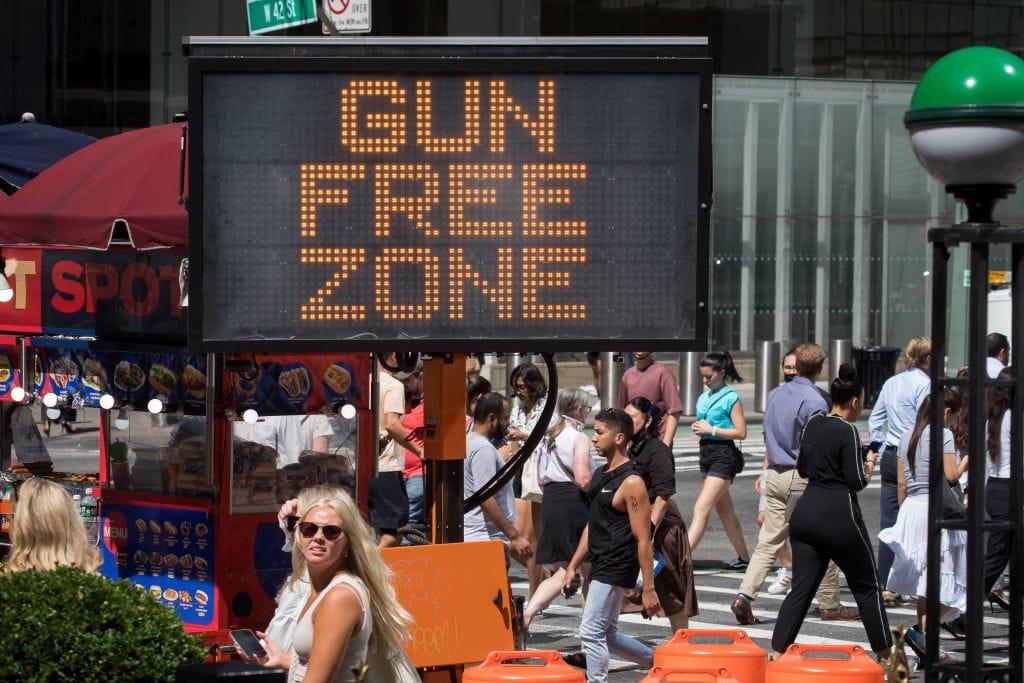

The anti-gun movement has a lot of tricks up its sleeve for circumventing Second Amendment rights. One of those is the idea of gun-free zones promoted as necessary public safety measures. The problem, or one of the problems, with these “safe spaces” or “sensitive places” is that states run by politicians hostile toward gun rights keep adding various categories of public spaces to the list of areas in which firearms are forbidden. On Nov. 16, the US Supreme Court denied cert to the Fourth Circuit case Novotny v. Moore, thus allowing all of Maryland’s current “sensitive places,” or gun-free zones, to remain in effect.
Maryland’s Gun Safety Act of 2023, signed into law in May of that year by Gov. Wes Moore, bans the carrying of firearms in government buildings, healthcare facilities, schools, and public establishments that serve alcohol. While most ardent gun rights advocates would object to this, it is nevertheless true that such locations are, by law, gun-free zones in most states – not that this justifies anything.
However, the Maryland law also forbids firearms in casinos, amusement parks, racetracks, museums, and stadiums. State parks and mass transit systems were designated as “sensitive places” by earlier legislation. Furthermore, it also forbade the carrying of weapons on any private property open to the public unless the owner explicitly allows guns on the premises. This last restriction has become commonly known as the “vampire rule,” alluding to folklore that holds vampires cannot enter a building unless invited in.
In June of this year, the Supreme Court struck down Hawaii’s “vampire rule.” And even before that, in January, the Fourth Circuit nixed Maryland’s version of the rule.
Gun-Free Zones a Weapon Against Gun Rights
Legal scholars might argue whether the decision to deny the plaintiffs’ petition for writ of certiorari was correct or not, depending on their perspectives. Ruling on the constitutionality of all gun-free zones is a different matter and, considering that the Court denies around 95% (and sometimes more) of the 4,000 or so petitions it receives each term, this probably shouldn’t come as a surprise.
Free with the Daily Briefing
85EssaysUnravel the Constitution
Hamilton, Madison & Jay’s complete case for America, free and searchable in the Publius Reader.
Free with the Daily Briefing. Unsubscribe anytime.
Even the most enthusiastic of Second Amendment advocates, while they may argue that no location should be off-limits, must concede that there are precedents, going back many decades, for certain buildings or public areas being gun-free zones. The difference throughout most of American history is that gun-free zones were not so numerous, arbitrary, and expansive that it was virtually impossible to legally carry a gun in public at all.
In the wake of the Supreme Court’s Bruen ruling, states and cities controlled by anti-gunners have used the imposition of gun-free zones to restrict, as much as possible, the ability of law-abiding Americans to publicly carry firearms without being in breach of the law.
Justice Clarence Thomas agreed with the Supreme Court’s decision to deny cert – four votes are required to grant a petition to hear a case – but he did express his skepticism of Maryland’s gun-free zone law. Thomas suggested “an appropriate and more narrowly focused case” should bring a Supreme Court decision.
From Liberty Nation News, Trivia, Facts, Check Us Out
Stay informed.
Today’s news, the Constitution and American history, written for young readers.
Visit GenerationLiberty.com
Thomas pointed out, "States have seized on the idea of 'sensitive places' to prohibit the peaceable carry of firearms in locations that bear little resemblance to legislatures, polling places, or courthouses." He went on to cite laws in other states that seem to be far more about preventing gun owners from exercising their constitutional rights than enhancing public safety.
He observed that New Jersey bans guns in at least 25 locations, “including zoos, public libraries, casinos, and state-owned beaches.” New York prohibits firearms in 20 categories of publicly accessible areas, and California has 29 classes of gun-free zones, including financial institutions and public gatherings or special events for which permits have been granted.
There’s a lot of legal work still to be done to eliminate the most egregious abuses of the gun-free zone concept. In the meantime, these zones will continue to be largely ineffectual at best – and target-rich environments for dangerous individuals at worst – because there is rarely anything to stop someone from ignoring the signs and carrying a gun into any one of these supposedly gun-free zones.