


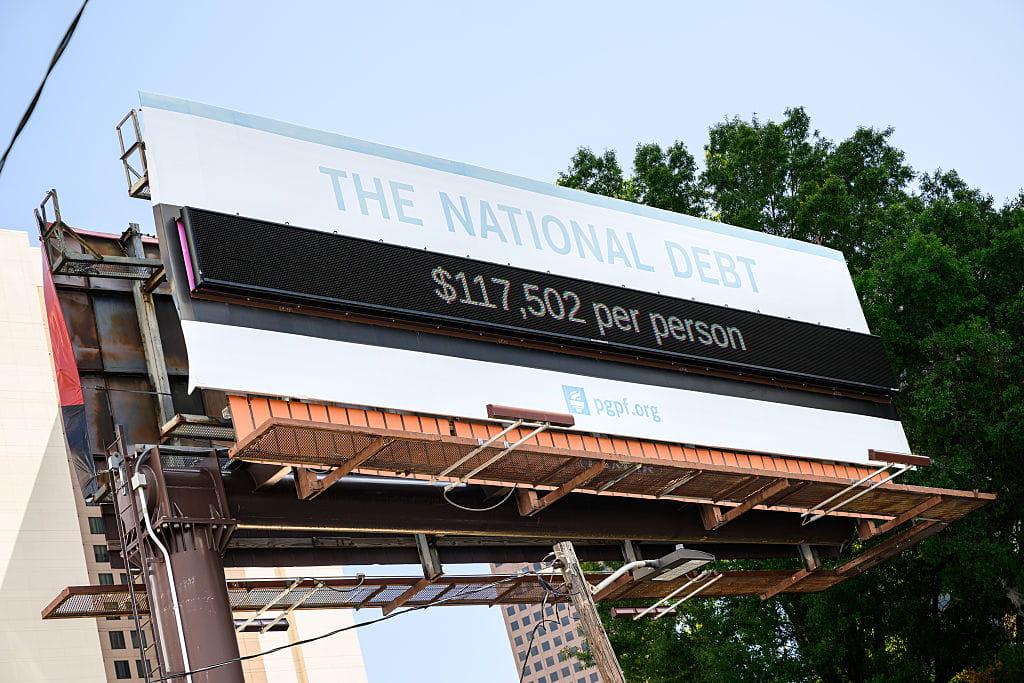

Investigations, impeachments, and indignation are set to be the key themes for the incoming Congress. But the White House and both chambers will be forced to relive the debt ceiling debate. Yes, it’s that time again when Republicans and Democrats feign outrage and threaten to destroy the economy, only to order crates of pizza at the 11th hour and extend the debt limit for another couple of years.
The Debt Ceiling Redux
Under last year's One Big Beautiful Bill, Congress agreed to set the debt ceiling at $41.1 trillion. With the national debt recently surpassing $40 trillion, the federal government will need another last-minute deal to kick the can down the road and ignore America's fiscal challenges.


Free with the Daily Briefing
85EssaysUnravel the Constitution
Hamilton, Madison & Jay’s complete case for America, free and searchable in the Publius Reader.
Free with the Daily Briefing. Unsubscribe anytime.
So, Washington is on track to hit the debt ceiling as early as February. When this happens, the government caps how much the Treasury Department can borrow.
Officials will have to tap cash on hand to meet their legal obligations, including interest costs, Medicare benefits, and Social Security payments. Like his predecessors, Treasury Secretary Scott Bessent will then have to use extraordinary measures, from accounting tricks to shifting funds, to cover Uncle Sam's bills for a few months.
Indeed, all eyes will be on the Treasury General Account's daily balances, essentially the federal government's bank account at the Federal Reserve.
Then, the X-date approaches. The Treasury exhausts all of its efforts, and the government officially defaults on its obligations. All those years of political theater go down the drain.
As usual, a three-act play from the Theater of the Absurd will commence. With the composition adjusted after the midterm elections, the first act will consist of Democrats proclaiming fiscal responsibility. The second will feature Republicans demanding lawmakers expand the debt ceiling. The final act will have both parties shaking hands.
Of course, in reality, it will eventually be the final curtain for America’s finances.
To Default or Not to Default
President Donald Trump teased that perhaps the federal government should default. His argument? Because it’s never happened before, who knows what will happen?
The likelihood is that interest rates would rise sharply, since investors would demand greater compensation for holding debt that Washington defaulted on. This would then produce a negative feedback loop: higher rates, bigger interest payments, a ballooning budget deficit, surging national debt, and higher rates. In this scenario, the only solution would be dramatic tax hikes.
From Liberty Nation News, Trivia, Facts, Check Us Out
Stay informed.
Today’s news, the Constitution and American history, written for young readers.
Visit GenerationLiberty.com
Shortly before his inauguration, the president told NBC News that he would support Democrats, including Sen. Elizabeth Warren (D-MA), who favor abolishing the debt ceiling. Indeed, scores of Democratic lawmakers have favored putting the kibosh on the limit to avoid these routine showdowns.
This is just as problematic for the United States. If the government is adding a trillion dollars to the pile every few months with a debt ceiling, then one can only imagine how much politicians would grow the national debt without one!
Meanwhile, the current administration’s efforts to mop up the red ink flooding the nation’s capital have fallen short. Imposing tariffs, establishing DOGE, entertaining Secretary Bessent’s 3-3-3, and fighting fraud, waste, and abuse have come nowhere near lowering the federal deficit or covering interest charges.
President Trump has gone so far as to propose printing money to help pay down or shrink the real debt level.
As Rep. Thomas Massie (R-KY) may have said it best, "Elon Musk found it was easier to land rockets backwards and put internet on Antarctica and get cars to drive themselves than it was to get anybody in these two chambers to cut a penny of spending.”
What to Do?
Just as many times as Congress has voted to raise the debt ceiling – 78 to be exact – various lawmakers have unveiled plans that would realistically improve America's finances.
Sen. Rand Paul's (R-KY) Six Penny Plan would cut six cents from every dollar annually for five straight years. Rep. Jay Obernolte (R-CA) introduced a measure that would require outlays not to surpass total receipts in any fiscal year unless authorized by a supermajority. Others outside the Capitol have suggested rolling back spending to pre-pandemic levels.
So, there are plans that could get America back on solid fiscal footing. But politicians and bureaucrats are addicted to taxpayer-funded, deficit-financed largesse and decadence, so it is mission impossible to bring spending back to 2019 levels – $4.4 trillion – without igniting the fire and fury of the ruling class.