

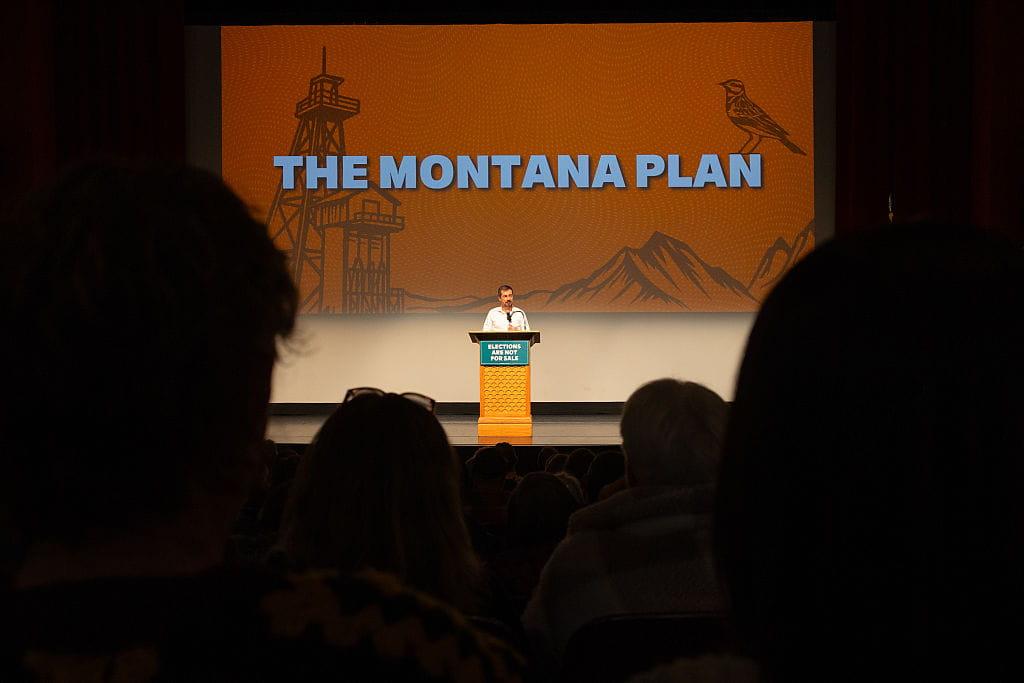

Legal challenges are piling up against a Montana ballot initiative that seeks to remove corporate money from the state’s elections. Voters overwhelmingly approved the measure in the 2026 midterms as an end-run around the Supreme Court’s decision in Citizens United v. FEC. Before the Associated Press even called the race, several groups filed a lawsuit challenging the measure’s constitutionality. Since then, other lawsuits have followed, even from out-of-state plaintiffs who claim the law threatens political participation across state lines. With similar efforts underway in other states, Montana could help set a precedent, possibly leading to a legal showdown in the nation’s highest court.
Montana Rewrites Corporate Power
Ballot Initiative 194, known as the Montana Plan, declares that “artificial persons,” including corporations, nonprofits, and certain other entities, cannot exercise “political spending power” in association with Montana’s elections. The measure, which passed 66% to 34%, is designed to sidestep Citizens United, the 2010 ruling holding that the First Amendment bars the government from restricting independent political spending by corporations and unions. Instead of limiting speech directly, though, the Montana Plan limits what corporations, as creations of the state, are empowered to do in the first place.
Free with the Daily Briefing
85EssaysUnravel the Constitution
Hamilton, Madison & Jay’s complete case for America, free and searchable in the Publius Reader.
Free with the Daily Briefing. Unsubscribe anytime.
The named defendants in the lawsuit, Montana Attorney General Austin Knudsen and Secretary of State Christi Jacobsen, are both Republicans. They’ve each said they won’t actively defend the measure, claiming it violates the First Amendment. Because they refused, the Transparent Election Initiative (TEI) – the group that spearheaded the effort and similar ones in other states – has requested to intervene as a defendant.
Meanwhile, the list of plaintiffs is growing. The initial filing came from the Montana Republican State Central Committee, the Frontier Institute, and the Montana Family Foundation. Later, the US Chamber of Commerce and Young Americans for Liberty filed separate lawsuits, which are now consolidated with the original case.
Montana has been down this road before. In 1912, the state’s voters passed the Corrupt Practices Act to prevent copper barons from controlling the state’s political process. The law stood for a century – that is, until the US Supreme Court struck it down in 2012, citing Citizens United. This time, however, a movement appears to be building.
The Ripple Effect
Though Montana was the first to pass such a measure by popular vote, it’s not the only state with a similar law. Hawaii’s governor signed Act 11 in May, a law stating, “Beginning July 1, 2027, a corporation operating under the jurisdiction of this State shall not have the power to expend moneys on or participate in any election activity or ballot-issue activity.” Much like the Montana Plan, Act 11 faces formidable opposition. The US Chamber of Commerce sued to block it; the Grassroot Institute of Hawaii, represented by the Institute for Free Speech, filed a separate challenge, in which the national ACLU submitted an amicus brief arguing the law violates the First Amendment.
The movement is spreading, too. Michigan voters approved a measure this year dubbed “Money Out of Politics,” aiming to bar political spending by gas and electric utilities, as well as certain government contractors. Two lawsuits have been filed against the proposal, arguing it violates the First Amendment. The measure passed with 81% of the vote and, unless a court blocks its implementation, is supposed to take effect by Dec. 3, 2026.
From Liberty Nation News, Trivia, Facts, Check Us Out
Stay informed.
Today’s news, the Constitution and American history, written for young readers.
Visit GenerationLiberty.com
Reform advocates say more than 30 states are pursuing similar efforts. What happens in Montana, though, might decide the fate of the others. The measure is set to take effect on Jan. 1, 2027, but a federal judge in Helena will hear the plaintiffs’ request to block it on Dec. 14. The Transparent Election Initiative appears undeterred. “We expected a lawsuit from day one, and we’ve been waiting for this moment,” Jeff Mangan, founder and president of TEI, said in a statement.
Chief Judge Brian Morris, who will decide whether the Montana Plan is constitutional, once voted to uphold a similar law. In 2011, when Morris was a state Supreme Court justice, he joined the majority that upheld the Corrupt Practices Act, a ruling the US Supreme Court later overturned. The Montana court reasoned that, unlike in Citizens United, where the justices found no “compelling interest to justify the speech restrictions at issue,” Montana’s history of corporate corruption provided one.
But Mangan isn’t arguing over speech. “We’re not looking at this as a First Amendment case,” he told Scott Harris at Between the Lines. “We’re looking at this as a 10th Amendment. The states have always had the absolute right to determine what powers their state’s corporations have or incorporations that work in their states have.”
Regardless of the outcome in Montana, this case appears likely to reach the Supreme Court, where a 6-3 conservative majority has repeatedly loosened campaign finance restrictions, including in June, when the justices struck down coordinated party spending limits in NRSC v. FEC.
That record doesn’t bode well for the Montana Plan, but it can’t erase what happened at the ballot box. The measure passed by more than 30 points in a ruby-red state, a sign that hostility toward corporate political spending is bipartisan. If the courts strike down the measure, that sentiment probably won’t disappear, and the coordinated efforts to circumvent Citizens United likely won’t end.