


What began as the low rumbling of a distant herd has become a hammering, pounding drive from the electorate to make certain unreliable members of the US Congress pay for skipping out on the job. Lawmakers are allowed to miss days for medical reasons – but not purely out of spite or because they just don’t have any motivation to show up. It is not okay to ditch when the people are expecting a job to be done. And the law agrees; the law just isn’t actually enforced. Maybe it would be a bit sweeter for the frustrated American people if a particular section of the law – the one that docks pay for the missed days – were activated.
But why now? Anger against the government was once scattered across both parties, but after the midterms, party preference has finally left the “Yeah, but” ranch and is equally out for whoever is denying the work of the people getting done. No one likes a sore loser, or a lazy ass in the US Congress, and the “make them pay” mentality is becoming a united cry.
And voters are not alone: Even many of the men and women on the Hill are calling on no-shows to get their hineys back in the chamber.
The most recent flagrant foul was committed by several GOP members who, in a huff, walked away after losing their re-election bids. Rep. Pat Harrigan (R-NC) poked the bear. “I don't know what you do with people that don't understand the concept of duty,” he said. “I mean, look, you signed up for a two-year term. You execute your two-year term, no matter what happens along the way politically. You have an obligation both to your constituency and to your country.”
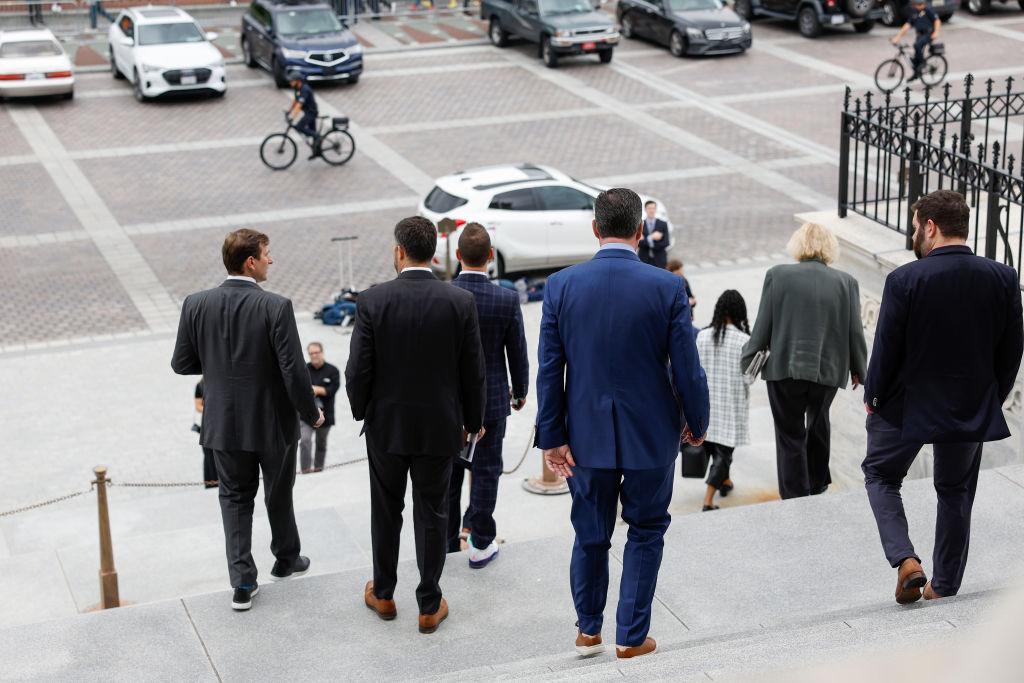
Nearly three dozen House members – 21 Republicans, 10 Democrats, and an independent – skipped votes and left Washington early on Wednesday, November 18, forcing House leadership to cancel Friday's scheduled votes and start the holiday break early.
We’ve Been Here Before
For the liberty-minded and lovers of a fair shake, there is precedent for a good – and constitutional – docking of pay for those elected officials who were in a snit and shirked their sworn duty.
Amid bitter debates over the Wilson-Gorman Tariff Act in the summer of 1894, congressional absenteeism had become so widespread that the House struggled to maintain a quorum. After considerable debate and a Judiciary Committee recommendation, congressional leadership began enforcing a law from 1856 and docking members' pay.
Accountability at last – but it didn’t last. The same mandate still exists, as Liberty Nation News’ Jim Fite can attest; it just isn’t being used. “Congressional pay is required by the Constitution but doesn’t require how it works exactly,” he explained. “That’s left up to Congress.” And so we have identified the first hurdle.
Fite continued: “Originally, members were paid a per diem for showing up – but in 1856, the Pay Act changed it to an annual salary. Section 6 included a safeguard that requires a deduction from a member’s pay for each day of absence from the House or Senate for any reason other than sickness of himself or of a family member.”
That $50 penalty would be about $1,926 today for every unexcused day missed – and, more importantly, every vote missed. So why aren’t we hearing about it now? As Fite explained:
“It’s a sort of self-reporting honor system, and even then, it doesn’t happen automatically. Congress polices its own attendance and pay by this law, and it almost never happens. In fact, it hasn’t happened since 1867 in the Senate and 1914 in the House. Outside of the Civil War era, and then once again in the 1890s, it was barely used anyway. Lawmakers don’t even bother to pretend to be sick anymore.”
More than 130 years later, many Americans are understandably angry. They are tired of partisan bickering, political grandstanding, government dysfunction, and elected officials who seem more interested in their next election – or lack of success in the previous election – than in doing the job for which they were hired.
Accountability for Congress?
The average voter doesn’t have the luxury of simply walking away when disagreements arise in the workplace. They cannot indefinitely postpone difficult decisions, ignore deadlines, or refuse to perform their duties without consequences. They are expected to show up, do their jobs, and earn their paychecks. Why should Congress be held to a different standard?
Free with the Daily Briefing
85EssaysUnravel the Constitution
Hamilton, Madison & Jay’s complete case for America, free and searchable in the Publius Reader.
Free with the Daily Briefing. Unsubscribe anytime.
Some of the missing members offered weak excuses but should still be questioned about motive and whether a nearly $2,000-a-day fine would sit well. Others, though, didn’t bother. Some of the no-show Republican representatives rode in on Trump’s coattails. Seeing his fancy jacket ablaze this cycle should have at least had them reading the room months ago.
Still, the excuses aren’t even being made to the people. That’s hubris: believing you do not owe anything to the job for which you took an oath but are owed respect and a respectable paycheck. The people, for too many administrations, have been ignored once Election Day has passed.
The frustration Americans feel today transcends political parties. It is about the growing disconnect between those who govern and those who consistently pay the bills that have ballooned out of control with no end in sight. Balance a budget? Pass legislation that was promised? How about doing your job or becoming obsolete to the constituency? It is obvious what happens when inactivity, name-calling, and broken promises have reached their limit in two branches of the government.
Perhaps the Congress of 1894 understood something the Swamp elite would do well to remember today: Public service is a responsibility, not a privilege without conditions, and a penalty that can be activated is already in place.
A docking of pay has a nice ring to it. After all, the American people are the employers. Members of Congress are the employees. Somewhere along the way, Washington seems to have forgotten who works for whom.