
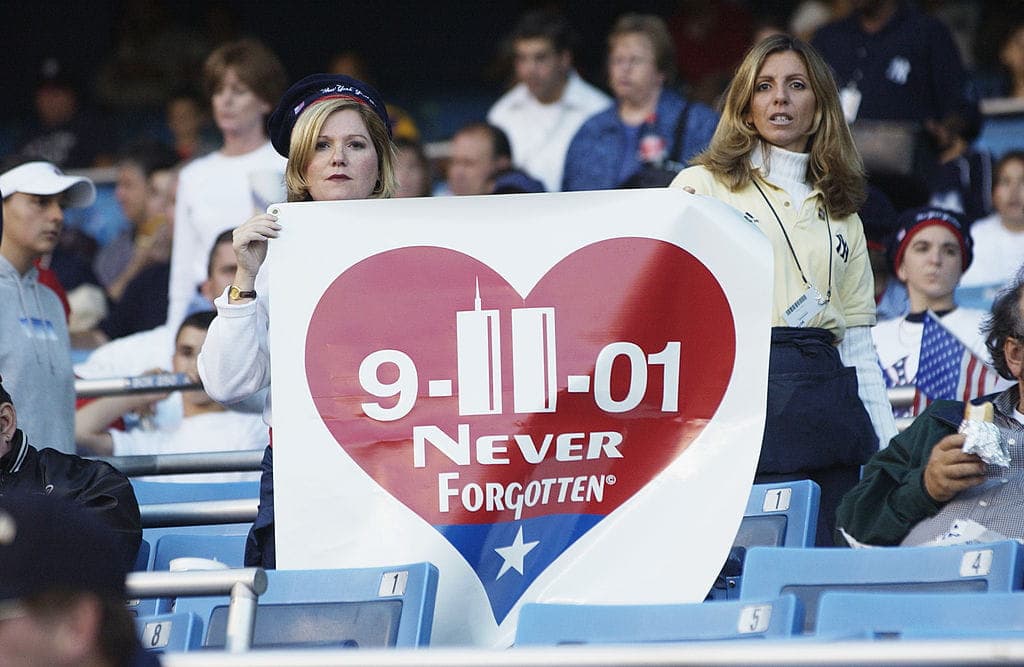

In 1953, author L.P. Hartley began his novel The Go-Between by asserting, “The past is a foreign country: they do things differently there." Now that the 9/11 attacks on the United States are just a couple days away from being 25 years old, a growing number of Americans have not experienced what can be considered the most defining day of the last half-century. To these people, 9/11 is not a reality but becomes the “foreign country” that Hartley spoke of in the opening lines of his book. And it’s vital to recognize that more and more of those who lived through that horrible day will be dying off, and only memories of 9/11 will remain.
It’s much like Pearl Harbor to those born after 1941. We can read about it and visit the USS Arizona Memorial in Hawaii, but we can no longer talk to the handful of people still alive who experienced it. At its most basic level, one day in the not-too-distant future, 9/11 will not even be a memory but a learned topic without the shared experience.
This theme is explored in the magazine America: The Jesuit Review. The headline reads: “I am not old enough to remember 9/11. But it matters that I carry on the memories of others.” Author Grace Doerfler was two years old at the time of 9/11, so she’s among the group of people who were alive but too young to understand the event. She wrote, “While I cannot remember 9/11 itself, it has deeply shaped my generation. The day is woven into the fabric of my life and the lives of everyone I know. I have no memories of a United States unmarked by terrorism, and I have grown up in a world struggling to come to terms with the scale of such violence.”
9/11 — An Experience or Just History?
Somewhere between 70% and 75% of the current US population was alive on Sept. 11, 2001, according to multiple sources. This means approximately 30% of Americans were born after the terrorist attacks. Then there’s the category of those who were alive but too young to comprehend it. Naturally, those who were not old enough, or who came after 9/11, have a very different frame of reference for the attack. Their view is more abstract. It is something to read about, but with no personal memory attached, their emotions are not connected to 9/11.
Free with the Daily Briefing
85EssaysUnravel the Constitution
Hamilton, Madison & Jay’s complete case for America, free and searchable in the Publius Reader.
Free with the Daily Briefing. Unsubscribe anytime.
The reaction is different from those who were alive and cognizant on Sept. 11, 2001. A Reddit thread titled “Do you remember 9/11?” captured the emotion attached to the day — much like “Where were you when President Kennedy was assassinated?” Only this time, the terror was widespread. It wasn't aimed at one man in one city; it involved four hijacked passenger jetliners: two took down the Twin Towers in New York; another hit the Pentagon in Arlington, VA, just outside Washington, DC; the fourth went down in rural Shanksville, PA. Fear was so rampant that Americans wondered what might be next. Would other cities be targeted? Was this the beginning of World War III?
Here are some personal reactions shared on Reddit just a few days ago from those who lived through it:
- “Yes, it was a turning point in my life, marking the boundary between childhood and adulthood.”
- “I remember how quiet everything felt outside that evening.”
- “My dad actually WAS in the air that morning, flying to New York for work. His flight was rerouted to somewhere like Baltimore, where he had to rent a car to drive back to Atlanta. He obviously didn’t know what was happening while he was in the air, but to hear him tell it — he looked out the window at one point of the flight, and there were two F-16s on either side of the plane. He’s convinced they were instructed to shoot down any plane where the pilot didn’t respond.”
- “It was absolutely terrifying.”
- “I don't think about it much, but that day is permanently burned into my memory.”
And then there’s the fringe: There are people known as 9/11 truthers who deny that airplanes were used to wreak havoc on that day. Instead, some believe that missiles and/or explosives were used on 9/11; others claim there was government foreknowledge of the attacks. Mainstream society does not take this reasoning seriously.
This is precisely why the older generation is duty-bound to share their personal experience of 9/11 with Generation Z and beyond. Only by remembering can we keep the truth of such a terrible tragedy for posterity. As a character in a novel written by Richelle Mead opined, “History is important because it teaches us about the past. And by learning about the past, you come to understand the present, so that you may make educated decisions about the future.”

.jpg%20fraud&w=1920&q=75)