


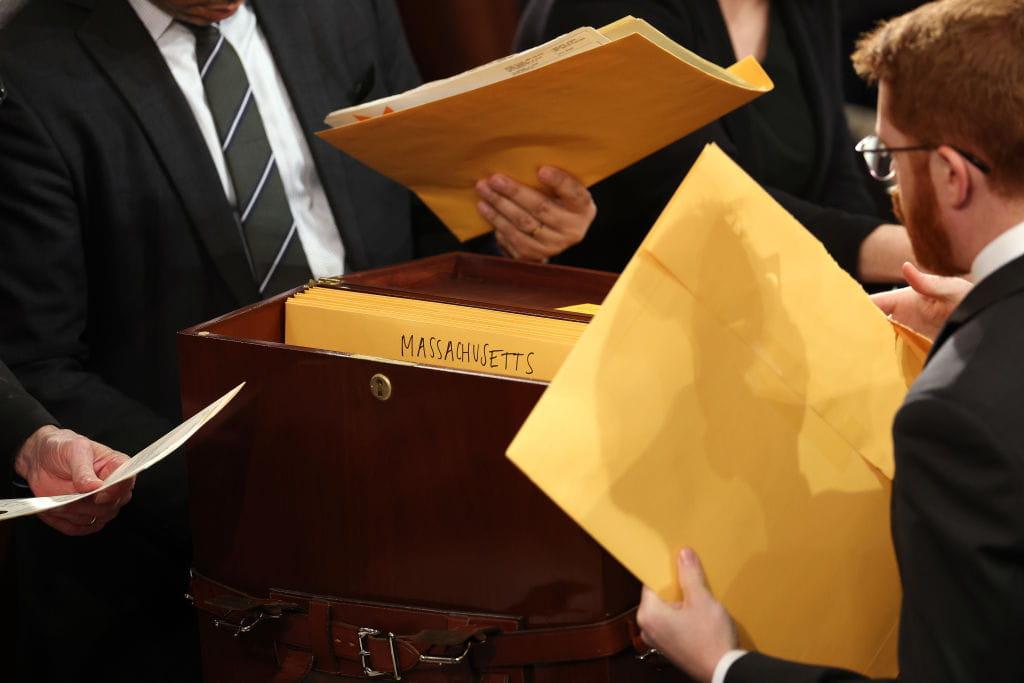

In the 2026 elections, Democrats didn’t just flip the House, Senate, and state governorships. They also walked away with a handful of “trifectas” – states in which they control the governor’s mansion and both chambers of the legislature. This likely means big changes for the residents of those states, but on a much bigger scale, it could also allow for the dismantling of the Electoral College – in practical effect, even if not in legal fact.
A Constitutional ‘Patch’ for the Electoral College?
The Electoral College is one of the few final protections of this nation’s status as a Republic, and it has been the target of Democrats for decades. Remove that, and the national popular vote determines who serves as commander-in-chief – precisely as it should be, the left argues. The very name of the Democratic Party says it – democracy over republicanism.
For those backing the one person, one vote ideology of pure direct democracy, the 2026 elections were a dream come true. For more than two decades, Democrats have been working on a way to get around the Electoral College since Republican George W. Bush won the election of 2000 despite losing the popular vote by half a percentage point.

Free with the Daily Briefing
85EssaysUnravel the Constitution
Hamilton, Madison & Jay’s complete case for America, free and searchable in the Publius Reader.
Free with the Daily Briefing. Unsubscribe anytime.
Maryland became the first state to officially join this movement, called the National Popular Vote Interstate Compact, or NPVIC, in 2007. Here’s how it works: The compact does not abolish the Electoral College. That would require a constitutional amendment. Rather, it relies on Article II, Section 1 of the Constitution, which gives each state legislature the authority to decide how its electors are appointed. Each state that joins the compact would then appoint its electors based not on the popular vote within its own borders, but by the national popular vote. It doesn’t go live, though, until enough states have joined to represent 270 electors – the minimum required to win the presidency.
As of November 2026, a total of 18 states and Washington, DC, have enacted the compact into law, bringing 222 electoral votes into play, and leaving the compact just 48 short of the 270 required for it to take effect.
But in January, Democrats will control trifectas in five new states that aren't already members – and only four of them are needed to bring the compact to life.
The five states now potentially in play are Pennsylvania (19 EVs), Michigan (15 EVs), Arizona (11 EVs), Wisconsin (10 EVs), and Nevada (6 EVs). Together, they hold a cumulative 61 electoral votes. The only path to victory for Democrats here must include both Pennsylvania and Michigan – but then any two of the three others joining gets the job done.
2028 and Beyond
Will the required four, or perhaps even all five, pass the compact into state law before the 2028 presidential election? Maybe. Winning a trifecta in a state and guaranteeing passage of a specific law are two different things, but it certainly makes it seem more likely than not to happen.
So what does the 2028 election look like if they do? Well, it depends on who wins and by how much. Proponents of abolishing the Electoral College – or, barring that, working around it – point out that five presidents have won the electoral vote and the White House despite losing the national popular vote. They see this as a bug in the system, not the feature that it is. So, clearly, it must be fixed.
The left loves to say that a Republican has only won the popular vote twice this century. Well, that’s true, too – but it doesn’t mean quite as much as they want you to think it does. This century has only seen two Republican presidents – both of whom lost the popular vote once, barely, and won it later for a second term. The last time before that a president lost the popular vote and won the office was Benjamin Harrison in 1888; it isn’t the frequent happening that Democrats seem to try to portray it as.
From Liberty Nation News, Trivia, Facts, Check Us Out
Stay informed.
Today’s news, the Constitution and American history, written for young readers.
Visit GenerationLiberty.com
When Bush lost the popular vote in 2000, he did so by only a 0.52% margin. He turned around and won the popular by 2.46% in 2004 for re-election. Donald Trump lost 2.09% to Hillary Clinton in 2016, but still carried 304 electoral votes and won the White House. In 2024, he beat out Kamala Harris by 1.47% of the popular vote and took 312 electoral votes.
So let’s say a Democrat wins the popular vote in 2028 but does not win a majority of the electoral votes. That isn’t nearly as common as some would have you think, but it could happen. If this compact is in place, the Democratic candidate would get between 272 and 283 electoral votes simply from states in the compact. At least some non-member states could well be involved in such a popular vote win, bringing the total up to over 300 easily.
A left-wing dream come true, no? Well, yes. But what if a Republican does win the popular vote? By the rules of the compact, that means all member states – typically reliably blue states – would have to give their electors to the winning Republican. This would mean an electoral landslide of roughly 500 or more of the 538 electors, looking on paper like Ronald Reagan’s 1984 landslide even if the national popular vote margin is 1% or less! So if 2028 ends up a repeat of 2024, the Democrats’ dream becomes a nightmare.