

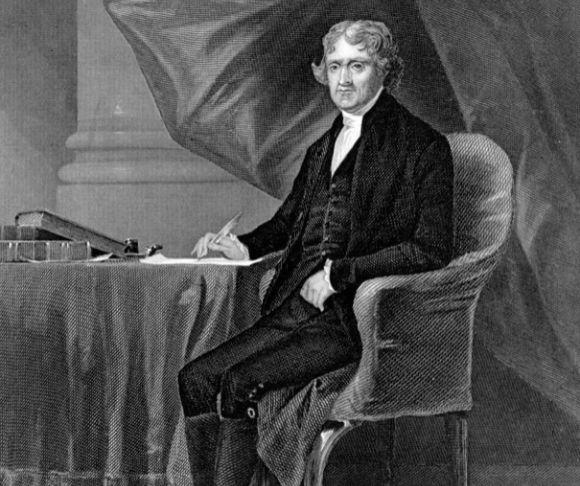

In just over one month, the 120th Congress will get sworn in, and among them will be the first Muslim elected to the United States Senate: Michigan's Abdul El-Sayed. The senator-elect recently said he would take his oath of office on the Quran, suggesting he could use a copy that belonged to Thomas Jefferson.
Now, Jefferson is perhaps best known for being the principal author of the Declaration of Independence. His fellow Founding Fathers were well aware of his talent for writing, with John Adams once telling him, “You can write ten times better than I can.” Of course, good writers tend to be avid readers, and Jefferson was certainly no exception. In fact, “avid” might be a bit of an understatement. The third president of the United States had an extensive library of more than 6,400 books at his Monticello estate just outside of Charlottesville, VA. Among the thousands of texts, though, was indeed the Quran — a fact that has managed to raise eyebrows over the years.
Jefferson and the Quran
Ever the intellectual, Jefferson bought a 1764 edition of an English translation of the Quran while studying law years before the Revolutionary War. Roughly a decade after obtaining the Islamic text, Jefferson wrote in private notes, paraphrasing John Locke, that “neither Pagan nor Mahometan nor Jew ought to be excluded from the civil rights of the Commonwealth [of Virginia] because of his religion.” At the time, Muslims were often called Mahometans. Historians generally agree that Jefferson’s early fascination with the faith was about intellectual curiosity rather than conversion.
Free with the Daily Briefing
85EssaysUnravel the Constitution
Hamilton, Madison & Jay’s complete case for America, free and searchable in the Publius Reader.
Free with the Daily Briefing. Unsubscribe anytime.
While Jefferson defended the right of Islam to exist alongside other religions in Virginia, he also criticized the faith. In Thomas Jefferson's Qur'an: Islam and the Founders, historian Denise A. Spellberg reconstructed Jefferson’s notes on Islam, which were written in a shorthand form:
“Jefferson included two direct negative references to Islam. First, he likened his opponents to Muslims, with a variation of Voltaire’s claim that Muslims wished for no form of science other than the Qur’an. Jefferson then asserted more generally that a state religion quashed ‘free enquiry,’ by which he meant the spiritual exploration of others whose ‘uncoerced reason’ led them to a different truth.”
Spellberg highlighted one of Jefferson’s shorthand notes, which read, “Mahomsm. supportd. by stiflg. free enqry,” and reconstructed it as “Mahometanism supported by stifling free enquiry.”
Put plainly: Jefferson asserted that Islam, a state-backed religion, was oppressive because it discouraged people from questioning or challenging its teachings.
The Barbary Pirates
In the late 18th century, the Mediterranean region of North Africa was known as the Barbary Coast. Pirates from the Barbary states had attacked merchant ships for centuries, and, after the Revolutionary War ended, American vessels became targets as well.
In March 1786, then-US minister to France Thomas Jefferson, along with John Adams, US minister to Great Britain, met with the ambassador of Tripoli — a Barbary state — in London. In a report to then-Secretary of Foreign Affairs John Jay, the two Founding Fathers recalled asking the ambassador why his people would “make war upon Nations who had done them no Injury, and observed that we considered all mankind as our friends who had done us no wrong, nor had given us any provocation.” The pair continued:
“The Ambassador answered us that it was founded on the Laws of their Prophet, that it was written in their Koran, that all nations who should not have acknowledged their authority were sinners, that it was their right and duty to make war upon them wherever they could be found, and to make slaves of all they could take as Prisoners, and that every Musselman who should be slain in battle was sure to go to Paradise.”
According to Jefferson and Adams, the ambassador also shared details on how the Barbary pirates used fear to conquer their enemies when launching unprovoked attacks on vessels:
“[I]t was the Practice of their Corsairs to bear down upon a ship, for each sailor to take a dagger in each hand and another in his mouth, and leap on board, which so terrified their Enemies that very few ever stood against them, that he verily believed the Devil assisted his Countrymen, for they were almost always successful.”
Jefferson’s thirst for knowledge and unwavering belief in religious liberty compelled him to defend the civil rights of Muslims, but that defense by no means reflected his complete approval of the faith itself.