

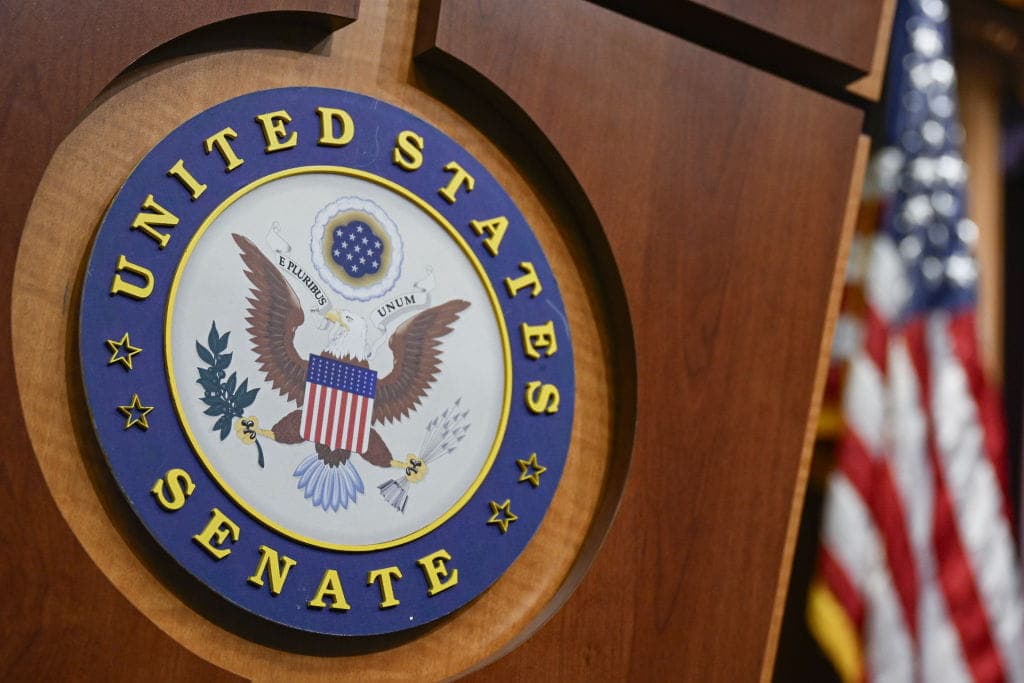

The Democratic Party’s path to retake the upper chamber seems to be widening – and in places once thought safe for Republicans. Cook Political Report recently moved Iowa and Texas into the toss-up column, both of which President Donald Trump won decisively in 2024. To retake the Senate, however, Democrats need to hold all their seats and flip four others, which would require capturing at least two seats in ruby-red states. Could Texas and Iowa be the pair of aces they need to triumph? On the surface, the idea almost seems ridiculous, but a closer look suggests otherwise.
The Senate Battlefield Expands
Democrats have dreamed of “Blexas” (blue Texas) for a long while, and when an opportunity to challenge a seat there emerges, they often claim, “This is the year!” Sen. John Cornyn (R) has held his seat since 2002 but was ousted in the primary by Ken Paxton, the scandal-plagued state attorney general many see as a flawed candidate. He received Trump’s endorsement just before primary day and now faces state Rep. James Talarico, a Democrat who has proved competitive. But critics believe he’s disconnected from real Texans and that his beliefs are too far left to stand a chance of getting elected. Plus, no Democrat has won a Senate race in the Lone Star State since 1988.
Free with the Daily Briefing
85EssaysUnravel the Constitution
Hamilton, Madison & Jay’s complete case for America, free and searchable in the Publius Reader.
Free with the Daily Briefing. Unsubscribe anytime.
If there is an opponent Talarico stands a chance of beating, though, Paxton might be it. “There’s a lot of people that, one, don’t really like Paxton at all, they think he’d be a terrible senator or they were loyal to Cornyn – or both,” a GOP donor told Politico. It probably doesn’t help that Paxton has kept a low profile during his campaign. “I’ve seen Mitch McConnell more than Paxton,” said Fox News host Jesse Watters.
Perhaps Paxton is trying to avoid questions about his string of legal troubles and scandals, including an impeachment, indictments on three felony securities fraud charges, and an extramarital affair. Still, it’s hard to convince voters to trust him when he stays out of sight. “You can’t be a terrible reprobate and be a lazy candidate,” said Jim Geraghty at National Review. “At minimum, you must be a hard-working terrible reprobate.”
Liberty Nation News’ polling aggregator shows Talarico with a one-point lead. That’s not significant; however, he’s polling better than the last Democrat to make Texas competitive, Beto O’Rourke, who lost to Republican Sen. Ted Cruz by just a few points. From April to July 2018, Cruz led in every poll. Talarico, meanwhile, has led Paxton in most surveys during the same period this year. Of course, Cruz was an incumbent back then, so that might explain why he polled better than Paxton has. Maybe the comparison is worthless, but with another ruby-red state loosening from the GOP's grip, Talarico’s polling numbers seem less like an anomaly and more like a sign.
In the Hawkeye of the Beholder
In Iowa, Republican Rep. Ashley Hinson faces state Rep. Josh Turek (D), a two-time Paralympic gold medalist. No Democrat has won a Senate race in Iowa since 2008, the same year then-Sen. Barack Obama won the Iowa caucus. The former president recently endorsed Turek, too, appearing in an advertisement in which the two shoot hoops and talk shop. An Obama endorsement may not hold the same weight it once did, but it could still move the needle, especially in a political landscape that Cook Political Report called “uniquely challenging for the GOP.”
That might have some truth to it because “Iowa is buckling under the weight of an ongoing Trump-led trade war with China,” explained Politico. “The state’s soybean industry alone could suffer losses of $191 million to $1.49 billion.” Perhaps this is why the race is in a dead heat, with Hinson leading Turek by less than one point in Liberty Nation’s polling average.
However, Republicans have nearly 184,000 more registered voters than Democrats in the state. Plus, Trump performed well there in each of his presidential bids, winning by 10 points in 2016, 8 in 2020, and 13 in 2024. Notably, the president’s popularity has declined since then, so his electoral performance there might not mean as much nowadays.

Not everyone agrees Iowa is up for grabs, though. “I’m sure Cook [Political Report] has its reasons for the change, but I don’t buy it,” said Tim Hagle, associate professor in the Department of Political Science at the University of Iowa, speaking to Newsweek. “Both races will be determined by Iowa’s No Party voters (independents) and they are very capable of splitting their vote.”
Indeed, independents will likely decide who wins this race, and they break for Turek by 11 points in a recent Emerson College poll. Though it seems unlikely Hinson will lose, the odds of Iowa flipping appear to be growing. Then again, we’ve seen this show before, haven’t we?
About Those Polls …
Patrick Ruffini, a pollster at Echelon Insights, recently analyzed 3,312 polls over the last four election cycles and found that “the average polling error across all polls was D+3.7, and 73% of polls released overstated the Democrat relative to the election result.” Midterm and presidential cycles, however, show dramatic differences.
During the presidential years of the Trump era, Senate polls remained biased until the very end, whereas in the midterm years, they were biased in the summer but ended up being fairly accurate by Election Day. But this is just a small window, and “the bias in polls tends to change randomly from year to year,” explained pollster G. Elliott Morris, responding to Ruffini’s analysis, after examining polls dating back to 1998.
For now, Democrats are apparently making significant inroads with rural voters. Since January 2025, the average of generic ballot polls over at FiftyPlusOne shows rural voters have shifted 13 points toward Democrats. Still, we’ve seen some big polling misses lately, so survey results should come with an asterisk. In the end, a summer mirage seems likely; the only question is who the polls are overestimating.

.jpg&w=1920&q=75)