


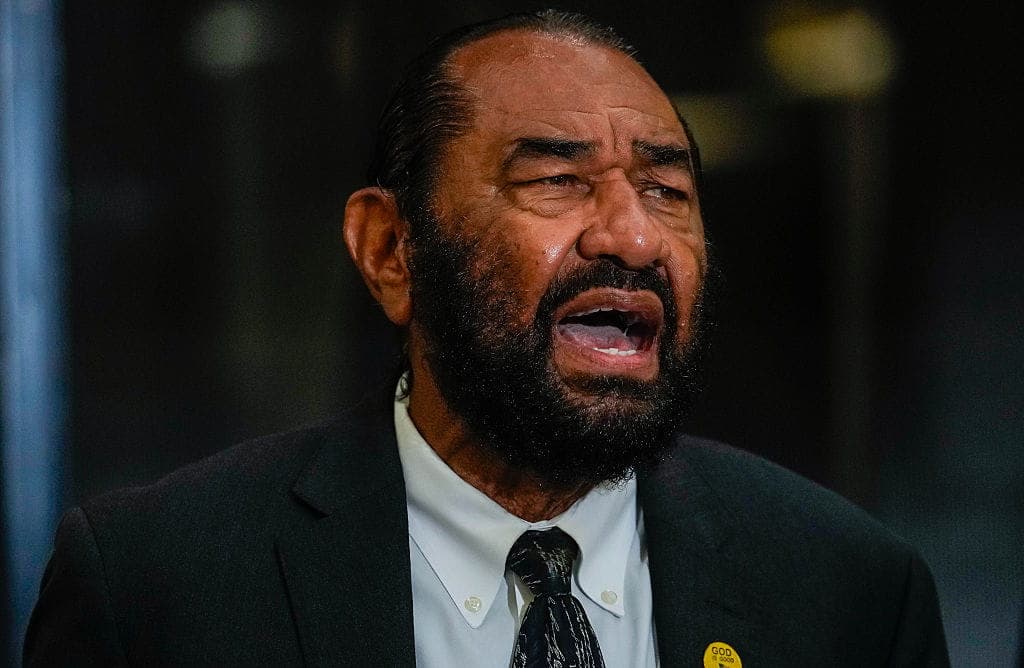

Rep. Al Green (D-TX) filed an impeachment resolution in the House on Monday, Aug. 24. This is the fifth time the Lone Star State representative has filed impeachment resolutions against President Donald Trump. Two formal efforts initiated by Democrats in Trump’s first term died in the US Senate.
Political news junkies may remember Al Green was censured by his colleagues in the House for his “disruptive behavior” back in 2025. That’s when he took his cane and raised it, shouting at Trump, who was trying to deliver an address to Congress. House Speaker Mike Johnson (R-LA) could be heard repeatedly trying to silence Green to no avail. His behavior was considered disruptive, and the Sergeant at Arms forcibly removed Green from the chamber.
The Al Green Cane Just Got Figurative
The Texas congressman’s House resolution read in part: “the president is a great threat to democracy and the Constitution for current high crimes and misdemeanors … [who is] brazenly and wantonly devolving the United States democratic republic into an authoritarian regime, where unjustified killings and coverups by ICE and CBP are normalized."

Sounds like he doesn’t like the man. He may also be blaming Trump for his loss in the Democratic primary this year and wants to go out with a bang. Green has been a congressman in the Lone Star State since 2005 and was forced to run in an incumbent-vs.-incumbent race caused by redistricting.
Responding to Green’s latest effort to impeach Trump, White House spokeswoman Lauren Bis told Fox News Digital, “The brave men and women of ICE and CBP put their lives on the line to arrest murderers, rapists, pedophiles, gang members, and terrorists. Al Green should be thanking President Trump and our law enforcement for delivering the largest decrease in violent crime in American history."
The censure is merely a symbolic gesture and holds no formal punishment. The vote was 224 to 198 while the Congressional Black Caucus could be heard in the background singing “We Shall Overcome.”
Censure: Legal But Rare
The US House of Representatives has the authority to censure its members under Article 1, Section 5, Clause 2 of the Constitution. But there are other, more severe forms of punishment for things such as criminal activity or a civil action that brings dishonor to the House. The governing body may expel, suspend, remove certain privileges, impose fines or monetary restitution, and remove seniority from offending members. The House's choice of censure in Green’s case is telling. It signifies a minor infraction of House decorum.


Free with the Daily Briefing
85EssaysUnravel the Constitution
Hamilton, Madison & Jay’s complete case for America, free and searchable in the Publius Reader.
Free with the Daily Briefing. Unsubscribe anytime.
Still, censure is legal but rare. It has happened less than 30 times in US history. Two of these took place in 1870 when the members were cited for “selling military academy appointments,” according to the website EveryCRSReport.com. They went on to say, “While the majority of the censures in the House occurred in the 19th century and concerned issues of decorum … [in] more recent years instances of financial misconduct appear to have been a major issue.”
Considering Republicans rule both chambers of Congress, the chances of Green’s impeachment effort are nil. Nevertheless, it gives the outgoing congressman a platform to state his utter disapproval of the president. In a letter to Trump, Green asserted:
“Mr. President, I am well aware of the fact that you will be defended by persons who will say, ‘The House won’t impeach, and if it did, the Senate won’t convict.’ Sir, my response is that articles of impeachment that are not approved by Congress can express on-the-record disapproval of presidential actions and demonstrate that there are some of us watching and willing to act."
As the congressman wraps up his congressional career in January 2027, it’s likely Al Green leaves office with more than just the reference that he is not the late great singer but rather the man who waved his cane uncontrollably while trying to shout down the president, proving the Sesame Street character Kermit the Frog is right:
“It’s not easy being green.”


.jpg&w=1920&q=75)