


While Americans further divide between left and right, progressive and conservative, and even liberal and socialist, often lost in the morass is how individual political actors are faring. All eyes focus on presidential approval but often ignore the popularity of those who lead their parties in Congress. New polling from Napolitan News provides some surprising results in the latest congressional beauty pageant.
The ‘Miss America’ Audition
Approval ratings are one thing, but the key concept is the difference between approval and disapproval. Take Speaker of the House Mike Johnson (R-LA). According to Napolitan News, he has a favorability of 37% and an unfavorability of 29%, giving him a plus eight score. Spoiler alert: He’s the most popular of the congressional leadership by a significant margin.
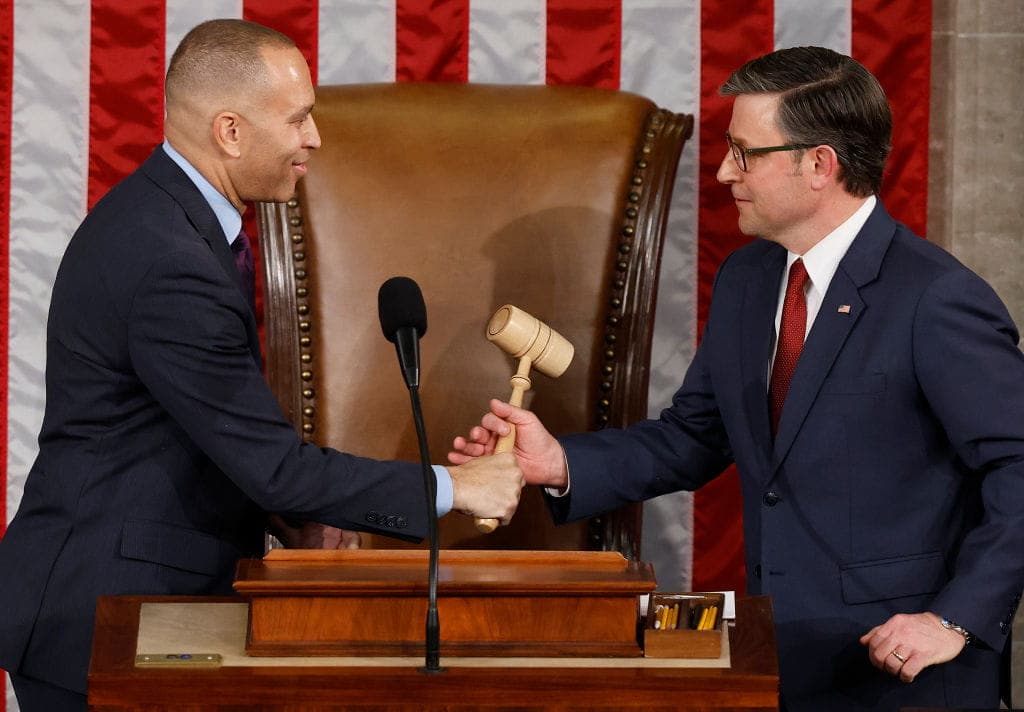
Consider his opposite in the lower chamber, Hakeem Jeffries (D-NY); he has a favorability of 32% and an unfavorability of 33%, a net negative one. He is both less popular and more unpopular than the man whose job he hopes to take after the midterm elections are settled.
And then we have the upper chamber. Senate Majority Leader John Thune (R-SD) has a net favorability of negative two points. That’s a tough position for someone hoping to maintain Senate control. But when we examine the Napolitan figures for his counterpart, Minority Leader Chuck Schumer (D-NY), he comes in at net negative three. It’s a narrow gap, but one that could make a huge difference after the November elections.


Free with the Daily Briefing
85EssaysUnravel the Constitution
Hamilton, Madison & Jay’s complete case for America, free and searchable in the Publius Reader.
Free with the Daily Briefing. Unsubscribe anytime.
If Democrats flip the House (as is widely expected), Jeffries will have to try to win the gavel in a political party caucus that appears just as divided as the country. Voters favor him only at 32%, and we can assume that most, if not all, Republicans have a negative view of the House minority leader. But it seems that his popularity does not sweep the board when it comes to Democrat voters. Just how that may be reflected when and if the time comes to seize the gavel in his own party is likely causing night sweats.
Schumer is in a similarly unenviable position. With Beltway and East Coast chatter rife that he will at some point face a challenge to his own Senate seat from the party’s young blood (we’re looking at you, AOC), being widely disliked by those who otherwise align ideologically is not a good starting point.
Notable Mention
As President of the Senate, VP JD Vance deserves at least an honorable mention. Above and beyond any of his congressional colleagues, the vice president’s approval is remarkably high. Napolitan’s poll gives him an approval of 48%, more than ten points ahead of second-place Mike Johnson.

As the heir apparent (although Marco Rubio is still well in the race), one might imagine that Vance would become the focal point for anger at the whole MAGA movement – after all, President Trump is term limited and the VP remains a firm defender of his boss. His disapproval numbers are at 44%, which is high but basically expected.
Just over 80% of Republican voters approve of him, and 74% of Democrats have an unfavorable opinion of the man who would be “king.” That’s quite a figure from the Democrats, suggesting that more than a quarter either have no opinion of him or actively approve of him. It is in these gaps that swing states are won and lost.
Political Albatross
Being in a political party means that a politico is tainted by his or her party’s brand – and the reverse is also true. When former Senate candidate for Maine, Graham Platner, exited the contest, the Democrats’ relief was palpable. And for those charismatic leaders who hope to rise above the generally low party approval ratings, that D or R can be an albatross.
There’s an old saying in British politics that people welcome the Labour Party with hope and the Conservative Party with relief, an adage that seemingly holds true on both sides of the Atlantic. But when parties and politicians can barely scrape into the net positives for approval, it’s a stark indication that there’s no escaping the albatross.

.jpg&w=1920&q=75)