
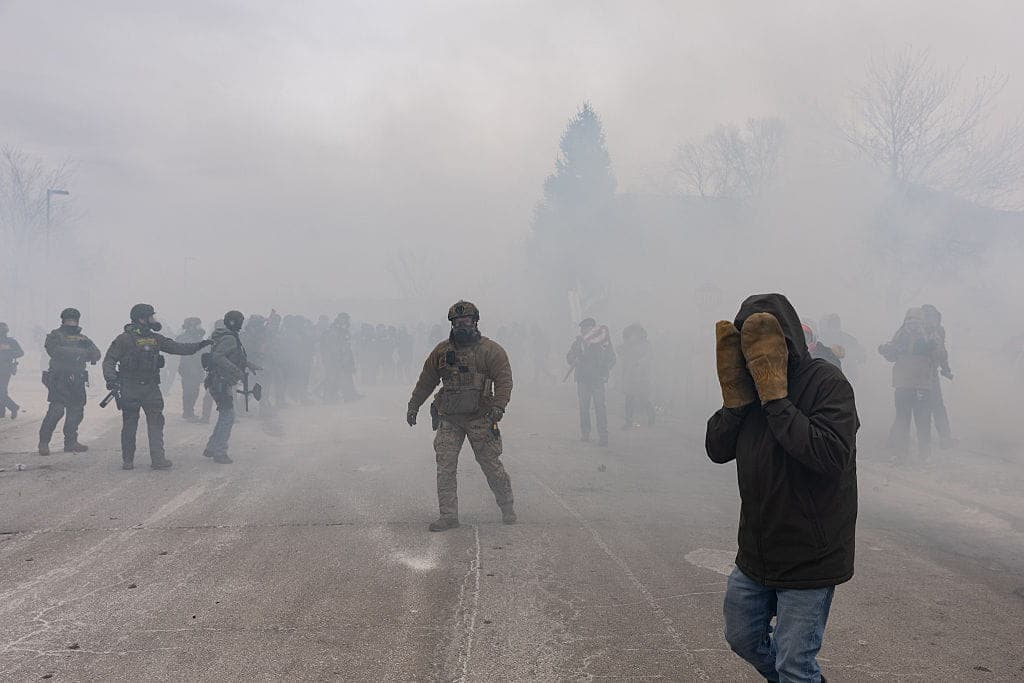

In a morning Truth Social post on Thursday, January 15, Donald Trump threatened to invoke the Insurrection Act and deploy troops to Minnesota. In what appears to be a worsening spiral, protesters are fighting law enforcement – including federal immigration agents – and getting hurt in the process. Protester Renee Nicole Good was shot and killed by ICE, leading to more demonstrators and additional violence. A week later, a Venezuelan man was shot by ICE, ramping up the protests even more.
With protesters now fighting the police and destroying property, President Trump is considering dusting off a power rarely used through US history, though it has been around in some form longer than the current US government and was used by George Washington himself.
Calling Forth the Insurrection Act
There has been a lot of talk about the Insurrection Act of late. President Trump first deployed the National Guard to Los Angeles in June 2025, and from there it spread to DC in August, Memphis and Portland in September, and finally Chicago in October.
On September 2, a federal judge ruled the administration’s June deployment was a violation of the Posse Comitatus Act, a law signed by President Rutherford B. Hayes in 1878 that generally forbids the use of federal military personnel as domestic law enforcement. By late December, the US Supreme Court had blocked the administration’s efforts to deploy troops to Chicago by leaving a lower court order in place, a decision that led the president to abandon his attempts to send the Guard to the aforementioned cities – for now.
Longstanding but Rarely Used
Most uses of the Insurrection Act came during and shortly after the Civil War, but it wasn’t exactly rare in the earlier years of the Republic. Washington’s 1794 use was followed by that of his successor, John Adams, in 1799 to put down Fries’ Rebellion in Pennsylvania. Add in Jefferson’s use and restructuring of the laws, and that’s the first three presidents of the United States all using that authority at some point. President Andrew Jackson used these laws (more or less) thrice – in 1831, he used the Insurrection Act to end Nat Turner’s Rebellion, a slave revolt. He used related legislation against South Carolina’s nullification of federal tariffs in 1832, and he deployed troops to help Maryland authorities during riots by Irish immigrant workers, though he didn’t formally issue the required proclamation to make it official. Abraham Lincoln invoked the Insurrection Act on April 15, 1861, to call up 75,000 state militia troops for the Civil War. Then, from 1871 through 1894, four different presidents used it on 12 separate occasions. It was during this period that the Ku Klux Klan Act of 1871 was added to the mix, significantly expanding presidential power in order to fight white supremacy during the Reconstruction era. The Insurrection Act went back to rarely being used over the following years, though never fading completely into obscurity. Woodrow Wilson used it to quell labor unrest during World War I in 1914, and again in 1921 for yet another labor dispute, this time by West Virginia coal miners. President Herbert Hoover ordered the US Army to violently clear out the “Bonus Army” of WWI veterans from DC, though he never issued an official proclamation to justify it. Franklin Roosevelt invoked the Insurrection Act to put down the two-day Detroit Race Riot in 1943, leading into the second most commonly used reason and time period. Between them, Dwight D. Eisenhower, John F. Kennedy, and Lyndon B. Johnson federalized troops eight times during the civil rights movement. The last three times the Insurrection Act was invoked were by Ronald Reagan in 1987 and George H.W. Bush in 1989 and 1992. Reagan’s was over a prison riot. Bush’s first was to end violence and looting in the Virgin Islands following Hurricane Hugo, and his second – the last time it has been invoked so far – was in the infamous Los Angeles riots of 1992 after the police beating of Rodney King.A Blast From the Past
Should Trump actually invoke the acts now, it will break the longest streak of not using it in the nation’s history. Legal scholars seem to disagree, however, on whether the current situation in Minnesota qualifies the president to deploy troops without a request from the state government. Under the current rules, as expressed by 10 US Code sections 252-255, the president can act without Congress or the state’s consent so long as one of several vague and, in some cases, arguably subjective conditions is met. Would it be a legitimate use of the law in this case? Ultimately, that’s for the courts to decide – however it goes, though, neither the president’s supporters nor his detractors are likely to be swayed.Dig Deeper Into the Themes Discussed in This Article!
Liberty Vault: The Constitution of the United States

.jpg%20fraud&w=1920&q=75)