

The US Supreme Court heard oral arguments on November 10, 2026, in a legal battle between a New Jersey farm and the Department of Labor (DOL) over the agency’s power to impose penalties and award wages under the H-2A temporary agricultural worker visa program. The case addresses immigration enforcement, but will likely have implications for numerous other federal agencies as well.
The H-2A Visa Program: How It's Supposed to Work
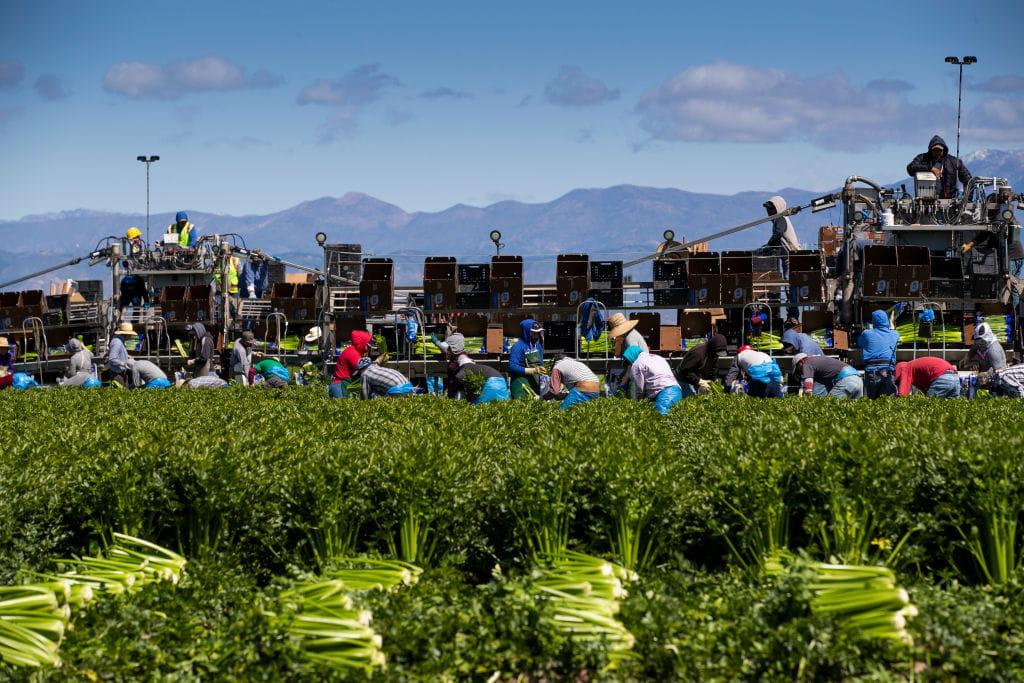
American agricultural employers hire nearly 400,000 foreign nationals annually under the H-2A visa program when there are insufficient US workers available. The program is regulated by the Department of Labor (DOL) and US Citizenship and Immigration Services (USCIS), and requires employers to provide no-cost housing, transportation reimbursement, and other benefits to approved H-2A workers.
Free with the Daily Briefing
85EssaysUnravel the Constitution
Hamilton, Madison & Jay’s complete case for America, free and searchable in the Publius Reader.
Free with the Daily Briefing. Unsubscribe anytime.
Sun Valley Orchards, LLC hired 96 temporary H-2A farm workers for its 2015 season to harvest produce. Following an investigation into the 2015 growing season, DOL charged that Sun Valley breached its H-2A contractual obligations by failing to provide required kitchen access and appropriate housing, and for firing workers before their contracts ended. DOL imposed over $550,000 in civil penalties and back wages, using its own administrative judges.
Sun Valley sued in US District Court for the District of New Jersey, claiming that Article III of the US Constitution requires federal courts, not administrative agencies, to decide cases concerning government penalties or contractual disputes. This Article III tension between the jurisdictional boundaries of the judicial and executive branches of the federal government extends beyond the H-2A visa program, so the Supreme Court’s decision in Department of Labor v. Sun Valley Orchards, LLC will likely either broadly affirm or profoundly transform existing and future enforcement procedures for numerous federal agencies and programs.
Did Congress Transfer Judicial Power to the Executive Branch?
The H-2A controversy arises from the congressional grant of enforcement power to the Secretary of Labor in 8 US Code § 1188(g)(2) “to take such actions, including imposing appropriate penalties and seeking appropriate injunctive relief and specific performance of contractual obligations, as may be necessary to assure employer compliance with terms and conditions of employment under this section.” Congress can only delegate its own power to the executive branch, though, not anything reserved to the judicial branch.
Sun Valley’s complaint was dismissed in federal district court, but found more fertile ground in the US Court of Appeals for the Third Circuit, which analyzed whether the DOL’s H-2A regulations authorizing the imposition of penalties and back wages fell within the “public rights exception” that permits certain matters to be adjudicated outside of Article III. Holding that Sun Valley’s contract and associated penalties did not fall within the public rights exception, the Third Circuit reversed the district court, finding that Sun Valley was constitutionally entitled to due process in an Article III court.
Clearly, the relationship between Sun Valley and the DOL involves both contractual and immigration issues. The Third Circuit concluded that contractual disputes and penalties are not exempted from Article III adjudication under the public rights exception, but allowed that immigration, and a variety of associated foreign policy concerns, fell within that exception’s purview. The court observed:
“It is true that portions of the sprawling H-2A program implicate the President’s unique power over foreign affairs. But at best, that shows that some H-2A-related actions may proceed in agency tribunals. For example, DOL could use agency proceedings to bar Sun Valley from the program or to remove ineligible foreign workers from its employ.”
Yet the fact that DOL has authority to adjudicate outside of Article III protections regarding immigration ‘does not give it carte blanche to do so for all violations,’ the court determined. The court would divide DOL procedures between in-house adjudication for matters that qualify under the public rights exception; all other matters would require DOL to file legal proceedings in federal court. If Sun Valley prevails at the US Supreme Court, H-2A contract oversight and enforcement would become more cumbersome, time-consuming, and costly.
Conflicting Legal and Political Causes… and Effects
Some advocacy groups are concerned that this outcome would be inefficient and prejudicial to US workers – both native and immigrant. In an amicus curiae brief to the US Supreme Court in the Sun Valley Orchards, LLC case, conservative Federation for American Immigration Reform (FAIR) supported the appropriateness of administrative adjudication of H-2A visas because of "a strong interest in the government’s ability to protect the working conditions of foreign, nonimmigrant workers (and of the Americans who work alongside them), because doing so prevents the cost of employing foreign workers from being unlawfully reduced, to the competitive disadvantage of American workers.”
From Liberty Nation News, Trivia, Facts, Check Us Out
Stay informed.
Today’s news, the Constitution and American history, written for young readers.
Visit GenerationLiberty.com
Yet conservatives on the US Supreme Court have not been enamored with broad expansions of administrative regulatory power, as demonstrated in the court’s pivotal Loper Bright decision, which reversed decades of judicial deference toward statutory interpretations by administrative agencies. According to Bloomberg Law, conservative justices “appeared skeptical” during recent oral arguments that DOL judges could constitutionally order farms to pay penalties for violating the H-2A visa program, and “several Republican-appointed justices seemed to doubt that the H-2A program’s requirements on employers fell within the ‘public rights’ exception to adjudication in federal court.” However, the Daily Caller reported that Sun Valley’s legal counsel “faced criticism from both the liberal and conservative justices.”
H-2A workers are widely reported to be subject to neglect and contractual breach by an industry that is policed largely by the DOL and its administrative penalties and procedures. Requiring judicial oversight would essentially transfer large swaths of DOL caseloads to federal courts overnight, with parallel implications for other federal agencies that operate administrative adjudication systems. The appropriate boundaries of the federal separation of powers hang in the balance, as the nation’s highest court considers the plight of a small fruit and vegetable farm in New Jersey.