


Just over one month since the US launched Operation Epic Fury in Iran, Vice President JD Vance said Tehran has “chosen not to accept our terms” for a lasting peace deal following high-stakes negotiations in Islamabad, Pakistan.
Vance’s update comes after discussions between the United States and Iran stretched into the early hours of Sunday morning local time, with officials from the warring adversaries working to reach an agreement amid a temporary ceasefire. Unlike the war itself, the 21-hour-long talks appear to have concluded for now.
Peace Talks
Addressing reporters at the Serena Hotel in Islamabad, Vance said the “bad news” is that the two nations have not reached an agreement:
“So we go back to the United States, having not come to an agreement, we’ve made very clear what our red lines are, what things we’re willing to accommodate them on, and what things we’re not willing to accommodate them on. And we’ve made that as clear as we possibly could, and they have chosen not to accept our terms.”
 The vice president said he does not intend to provide the public with the terms of the negotiations but confirmed that they include an “affirmative commitment” that Iran will not pursue nuclear weapons, nor the tools to create them. Vance concluded the short press conference without providing details on next steps. Iranian state television accused the US of “demanding too much,” adding that the Strait of Hormuz, uranium enrichment, and “other issues” drove the negotiations to a dead end.
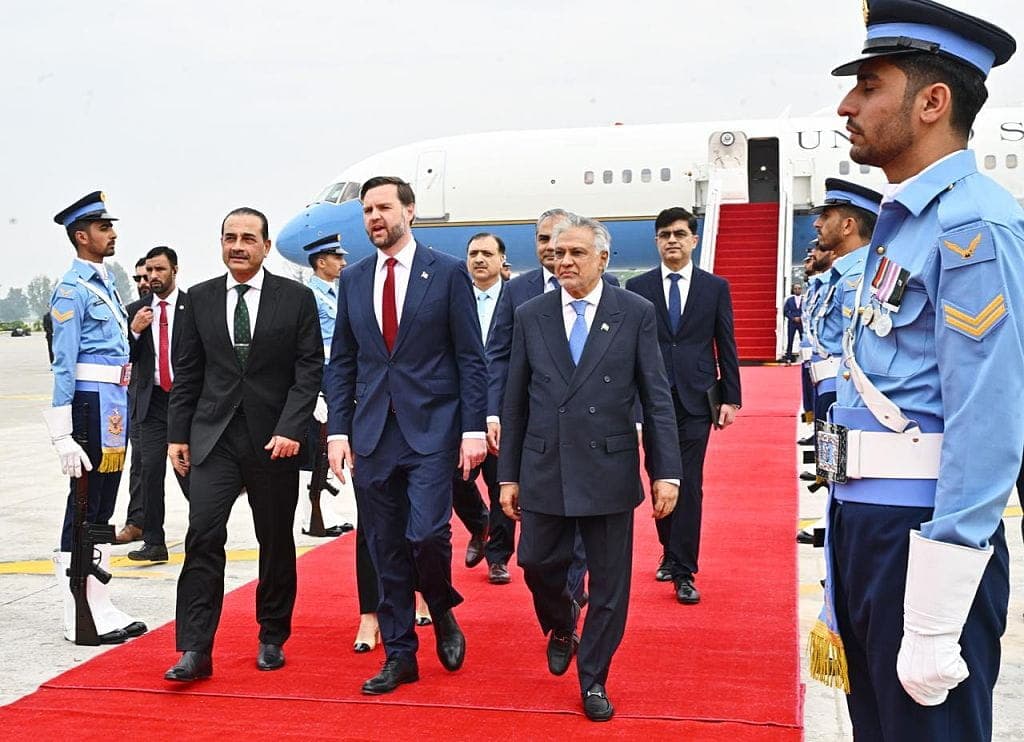
VP Vance, along with US special envoy Steve Witkoff and President Donald Trump’s son-in-law Jared Kushner, arrived in Islamabad on Saturday for the discussions with high-level officials from Iran, including the head of Iran’s Parliament, Mohammad Bagher Ghalibaf.
A Winning Message
Speaking with reporters outside the White House, President Trump said the outcome of the talks won’t impact the United States’ success in the conflict. “We win. Regardless what happens, we win. We’ve totally defeated that country,” Trump said, “and so let’s see what happens. Maybe they make a deal, maybe they don’t. From the standpoint of America: we win.” Trump continued:
“We defeated their navy. We defeated their air force. We defeated their anti-aircraft. We defeated their radar. We defeated their leaders. Their leaders are all dead. And now, all we do, is we’ll open up the strait even though we don’t use it because we have a lot of other countries in the world that do use it.”
Before departing, President Trump slammed NATO’s inaction in the strait, accusing the nations that rely on the waterway of being “afraid, or weak, or cheap.”
Mines in the Strait of Hormuz
US Central Command (CENTCOM) announced on Saturday, April 11, that US forces have started preparing to clear mines in the Strait of Hormuz. The USS Frank E. Peterson and USS Michael Murphy passed through the controversial channel to confirm it was clear of all sea mines laid by Iran’s Islamic Revolutionary Guard Corps. The effort will soon include additional US forces and underwater drones, CENTCOM noted.
“Today, we began the process of establishing a new passage and we will share this safe pathway with the maritime industry soon to encourage the free flow of commerce,” said Adm. Brad Cooper, commander of CENTCOM. For now, it appears diplomacy is once again on pause as the US military works to reopen the Strait of Hormuz.