


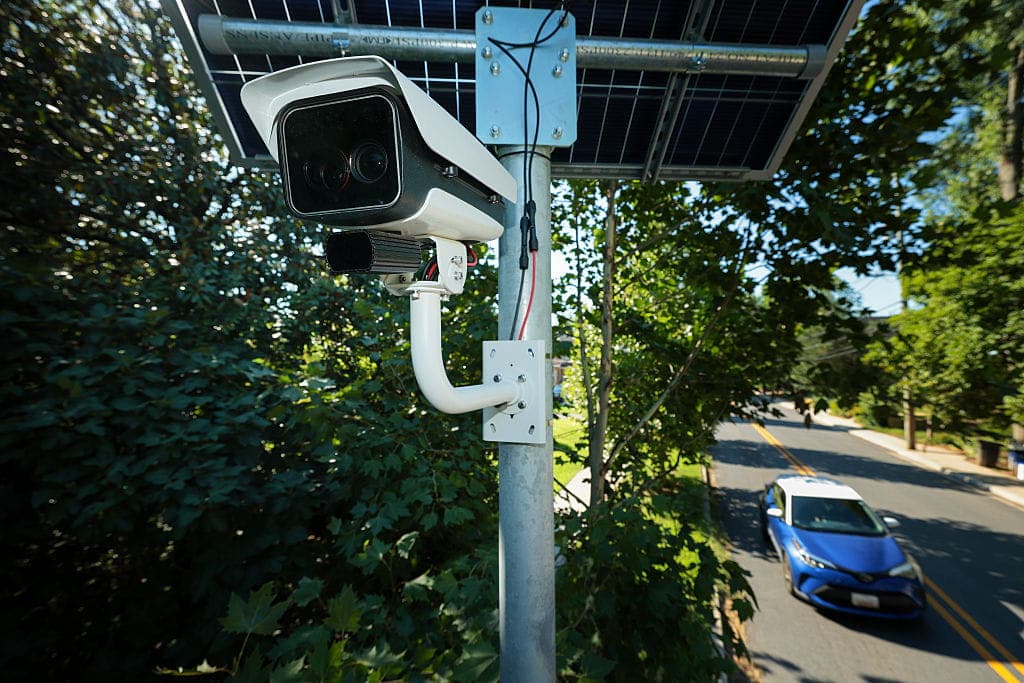

Concern about Flock cameras, also known as automated license plate readers, is gaining heat. Just how intrusive are they into private lives? Do they really create records of people’s daily routines, building profiles of their habits and where they like to go? An even more worrying fear for gun owners is how the information captured by these ALPRs may be used to identify those who purchase or have firearms.
Taking Down Flock Cameras
Gun shop owners have started taking down Flock cameras over the growing concern of their customers. The main worry is that the automated license plate readers can create a searchable record that shows a vehicle was at or near a firearms-related business, which could include a range or gun show, at a particular time. Would this mean ordinary, lawful Second Amendment activity could become part of a government accessible database?
Free with the Daily Briefing
85EssaysUnravel the Constitution
Hamilton, Madison & Jay’s complete case for America, free and searchable in the Publius Reader.
Free with the Daily Briefing. Unsubscribe anytime.
The fear is justified. Artificial intelligence can and does make mistakes, and it can be manipulated and abused. In June, San Francisco police said their Flock license plate data had been improperly searched nearly 300 times by federal and out-of-state agencies. This raises the concern that private information can be used by other agencies throughout the area, state, or even nation. Even though the city cut off that access after discovering the problem, the potential for that kind of activity to go unchecked remains.
A camera outside a gun store doesn’t automatically tell police that John Smith bought a Glock. But a plate scan can potentially establish that a particular vehicle was at a certain location at a particular time. When multiple cameras capture that vehicle’s information, it can reveal movement patterns, which is where the privacy issue comes into play.
So, a government doesn’t need a database labeled “Gun Owners” if a searchable location network can show that Vehicle A regularly visits a gun store, Vehicle B visits a shooting range twice a month, and Vehicle C attended a gun show. While that doesn’t prove who owns a gun or what they purchased, it can reveal associations with constitutionally protected activity.
The Washington Post reported this month that Flock has more than 120,000 cameras operating in more than 6,000 communities and records 20 billion plate scans a month.
What Are the Chances?
Recording license plates isn’t a new thing, and neither is gathering information about gun owners. Long before Flock's nationwide network existed, federal agencies were experimenting with automatic license-plate readers and considering how they could be used at gun shows.
In 2015, the American Civil Liberties Union revealed a 2009 Drug Enforcement Administration (DEA) email obtained through a Freedom of Information Act request. The email showed the DEA's Phoenix Division working with the Bureau of Alcohol, Tobacco, Firearms and Explosives on efforts involving firearms trafficking and gun shows. The email specifically referred to operations concerning license-plate readers at gun shows. That immediately raised privacy concerns because an automatic license-plate reader doesn't know whether someone attending a gun show is suspected of committing a crime. It can simply capture the plates of vehicles passing through its field of view. However, it was discovered that this particular plan was never carried out.

In 2010, though, that plan became a reality in a separate Immigration and Customs Enforcement (ICE) operation. ICE sought help from local law enforcement to use license plate readers at gun shows in Southern California with the purpose of tracking illegal firearms into Mexico. At the Del Mar Fairgrounds near San Diego, law enforcement drove around the parking lot using license plate readers to collect information of gun show attendees. The event usually attracts between 6,000 to 9,000 customers. While the objective was to stop illegal gun trafficking, innocent American gun owners were having their information collected.
On November 18, 2016, Sen. Ron Johnson (R-WI), then chairman of the Senate Homeland Security and Governmental Affairs Committee, sent a letter to ICE Director Sarah Saldaña demanding information about the operations:
“As the nation tackles border security and immigration, it is unclear why ICE sought to use its limited resources to gather information about a constitutionally protected right. It is also unclear whether ICE, through these operations, has created a database of information about individuals who attended gun shows.”
Today’s Flock cameras are even more sophisticated. As 1819 News wrote, regarding the data collected by these security systems:
“And the record contains far more than your tag number. Each image becomes a searchable record containing the plate, time, location, direction of travel, make, color, body type, and other identifying features. Flock calls this part of their system the ‘Vehicle Fingerprint,’ and their own materials advertise the ability to conduct searches using unique vehicle details, including bumper stickers and decals. That matters in Alabama. A Gadsden flag, Glock sticker, BamaCarry decal, or other Second Amendment message on the back of a truck is not just something another driver sees at a red light. It’s now a searchable data point tied to that vehicle, the owner, and your movement.”
Gun shops aren't exactly businesses that can afford to be casual about security, which makes the decision to remove Flock cameras even more significant. Owners are voluntarily giving up a tool meant to help protect their property because of concerns that the same technology could create a record of their customers’ lawful activities.


.jpg&w=1920&q=75)