

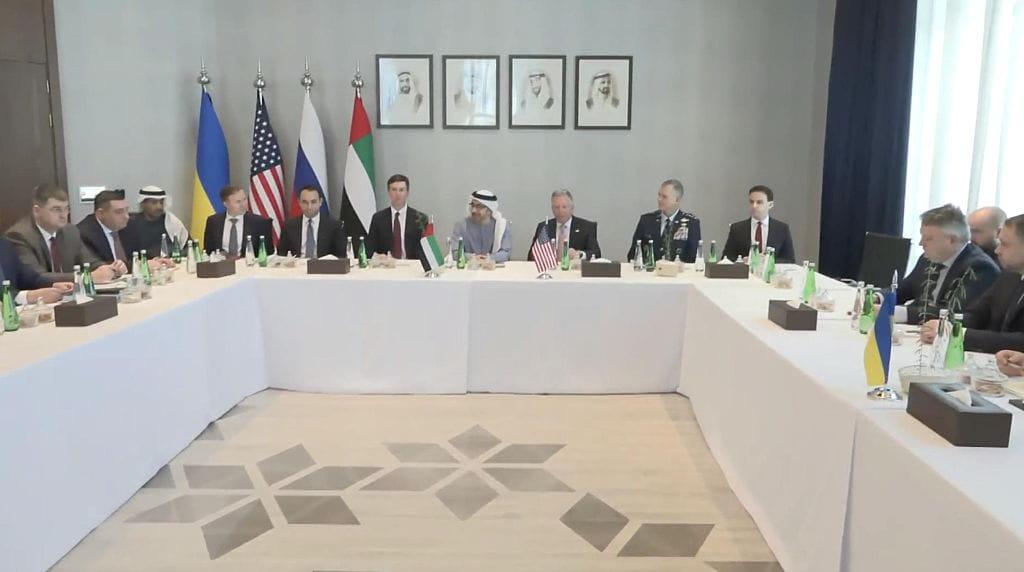

The United States, Ukraine, and Russia held their first trilateral peace talks in nine months. As was widely expected before the negotiations began in Abu Dhabi, hopes for a breakthrough were modest. Mediated by US envoys Jared Kushner (President Donald Trump’s son-in-law) and Steve Witkoff, the talks included Ukraine’s delegation, led by Rustem Umerov (head of the Foreign Intelligence Service), and Russia’s delegation, led by presidential aide Vladimir Medinsky.
Negotiations Resume After Long Pause
In late October, Russian President Vladimir Putin indicated Russia was willing to start negotiations around Nov. 10, which has come to pass. The meeting was greeted with cautious optimism by the Trump administration. Fox News reported, “This comes after President Donald Trump said last month [October] that efforts to resolve the war were ‘maybe now the closest we’ve been,’ adding that he believed both sides wanted an end to the conflict after years of fighting and heavy casualties.”
A major issue since the beginning of negotiations has been security guarantees for Ukraine. To that end, “The Trump administration has asked Russia to accept an ‘Article Four- and an Article Five-like security guarantee’” for Ukraine, one that would effectively be similar to NATO's, a US official said Nov. 9 on a background call previewing the negotiations, Fox News explained.
Article Four says that any NATO member state may request consultation with the other members when it perceives a threat to its political independence, security, or territorial integrity. Article Five says that an armed attack on one or more NATO members would be considered an attack against all members.
Sides Still Far Apart on Territorial Issues
Though territorial disputes are a key concern for Ukraine, there was no expectation of resolving them during these talks. Indeed, there was no progress in reaching agreement on a ceasefire, long-term security guarantees, or territorial matters. “Medinsky also struck a hard line on territory, saying, ‘Every inch of Russian land will be returned to Russia, one way or another,’” the Kyiv Post noted.
Free with the Daily Briefing
85EssaysUnravel the Constitution
Hamilton, Madison & Jay’s complete case for America, free and searchable in the Publius Reader.
Free with the Daily Briefing. Unsubscribe anytime.
After two days of discussions (the meeting on the first day, Nov. 10, lasted around four hours, and the second day ran two hours), they agreed to a large-scale prisoner exchange. Kushner explained at a press conference, “One of the positives is we agreed that we’re going to have the biggest humanitarian release of prisoners, [and] we’re going to finalize the numbers tomorrow.”
Ukrainian President Volodymyr Zelensky suggested that the numbers of prisoners exchanged could be as large as “1,000-for-1,000 or 1,500-for-1,500.” However, “Neither Kyiv nor Moscow has disclosed the exact number of people who could be included in the upcoming exchange or when it might take place,” according to The Kyiv Independent.
As reported by the Associated Press, “The White House aims to use this week’s talks with Ukrainian and Russian officials in part to persuade Moscow to agree to broader negotiations that would include key European officials on how to end nearly five years of war, US officials said [on Nov. 9].” In the past, Moscow’s negotiators have resisted involving Europe.
Parallel Discussions Seek to Include Europe
In parallel discussions ahead of the Abu Dhabi talks, the United States addressed one of Russia’s major complaints about European nations. The Kremlin has consistently demanded that Russia have major influence over the future of what were once the Soviet Union’s satellite states. The Wall Street Journal explained, “The Trump administration is putting a longstanding Russian demand at the heart of its latest push to end the war in Ukraine: renegotiating pan-European security in ways the Kremlin hopes will give it more influence in the region.” This US initiative has European and NATO countries uneasy.
From Liberty Nation News, Trivia, Facts, Check Us Out
Stay informed.
Today’s news, the Constitution and American history, written for young readers.
Visit GenerationLiberty.com
Additionally, Putin has consistently demanded that Western nations curtail their military exercises and deployments in Eastern European countries formerly in the Soviet Union’s sphere. As the WSJ observed, “That would rewrite Europe’s post-Cold War order, sponsored by the US under both Republican and Democratic presidents, that guaranteed all countries’ sovereignty, including their freedom to choose their own alliances.”
Before the Abu Dhabi negotiations, in meetings that included European countries, the United States, and Ukraine, the US made the case that “work on a ceasefire in Ukraine must proceed alongside discussions about Europe’s future security arrangements,” the WSJ reported. Exactly what those “future security arrangements” would look like is not clear.
On the positive side, the prisoner exchange is encouraging. Having both sides talking is also worthwhile. However, key issues such as security guarantees and territorial solutions appear to be real sticking points.
~
The views expressed are those of the author and not of any other affiliate.