


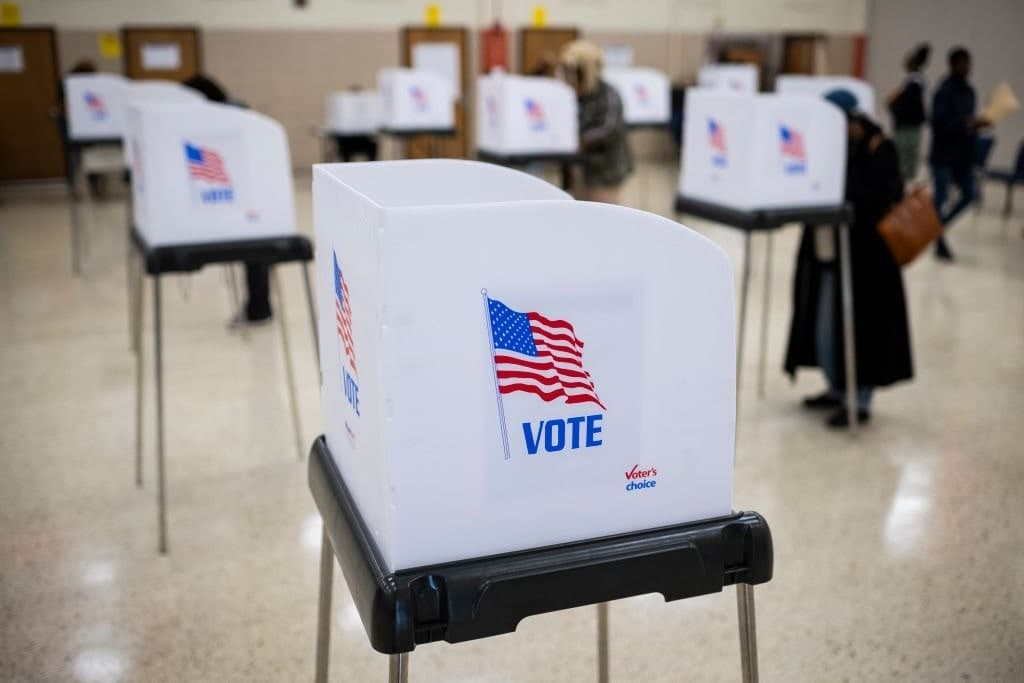

The years immediately following any presidential election represent a breather from the unmatched intensity of campaigns to capture the White House and Congress. Few races of national impact take place one year later, but both sides inevitably attempt to draw meaning and spin the results, no matter the outcomes of a handful of high-profile contests. Will this year’s slate of races be revealing about prospects for 2026, when all 435 seats in the House and 33 more in the Senate are up for grabs? In ordinary times, the answer would be, probably not. But times are never ordinary with Donald Trump commanding the White House.
Is that why an obscure self-proclaimed socialist whom Trump calls a communist, Zohran Mamdani, is at the threshold of becoming the next mayor of New York City? Well, Democrats who dominate the Big Apple, still staggered by the outcome of the 2024 election, have made clear that they intend to seriously disrupt business as usual. As the party suffers through its lowest approval of the century, the quintessential establishment candidate, disgraced former Gov. Andrew Cuomo, has failed to gain traction after a listless primary campaign in which he was routed by the smooth-talking, charismatic Mamdani and has since pivoted to an independent candidacy that has also met with minimal enthusiasm. Eccentric, red-bereted Republican Curtis Sliwa is the third candidate, the longest of long shots who is splitting the anti-Mamdani vote, all but assuring that a radical Muslim will become the next mayor of the nation’s greatest and most heavily Jewish city. Cue the upheaval.
Election Time Along the Atlantic Coast
New Jersey and Virginia will select new governors today, and both could be women. The fascinating element of this pair of contests is that the two states have evidently reacted in almost opposite ways to the predictably tumultuous nine months of Trump’s second term. In Virginia, where Trump has never gained traction — it’s the only southern state he has lost three times — the consistent popularity of Gov. Glenn Youngkin, who scored an upset victory four years ago, has not transferred to the GOP lieutenant governor seeking to succeed him, Winsome Earle-Sears. She has consistently trailed well behind Democrat Abigail Spanberger, who has run a mediocre campaign and yet is expected to win decisively. While Youngkin was elected amid the growing unpopularity of former President Joe Biden, Earle-Sears faces the reverse effect. Trump’s shrinking of the federal government has unsurprisingly proven to be toxic in heavily populated northern Virginia, home to hundreds of thousands of federal employees.
But in New Jersey, where Trump made major inroads in 2024, coming within six points of winning the state after losing by 15% in 2020, Republican Jack Ciattarelli, former assemblyman who lost narrowly in the 2021 race for governor, has been closing in on Democrat Mikie Sherrill, a four-term member of Congress, and stands a realistic chance of pulling off an upset. He has run an effective campaign in a state that, while heavily blue, has elected GOP governors four times in the last 30 years, with Chris Christie and Christine Todd Whitman each serving two terms.
Races Promising the Greatest National Impact
While most of the national attention has focused on the NYC mayoral contest and the two gubernatorial races, a special election on a California ballot initiative, Proposition 50, is likely to have the greatest impact on 2026 and perhaps 2028. It comes in response to Texas making the controversial decision to engage in mid-decade gerrymandering, redrawing the state’s congressional districts to add up to five Republican seats in the House in next year’s midterms. As other red states followed suit, Golden State Gov. Gavin Newsom, a near-sure bet to seek the presidency in 2028, called for a referendum suspending the state’s nonpartisan redistricting board in order to allow the state to tilt its map in a way that could add up to five new Democratic seats. Gerrymandering ordinarily occurs only after the census conducted in the first year of every decade, and this tit-for-tat redistricting occurring five years earlier than usual is hardly a healthy sign for the republic, but that is a discussion for another day. Every poll conducted on Proposition 50 shows that California voters heavily favor it.

Also up for grabs today will be control of the Pennsylvania Supreme Court, as voters cast yes or no votes on whether to retain three justices from the high court’s 5-2 Democratic majority. The outcome could prove to be significant in 2028 if there are legal challenges to the presidential election results, as happened in the disputed 2020 election. If the three justices are voted out, the state’s Supreme Court would fall into a 2-2 tie between Republicans and Democrats, with new justices to be elected in 2027. There will also be a number of municipal elections in addition to New York. Detroit, Pittsburgh, Jersey City, and Buffalo will elect new mayors, while incumbent mayors in Atlanta, Minneapolis, and Cincinnati are seeking re-election.
Finally, in a race that has unexpectedly drawn national headlines, the Democratic attorney general nominee running on the ticket with Spanberger in Virginia is reeling from an ugly scandal. Jay Jones, facing off against incumbent AG Jason Miyares, was outed for appalling text messages wishing a gruesome death upon a political enemy and his family. It is rare for a down-ballot candidate running in conjunction with the winning gubernatorial nominee to lose his race, but Jones may well prove to be an exception to the rule.
Of all the contests to be decided today, the one pitting Jones against Miyares may be the only one not directly impacted by the overwhelming centrality of Trump. Any president will be heavily evaluated after his first year in office, but with his outsized personality and a supremely audacious agenda testing the outer limits of his power, Trump towers over this off-year election to a degree arguably greater than any president other than Trump himself eight years ago. He claimed credit for an impressive victory by Youngkin in 2017, but during the 2018 midterms, things did not end well for the 45th president. As the 2026 midterms approach, the 47th commander-in-chief will be hoping that at least New Jersey will add some light to an otherwise dark, though not particularly significant, electoral tableau. Rest assured of one thing. No matter the results that start trickling in this evening, both sides will find a way to declare victory. It will be up to you to determine the truth.

.jpg&w=1920&q=75)

.jpg&w=1920&q=75)