


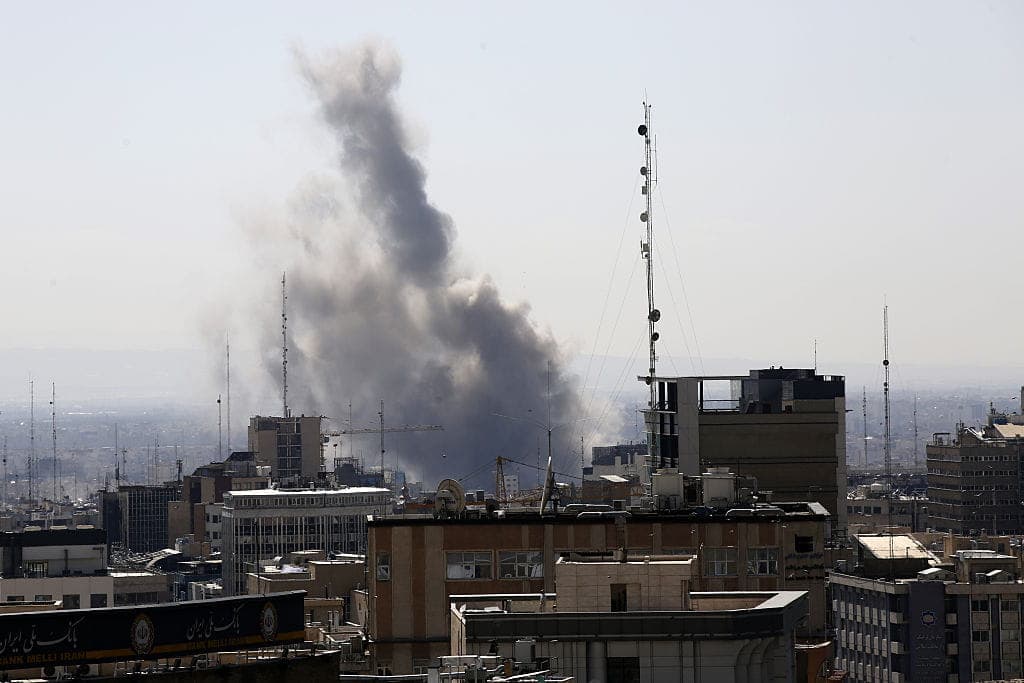

On August 30, US Central Command resumed air attacks against Iran, followed by a significantly larger air assault on September 1. These attacks came after a pause in airstrikes lasting nearly a month. However, the US Navy blockade of the Strait of Hormuz remains in place and effective. The airstrikes came in response to the Islamic Revolutionary Guard Corps’ (IRGC) preparation to launch rockets capable of laying marine mines in the strait. Additionally, the airstrikes came in combination with the draconian application of a wide range of intense economic sanctions.
Airstrikes on Iran Take Out Rocket Launchers
The August 30 airstrike took out two Iranian rocket launchers on Larak Island. These rockets were designed to lay sea mines and were aimed at the Strait of Hormuz. According to The Wall Street Journal, Captain Tim Hawkins, the spokesman for US Central Command, explained: “Last week, Centcom [US Central Command] completed clearing sea mines from the strait’s international shipping routes. We simply will not allow Iran to emplace more mines.” In the last couple of months, the command has removed all the sea mines Iran placed in the strait.


Free with the Daily Briefing
85EssaysUnravel the Constitution
Hamilton, Madison & Jay’s complete case for America, free and searchable in the Publius Reader.
Free with the Daily Briefing. Unsubscribe anytime.
The US Navy has also continued with its 100% blockade of ships heading to or returning from Iran. As of September 3, 87 ships have been redirected, three ships attempting to run the blockade have been disabled with precision munitions, and two have been boarded.
The last wave of airstrikes was on September 1, which President Trump characterized as “large and powerful, and in retaliation for the Iranians’ failed attempt at adding sea mines to the Strait.” Additionally, Trump said that strikes were in response to the Iranians launching eight ballistic missiles at US military bases in Jordan – all of which were destroyed before doing any damage. According to a US Central Command press release, the September 1 airstrikes hit IRGC “targets including air defense sites, radar systems, maritime assets and facilities, mine laying capabilities, and communications sites.”
Until recently, Iran has managed to endure the economic pressure on its financial resources. However, that is at an end. On August 24, US Treasury Secretary Scott Bessent announced the implementation of Operation Economic Outcast (OEO) designed to bring Iran to its knees financially. As Bessent explained in a Treasury Department official statement:
“Iran now faces a very clear choice, with only two paths before them: complete global isolation and a subsistence economy, or a path back to normalcy, with an opportunity to rejoin the global economy…Treasury has mapped every node, every facilitator, and every network that Iran has used to smuggle oil and evade sanctions. Beginning today, the actions of Treasury and other agencies will tighten the noose and block every potential source of revenue that funds the IRGC and the Iranian regime. We are enforcing a zero-leakage approach.”
Bessent went on to explain that third parties choosing to engage with Iran, “this murderous regime,” will lay themselves open to the full weight of the economic reach of the United States. The secretary asserted that the economic sanctions would include nearly "60 entities, individuals, and vessels across the world…” Bessent pointed out that these enterprises have helped the Iranian regime engage in cyber-attacks, receive oil revenue, and acquire nuclear and ballistic missile technology.
Economic Crisis Just Over the Horizon
In his analysis of the OEO initiative, Liberty Nation News’ Senior Political Analyst Tim Donner observed: “OEO will effectively amputate five vital lifelines for the Iranian economy: digital assets, technology, aviation, gold, and shipping.” As time goes on, the pressure on Iran will continue to increase. Iran will not be able to conduct business in the global market. Cash reserves to pay government employees and the military are drying up. Inflation is hitting never-before levels. The latest report says the Rial is trading at over two million to the dollar, and the inflation rate is over 70%. “The drop in oil revenue, combined with high inflation and the plummeting value of Iran’s rial currency, has left the regime with less cash on hand to pay the high premiums it requires to actually skirt the sanctions, the Iranian sources added,” the New York Post reported. Considering OEO, the US Navy blockade, and the airstrikes designed to eliminate Iran’s capability to respond effectively militarily, Iran is headed toward collapse. To put it bluntly, Iran is in a world of hurt.
~
The views expressed are those of the author and not of any other affiliate.



.jpg&w=1920&q=75)