

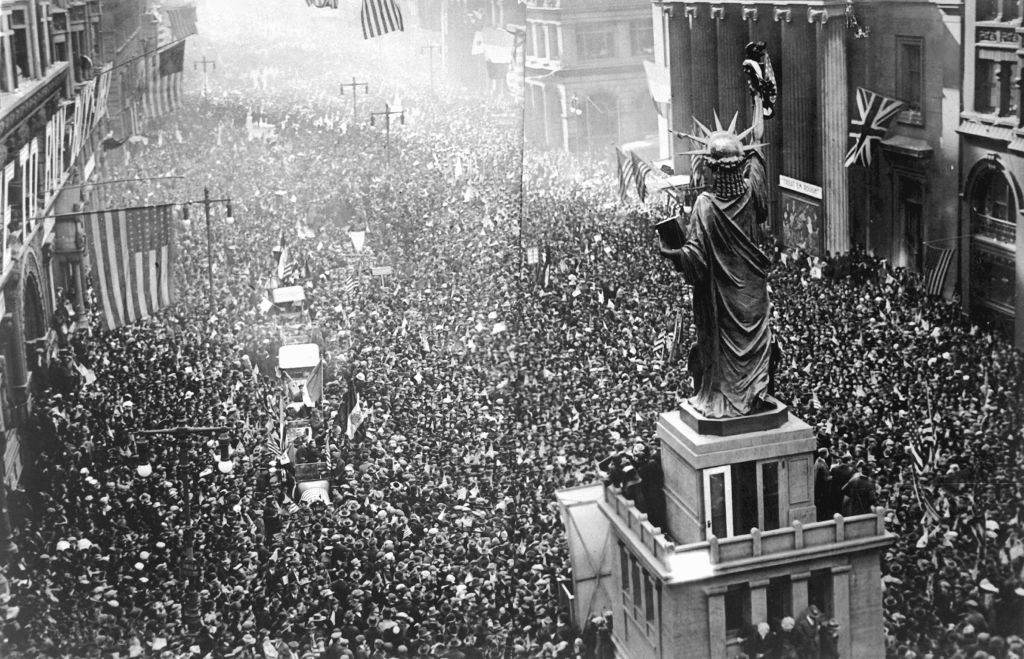

It was the last day of the “War to End All Wars” – or so the world hoped. As we are now painfully aware, however, it was only the beginning. Armistice Day, November 11, 1918, meant an end to the First World War, but peace didn’t last.
Armistice Day Became Veterans Day
The Armistice was signed, but the day did not become the legal holiday Armistice Day until 1938. Later, in 1954, President Dwight Eisenhower signed a law renaming it Veterans Day. However, what was that last day of fighting like for the soldier in the trench on the battle line? For him, the fight was on until literally the very last minute.
Free with the Daily Briefing
85EssaysUnravel the Constitution
Hamilton, Madison & Jay’s complete case for America, free and searchable in the Publius Reader.
Free with the Daily Briefing. Unsubscribe anytime.
German, British, and French officials signed the armistice documentation a few minutes after 5:00 a.m. on November 11 in the Forest of Compiègne, a short distance north of Paris, in a railway dining car. The commander of Allied forces, Marshal Ferdinand Foch, insisted that the cease-fire take effect six hours later, for the symbolic gesture of the war ending on the 11th day of the 11th month at 11:00 a.m. Paris time. This delay also gave time to get the news to the front lines. Meanwhile, the fighting raged. Artillery kept firing, and infantrymen kept attacking.
The Associated Press observed: “There were many reasons why men kept falling until the call of the bugler at 11 a.m.: fear that the enemy would not abide by the armistice, a sheer hatred after four years of unprecedented slaughter, the ambition of commanders craving a last victory, bad communications, the inane joy of killing.” The only symbolism for those in the trenches was that the slaughter continued for six hours after the armistice was signed. “Historian Joseph Persico estimated the total dead, wounded and missing on all sides on the final day was 10,900,” AP added.
The Last Minute of War
Americans were not spared in the last minutes of the war. According to History.com, a young soldier’s personal story stands out. Twenty-three-year-old Henry Gunther, a Baltimore bank employee of German descent, charged a German machine gun position and was killed at 10:59 a.m. on what would become Armistice Day. He had been demoted for writing a letter home to a friend “complaining about life in the trenches" and urging him to avoid serving his country. Gunther was reduced in rank from sergeant to private. Historians are at a loss to explain why Gunther did this when, had he just kept his head down for another minute, he might have saved his life. Some believe he mounted his charge to regain the respect of his fellow soldiers.
From Liberty Nation News, Trivia, Facts, Check Us Out
Stay informed.
Today’s news, the Constitution and American history, written for young readers.
Visit GenerationLiberty.com
History.com records: “General John Pershing, chief of the American Expeditionary Forces, officially recorded Gunther as the last American soldier to die in World War I, although the death toll would climb as it took several days for the news to reach remote battlefronts around the globe.” If Gunther did what he did to get promoted back to sergeant, he was successful. He was awarded the Distinguished Service Cross and won his sergeant’s stripes posthumously.
Though his story was particularly tragic, Gunther was not the only American to die on the last day of World War I. As the website explains: “According to author Joseph Persico, Gunther was one of at least 2,738 troops -including 320 Americans - to die on the Western Front in the war’s final day, most of them in the six hours between the armistice signing and enactment.”
The Abrupt End of World War I
As abruptly as World War I was set in motion by the assassination of Archduke Franz Ferdinand of Austria-Hungary on June 28, 1914, it was over. Fox News provides some perspective about the sounds of the last day: “All around you, though, the roaring sound of gunfire and deafening explosions continue until the very last minute – making it seem as though the battle will never truly end.”
“But as the clock strikes 11 a.m. on Nov. 11, 1918, the guns abruptly fall silent, and the war is finally over.” However, in the 108 years since, the sounds of war around the world have not stopped. Though wars persist, Veterans Day and its predecessor, Armistice Day, should remind us of the sacrifice war demands, even to the last day.
~
The views expressed are those of the author and not of any other affiliate.