


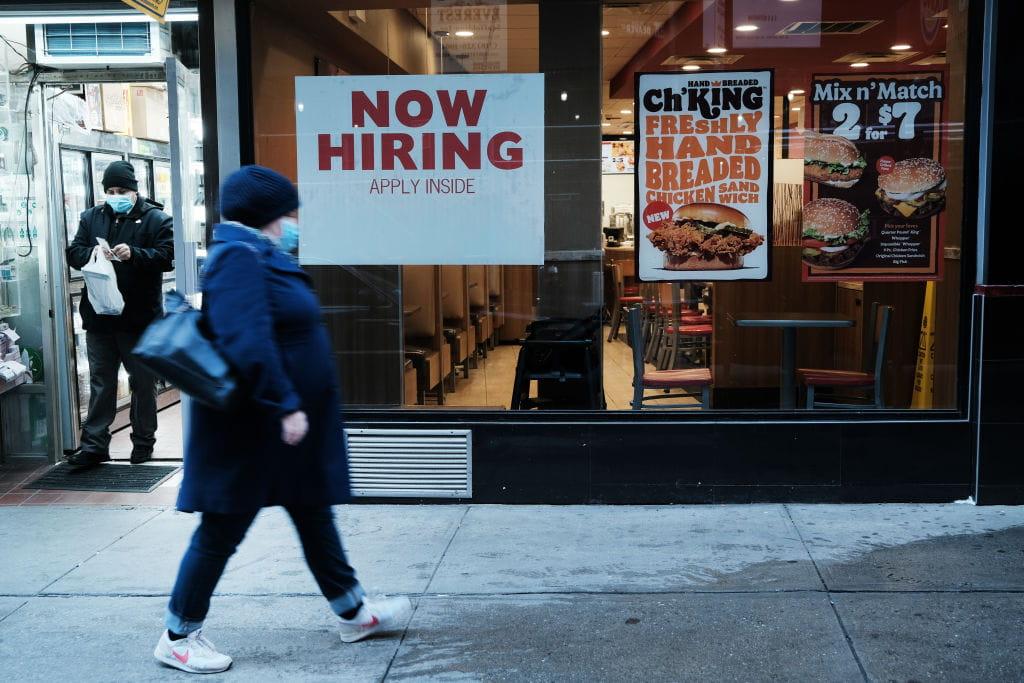

Buried amid midterm election results and red ink on Wall Street was a series of impressive employment indicators this past week. Despite the plethora of headwinds traversing the economy, the US labor market, particularly the unemployment rate, has been the one constant in all of the turmoil and volatility. October proved to be a stellar month for workers.
Autumn in the US Labor Market
The main event last week was the October nonfarm payrolls report. The monthly snapshot of employment conditions came in far above economists’ expectations. According to the Bureau of Labor Statistics, the US economy added 165,000 new jobs, easily beating the consensus estimate of 65,000. The unemployment rate also slipped to a lower-than-expected 4.1%, from 4.2% in September.
What made the October jobs report so good were all of the upward revisions in previous months. September's reading was adjusted higher by 31,000 to 60,000. August's print was revised higher by 53,000 to 186,000. This contrasts sharply with previous years, when the numbers regularly showed job growth was much lower than initially reported.


Free with the Daily Briefing
85EssaysUnravel the Constitution
Hamilton, Madison & Jay’s complete case for America, free and searchable in the Publius Reader.
Free with the Daily Briefing. Unsubscribe anytime.
Last month's payroll expansion was not just about healthcare, which has been the dominant driver of job growth over the past couple of years. The bureau reported that a wide array of industries contributed to solid job creation: professional and business services (70,000), transportation and warehousing (25,000), and manufacturing (19,000),
But it was not only the widely watched monthly jobs report that signaled growing momentum in the US labor market.
A key statistic that has been under the radar for months is historically low unemployment claims. Initial jobless claims, which measure the number of people filing applications for benefits, fell to a 57-year low for the second time this year. Weekly claims have been in a historically tight range of 189,000 to 230,000 in 2026.
Additionally, planned job-cut announcements fell by 71% in October from a year ago, according to global outplacement firm Challenger, Gray and Christmas. Even with several major layoff plans unveiled this earnings season, companies have refrained from aggressive terminations.
So, workers are being hired, fewer employees are being let go, and more Americans are returning to the labor force. What’s more, they are more productive, with output climbing almost 4% in the third quarter, marking the strongest number since the third quarter of 2025, according to the Department of Labor.
Now Comes the Bad News
The main problem for workers has been inflation eating away at their paychecks.
From Liberty Nation News, Trivia, Facts, Check Us Out
Stay informed.
Today’s news, the Constitution and American history, written for young readers.
Visit GenerationLiberty.com
With renewed inflation pressures amid the oil-price shock from the war in Iran, headline consumer inflation has been picking up steam. October’s Consumer Price Index (CPI) will be released on Nov. 10, and early estimates suggest the monthly and 12-month rates will be elevated.
Real (inflation-adjusted) earnings have taken a beating in recent months. Last month, real hourly and weekly wages were negative. As long as the Iranian conflict persists and upends global energy markets, workers will continue to fall behind the cost of living, a key factor behind the disastrous midterm results for President Donald Trump and the Republicans.
For now, structural inflation appears to be intact, running below 3% (still above the Federal Reserve’s 2% target!). But the longer oil hovers around $100, gas remains at $4, and diesel at 6%, the harder it will be to prevent second- or third-order inflation effects.
Nice Work If You Can Get It
The headline numbers are terrific. Some of the under-the-hood figures are also good. But a few trends are concerning (isn’t there always?). One is that the long-term unemployment rate is around 28%. Another is that workers’ share of economic gains is at its lowest level since the bureau began that series in the 1940s. Finally, the artificial intelligence (AI) revolution is still harming young graduates and entry-level workers.
In the end, in today’s labor market, if you are employed, you will be doing well. If you have lost your position, the job hunt will be harder. It turns out the classic jazz standard is proving right: It’s nice work if you can get it.