


President Trump has let it be known that he is not putting up with Tehran’s negotiating games. In response to the Islamic Revolutionary Guard Corps’s (IRGC) surprise attack, launching numerous ballistic missiles at American military facilities in Jordan on Tuesday night (July 28), America’s commander-in-chief said the strikes would be answered with ferocity. All incoming missiles were intercepted, and no damage was done, nor were US service members killed or injured. What the attack did accomplish, however, was to motivate the US president to act decisively. As Fox News reported: “The United States resumed airstrikes inside Iran Wednesday night in retaliation for Tehran’s attempted surprise ballistic-missile attack on American forces, as an Iran expert warned that the regime has become increasingly willing to test Washington despite its weakened military capabilities.”
An Unmistakable Message to Iran
If the US had thought the Iranian regime had gotten the message to cease its attacks on shipping in the Strait of Hormuz, it hadn’t. Several oil tankers and cargo vessels have been hit. According to a US Central Command (CENTCOM) X posting:
“[F]orces successfully completed a heavy wave of strikes against Iran in response to yesterday's attempted missile attacks on U.S. forces. CENTCOM assets struck dozens of Islamic Revolutionary Guard Corps (IRGC) targets in Iran, including military command centers, missile and drone facilities, coastal surveillance and defense sites, and maritime capabilities. The strikes aimed to further diminish threats posed by Iran and its proxies to American forces, commercial shipping, and neighboring Gulf countries.”
The air strikes that followed were the first direct strikes on Iranian territory since an earlier five-night lull. Some hoped the pause in the air campaign would provide a little breathing room for another attempt at diplomacy and to demonstrate that, even though the US has considerably more wartime capability than Iran, there is still an appetite for a durable peace arrangement. In the Gulf of Oman and the Persian Gulf, US forces are continuing to enforce the maritime blockade on ships sailing to and from Iran’s ports. CENTCOM explained, “As of July 30, CENTCOM forces have redirected 24 commercial vessels, disabled 2, and boarded 2 to ensure full compliance.”
The attempted surprise attack on US military facilities in Jordan showed Iran’s priorities are seemingly designed to keep the conflict going as long as it can. The consequence of this behavior is that Iran has now prompted Saudi Arabia to take a much more active role in the Gulf region conflict.


Free with the Daily Briefing
85EssaysUnravel the Constitution
Hamilton, Madison & Jay’s complete case for America, free and searchable in the Publius Reader.
Free with the Daily Briefing. Unsubscribe anytime.
In coordination with US forces, American and Saudi aircraft attacked several weapons storage and logistics sites maintained by Iranian proxies in eastern Iraq. According to an Associated Press report, “The latest barrage came after the US partnered with Saudi Arabia to strike Iran-backed militias in neighboring Iraq, killing at least 20 fighters and six Iranian advisers.” These combined military operations are a response to more than 30 drone attacks launched by the IRGC against Saudi oil refineries and other energy infrastructure targets, as well as US bases in the Kingdom. As the AP explained, reports from a meeting on July 29 between Saudi Defense Minister Khalid bin Salman, President Trump, and Vice President JD Vance revealed, “[T]he Saudi decision to join the U.S. attacks against the Iraqi militias was meant to send a message to Iran that it wouldn’t tolerate Iran or its proxies targeting the Saudi oil industry and other critical infrastructure.”
Destruction
What is becoming clearer is that despite the United States’ persistent attempts at a diplomatic solution to the Iran conflict, what’s left of the leadership in Iran is of no such inclination. Their behavior suggests that they are irrational and bent on escalating the fighting to include all of their Gulf region neighbors. Its strategic objective is ostensibly to maintain control of the Strait of Hormuz, regardless of the cost. The challenge for the US is that attacking critical Iranian energy facilities and key infrastructure runs the risk of hurting Iranian civilians, the very people the US has been attempting to protect.
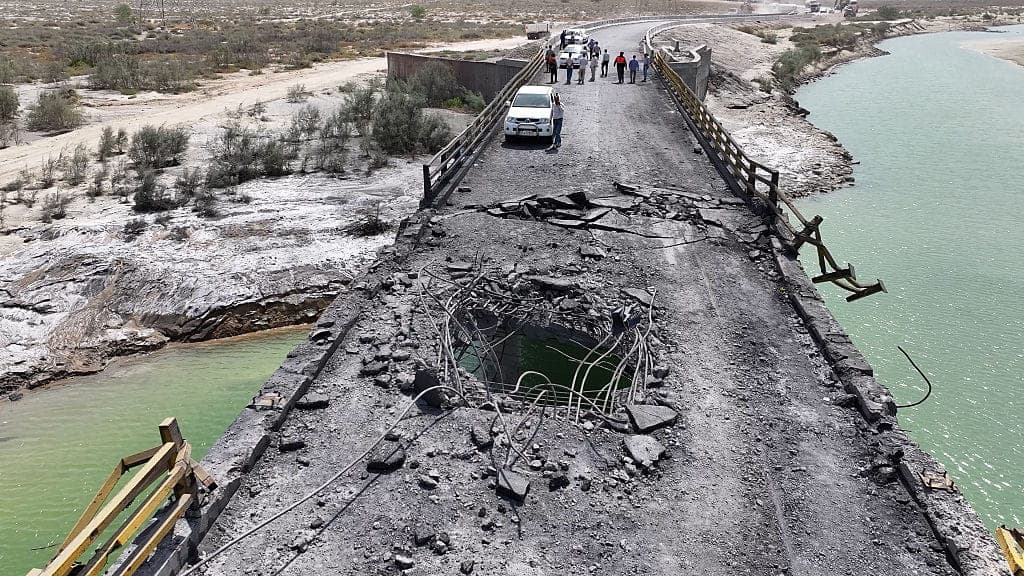
However, everything else the IRGC needs for transportation and logistics capacity is fair game – including roads, railroads, bridges, and the electrical grid. When the IRGC and other Iranian leadership feign a willingness to come back for substantive talks, simply refusing to engage and continue bombing serves as a sobering message: All-out war with the US isn't as glorious as they seem to think it will be.
~
The views expressed are those of the author and not of any other affiliate.

.jpg%20Democrats&w=1920&q=75)
.jpg%20illegal%20alien&w=1920&q=75)