
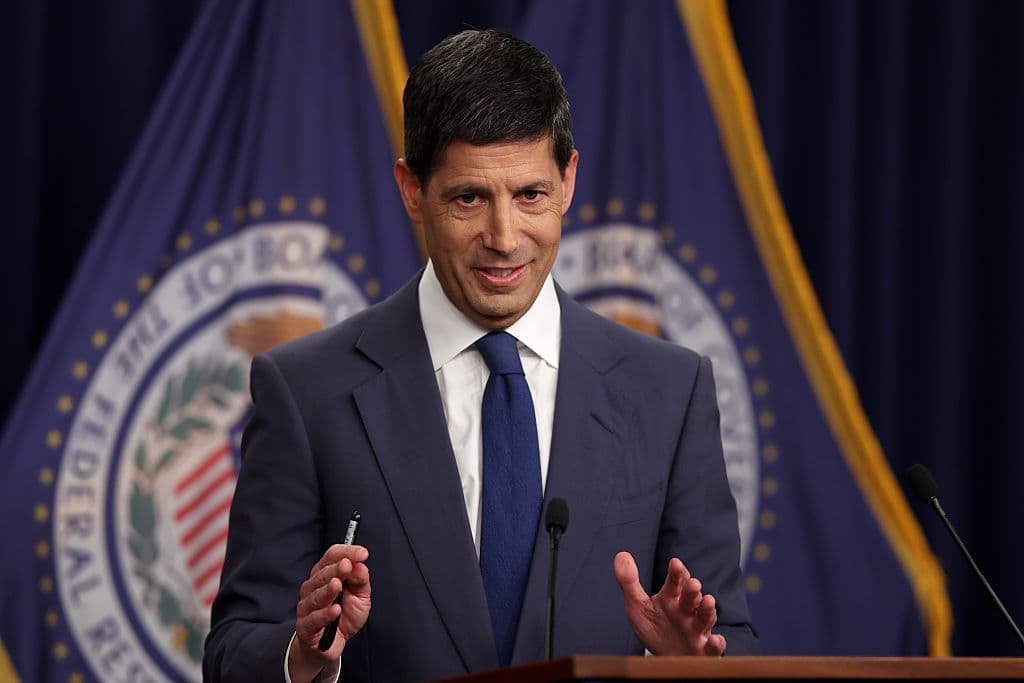

Federal Reserve Chairman Kevin Warsh routinely points out that inflation has run above the US central bank’s 2% target for 64 consecutive months. He has reaffirmed the institution’s commitment to delivering price stability and allowing financial markets to function on their own without the Fed’s handholding. But is Warsh’s zero-tolerance inflation policy all talk, or can America expect results soon?
Kevin Warsh, Rinse, and Repeat
Since returning to the central bank after more than a decade-long absence, Warsh has repeatedly requested a good old-fashioned “family fight.”
Based on the July policy meeting’s outcome, he may have gotten what he wanted. The Federal Open Market Committee (FOMC) voted 9-3 to leave the federal funds rate unchanged in the current target range of 3.5% to 3.75%. Cleveland Fed President Beth Hammack, Minneapolis Fed President Neel Kashkari, and Dallas Fed President Lorie Logan dissented, preferring a quarter-point hike.
While June’s inflation numbers triggered collective sighs of relief, the ebullience was fleeting as the spike in global energy prices from the resumption of US-Iran hostilities revived concerns over coming price pressures. Forecasts for the July and August Consumer Price Index (CPI) and Personal Consumption Expenditures (PCE) reports have already been revised higher as the Middle East conflict drags on and oil and gas prices surge.
Free with the Daily Briefing
85EssaysUnravel the Constitution
Hamilton, Madison & Jay’s complete case for America, free and searchable in the Publius Reader.
Free with the Daily Briefing. Unsubscribe anytime.
Investors had anticipated tightening this year, but now expectations for a September interest rate hike have diminished. Wall Street is now split on whether the Fed will raise rates or keep the policy rate on pause, though Warsh said he would not portray the latest decision as a pause at all.
“I wouldn’t characterize what we did as anything like a pause. I would characterize what we did as a rigorous review of the economic situation,” he told reporters at the post-meeting news conference. “I would characterize what we did as a review of the big hard questions, and I’d characterize it as a view of what our own homework is to try to resolve those questions in the period ahead.”
Fine. After the market’s midweek meltdown, the world can label it an uncomfortable hold. Yields on long-term Treasury securities are screaming about something, as the 30-year reached its highest level since 2007. Perhaps it is increasing inflation expectations. Maybe it is a continual headache over the US government’s ailing fiscal health.

Whatever the reason, Warsh indicated that he welcomes the Treasury market’s volatility, assigning its upward movements to the lack of forward guidance. In other words, the market is influencing interest rates, not the Federal Reserve’s constant intervention.
“Market attention centered on real data and real economic developments. Prices reacted in real time to incoming information,” the new central bank leader stated. “Market participants are learning to play the ball, not the referee, and market prices will continue to respond in the direction and magnitude they see fit.”
Will Wall Street receive greater insights into Warsh and Peace when the Fed head delivers his first keynote speech at the annual Jackson Hole economic symposium next month? While it typically begins a policy reset, Warsh is unlikely to provide any information beyond what he already has. Still, it will be must-see viewing!
A Lucas Critique
For the policy wonks and econ nerds, an interesting moment from the press conference occurred when Kevin Warsh cited the Lucas critique. This is an argument from US economist Robert Lucas’ paper, contending that experts cannot judge new policies relying on old economic data since the economy changes its behavior once the policy is adjusted. This is essentially an indictment of Keynesian models.
In other words, the financial markets are adapting to the world of Warshonomics, one that ditches forward guidance, abandons the long-held belief of perpetual interference, and leaves the balance sheet alone. Fasten your seatbelts; this is going to be a bumpy ride on the road to repricing.

.jpg&w=1920&q=75)