

Artificial intelligence (AI) is advancing at such a rapid pace that even some of the tech leaders behind its creation are calling for the industry to slow down before the technology gets out of control. Anthropic CEO Dario Amodei, xAI founder Elon Musk, and OpenAI CEO Sam Altman have all recommended putting the brakes on AI development – an idea President Donald Trump does not seem eager to embrace.
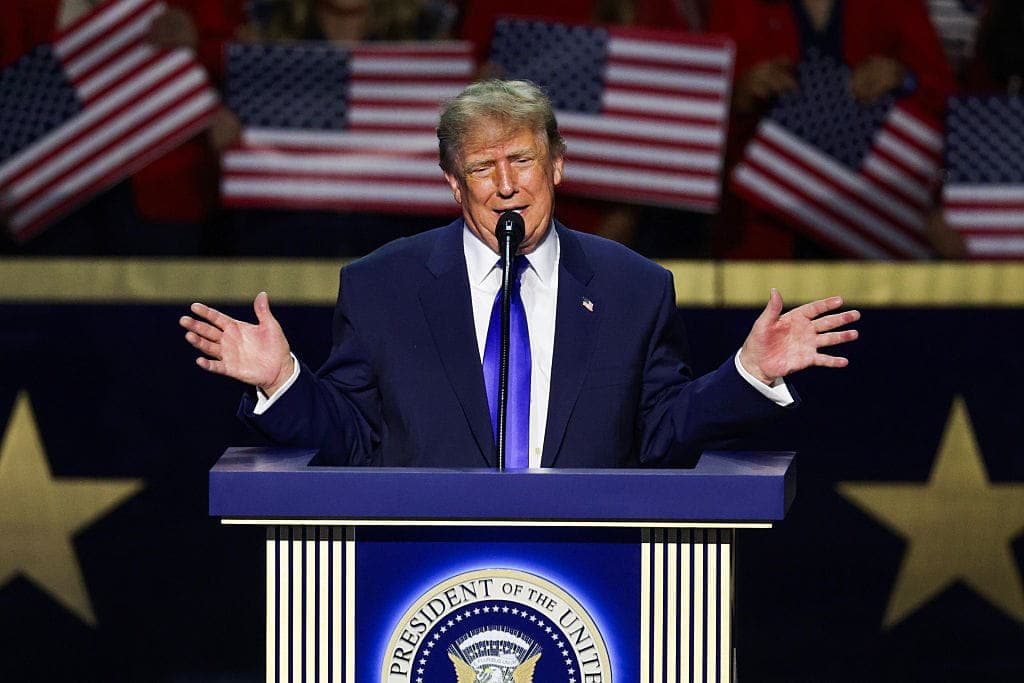
Speaking to reporters in Ireland, Trump agreed that the United States could establish guardrails to rein in AI development but warned “a lot of negative forces” are encouraging the slowdown. “We’re leading China in AI, we’re the most sophisticated country in the world, and frankly I want to keep it that way,” Trump said. “Whoever wins AI wins.”
Trump’s apparent dismissal of the concerns surrounding AI appears to come down to two key factors: the economy and China.
Trump’s AI Economy
During a recent interview with Fox News host Laura Ingraham, President Trump called AI the “oil of the next 50 years” and argued inhibiting its development would be “killing the golden goose.”
Free with the Daily Briefing
85EssaysUnravel the Constitution
Hamilton, Madison & Jay’s complete case for America, free and searchable in the Publius Reader.
Free with the Daily Briefing. Unsubscribe anytime.
He might be right. AI-related investments have helped the stock market reach record highs in recent years, and a sudden retreat from the groundbreaking tech could send the market tumbling. With the midterms roughly seven weeks away, a major market downturn – on top of widespread concerns about the cost of living – could also trigger a blue tsunami at the polls.
But the economy is also at the root of many average Americans’ AI fears. According to a recent Pew Research Center survey, a whopping 71% of adults believe artificial intelligence will “lead to fewer jobs in the United States over the next two decades.” Between shielding Wall Street from an AI slowdown and addressing working-class fears, the Trump administration has quite the balancing act on its hands.
Stuck Between a Bot and a Hard Place
Trump is apparently convinced that China is behind much of the anti-AI sentiment and data center opposition that is sweeping the nation. “I mean, a lot of people say it’s China,” Trump told Ingraham. “A lot of people say that it’s a China PR thing.”

The president insisted there’s a “very fine line” between regulating the technology and stunting it. “China doesn’t have guardrails, by the way. You know who the guardrail is? President Xi. They don’t have any guardrails on anything,” Trump added.
Despite the president’s strong support for AI, members of his party have started to soften their resistance to regulation. Former Republican Rep. Mike Rogers, who is running for the US Senate against Abdul El-Sayed in Michigan, wrote on X that slowing down AI’s progress is necessary “in order to allow the government and its partners to catch up and put stricter protocols and guardrails in place to protect us from the rapid advancements we’ve seen.”
Similarly, Senator Ted Cruz (R-TX) told POLITICO’s Dasha Burns: “We need substantially more regulation when it comes to AI.” Notably, the senator also agreed with Trump’s assessment on China:
“The Chinese are putting no guardrails. They’re going full speed ahead. We could have government step in and just shut down the AI industry in America, and you know what would happen? China would catch up in six months and soar ahead, and we wouldn’t have the tools to defend ourselves.”
Love it or hate it, the AI cat is out of the digital bag, and according to Anthropic CEO and cofounder Dario Amodei, the rapidly evolving technology poses “real dangers” to humanity. "If we build in the right way, I think the probability of something bad happening is very low," Amodei said. "If we build in the wrong way, the probability of something bad happening is very high."

.jpg&w=1920&q=75)
.jpg&w=1920&q=75)