


.jpg&w=1920&q=75)

The 1990s were indeed a unique period in the United States. The decade seemed like a mix of an early 20th-century industrial revolution, a 1950s post-war economic boom, and the personality of the 1980s. While today’s world lacks character, the late 2020s appear to economically emulate the latter half of that decade, from technology to interest rates.
Interest Rates of the 1990s
Is it hard to believe that financial markets are going apoplectic about surging interest rates? The entire US Treasury yield curve has risen steadily since the outbreak of war in the Middle East this past winter. The benchmark ten-year Treasury yield is approaching 5%, while the 20- and 30-year yields are firmly above that level. Even the two-year, which typically tracks Federal Reserve policy expectations, is eyeing 4.5%.


Free with the Daily Briefing
85EssaysUnravel the Constitution
Hamilton, Madison & Jay’s complete case for America, free and searchable in the Publius Reader.
Free with the Daily Briefing. Unsubscribe anytime.
Market watchers have blamed this summer’s ascent on fiscal fears, persistent war-driven inflation worries, and tightening monetary policy. But many never ask: What if the government bond market is simply normalizing after 20 years of ultra-low interest rates?
Under Chairman Kevin Warsh’s reform agenda, the Federal Reserve is no longer holding Wall Street’s hand and is leaving investors to fend for themselves. Occupants inside the Eccles Building, in theory, will be guided by market signals – not the other way around.
Despite some hiccups, US stocks have survived the rise in yields. Whether the surge will eventually come back to haunt the equities arena remains to be seen, but the New York Stock Exchange has traveled down this path before. And everyone survived.
In fact, in the late 1990s, the ten-year yield was even higher than it is today, without a war in Iran, a $40 trillion national debt, or a $2 trillion budget deficit. It was not until the Global Financial Crisis that the benchmark instrument fell sharply as investors poured into the safe-haven asset to shield themselves from disaster.
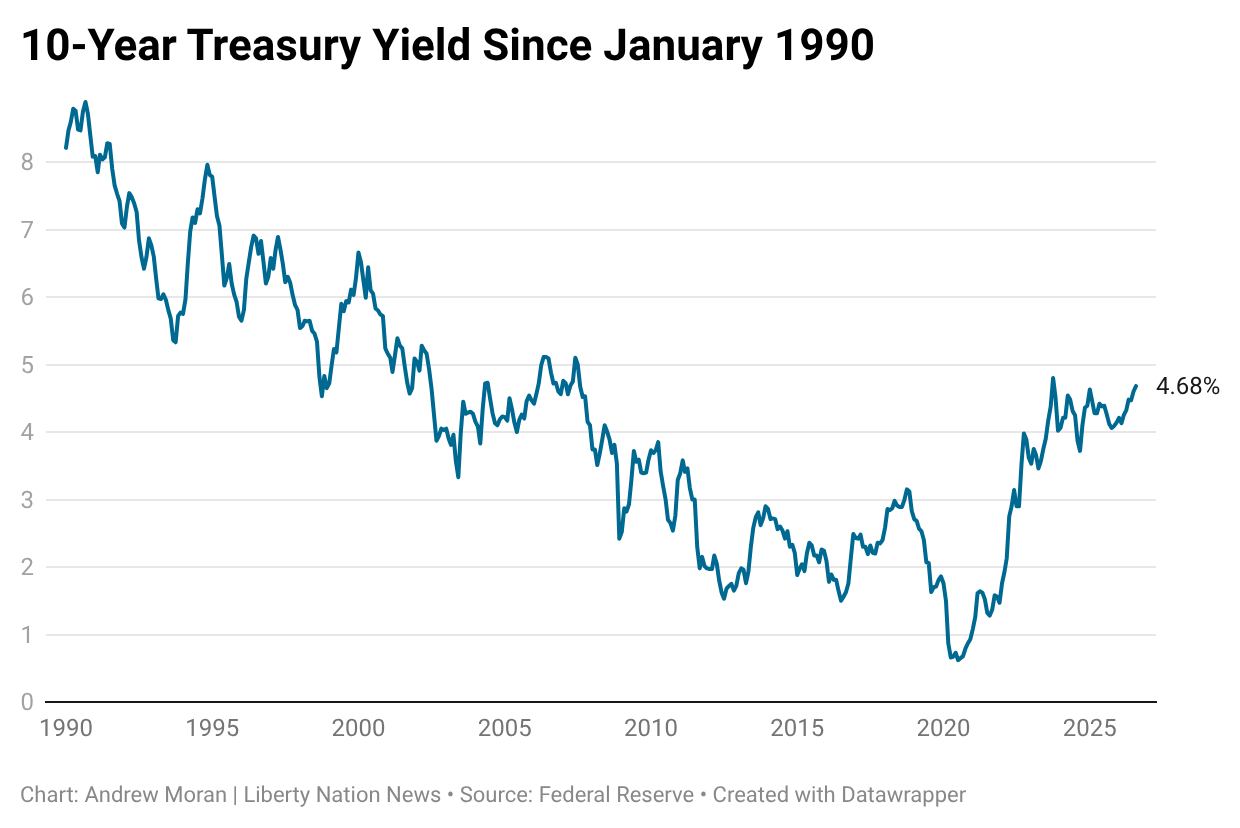
While the administration is employing various measures to bring down interest rates – be it demanding the Fed to cut the federal funds rate or bolstering debt buybacks – the White House is refusing to do the one thing that can stabilize the Treasury market and reignite the stock market rally: Ending the Iranian conflict.
Revolution: AI Edition
You’ve got mail! That phrase perfectly encapsulated the 1990s dot-com boom.
The internet revolution was on par with previous industrial revolutions that advanced economic prosperity. Yes, there was collateral damage as dumb money dove into any company that added .com to its name. But this era also gave rise to some of today’s biggest brands, from Amazon to Nvidia.
The chief conversation on Wall Street is whether the AI boom is in a bubble. Both sides of the debate present good arguments, but a key fact is that companies in 2026 are logging solid earnings, something US firms lacked in the late 1990s and early 2000s. Hyperscalers' capital expenditures are a trillion dollars, and demand for components essential to the AI infrastructure buildout is enormous.

Even if AI is bubblelicious, the inevitable pop will still result in companies having to stay behind, clean up the mess, and usher in a new era in the field of excellence. Another fact omitted in a potential collapse of the AI rally: $7 trillion is sitting on the sidelines and waiting to buy the dip in the Magnificent Seven or scoop up discounts in blue-chip names.
Is President Donald Trump exaggerating when he says America is in a Golden Age? History will tell if the late 2020s will emulate the late 1990s.
Back to the ‘90s
Scanning the Xverse will lead to interesting finds. One of these is that a certain corner of the social media platform yearns for a time of Blockbusters, long-cord telephones, and MOVIEFONE. A video-rental store may no longer be viable, and you can check showtimes for the latest film release with a click of a button. Instead, the best this part of the decade can offer is elevated interest rates and a technological revolution.

.jpg&w=1920&q=75)
.png&w=1920&q=75)
