


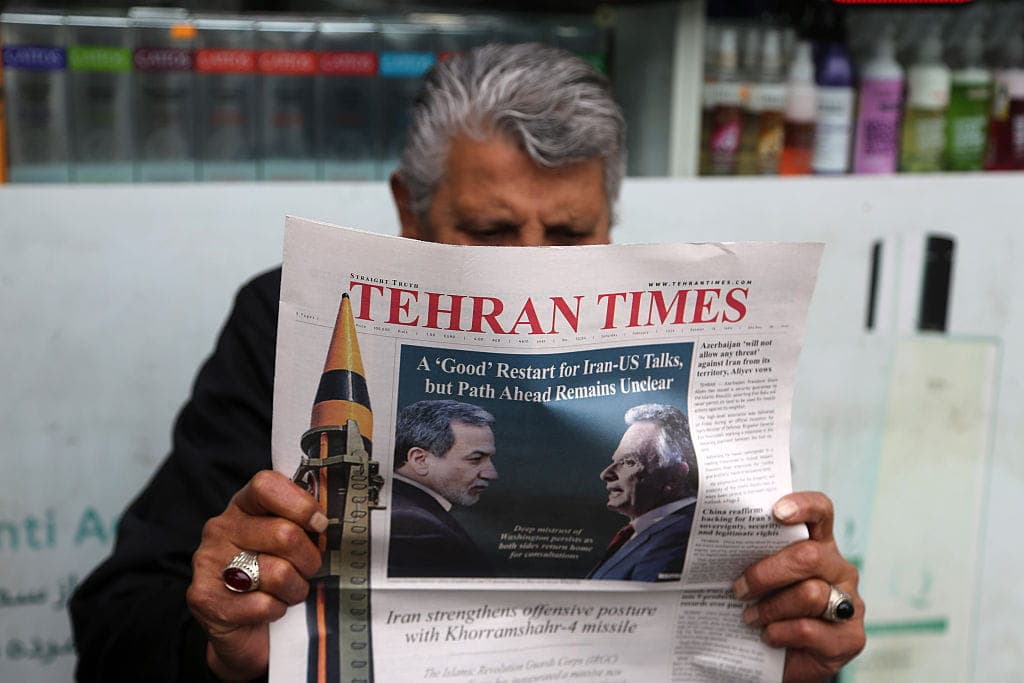

The United States and Iran held their second round of nuclear weapons talks on Feb. 17. Early reports suggest that the negotiations, though brief, yielded some positive results. When adversaries meet to reach common ground, the first steps are confidence-building measures to create an atmosphere in which there is no confusion about each side’s position. However, there is a difference between establishing trust and simply stalling.
Formidable US Force in the Region Should Concern Iran
The United States is adding a compelling dimension to the talks by positioning two carrier attack groups in the Gulf region: The USS Abraham Lincoln is currently there, and the USS Gerald R. Ford is en route, expected to arrive in two weeks. The Wall Street Journal's editorial board asked an important question: “Does Iran have two weeks to spare? Perhaps, as a second US aircraft-carrier strike group heads to the region. But on [Feb. 17], Axios reported that the US moved more than 50 F-35, F-22, and F-16 jet fighters to the region in the preceding 24 hours.”
From Liberty Nation News, Trivia, Facts, Check Us Out
Stay informed.
Today’s news, the Constitution and American history, written for young readers.
Visit GenerationLiberty.com
News, Trivia, Facts, Check Us Out
Stay informed.
Today’s news, the Constitution and American history, written for young readers.
Visit GenerationLiberty.com
The Trump administration’s message is clear: “The US is not going to talk forever. Iran will bring the talks to a successful (‘successful’ on US terms) conclusion or suffer devastating consequences.” Whether that motivated Iran to be more accommodating is difficult to say, but, according to Reuters, “Iran and the United States reached an understanding on [Feb. 17] on main ‘guiding principles’ in talks aimed at resolving their longstanding nuclear dispute, but that does not mean a deal is imminent, Iranian Foreign Minister Abbas Araqchi said.” A US official familiar with the discussions told NBC News that “progress was made, but there are still a lot of details to discuss.” Others called these comments too “vague” to be substantive and overly encouraging.
Special Envoy Steve Witkoff and Jared Kushner are representing the United States in the talks. As in the past, the Geneva talks are indirect – the United States and Iran do not address each other directly but communicate through an Omani intermediary. Again, from Reuters, “Oman's Foreign Minister Badr al-Busaidi said in a social media post on X, ‘much work is yet to be done,’ but Iran and the U.S. were leaving with ‘clear next steps.’”
However, any positive sentiments are not universally held in Tehran. According to the Institute for the Study of War’s (ISW) "Iran Update" on February 17, 2026:
“Iranian Supreme Leader Ali Khamenei rejected the United States’ demands for Iran to halt uranium enrichment and limit its ballistic missile program in a speech on February 17. Khamenei’s speech coincided with the second round of US-Iran talks in Geneva, Switzerland. Khamenei stated that Iran has a ‘right’ to have a ‘nuclear industry,’ which is a reference to Iran’s nuclear program and uranium enrichment capabilities.”
In a world where nuclear proliferation raises the potential of deadly attacks by rogue nations such as Iran, the Ayatollah does not have a “right” to possess atomic weapons. Nor does Tehran have a right to hold Israel and its Gulf neighbors hostage to long- and intermediate-range ballistic missiles. Nevertheless, as ISW reported, “Khamenei also described Iran’s ‘possession of deterrent weapons,’ almost certainly in reference to Iran’s ballistic missiles, as ‘essential and obligatory’ and claimed that this issue has ‘nothing to do with’ the United States.” Despite the Ayatollah’s assertions, Iran’s ballistic missile inventory and its capacity to develop and deploy them put the United States and its regional allies in range of those missiles – and they are a real threat.
Getting Bogged Down in Minutiae
The WSJ raised an important caution. Are the US negotiators making progress on the four major issues: nuclear enrichment, stockpiles of ballistic missiles, support for terrorist proxies, and bestial treatment of Iran’s citizen-protesters? Or are they getting bogged down in the minutiae of the nuclear issues? “This should be a moment to confront the true nature of the Iranian regime. Yet US officials are again mired in discussions about nuclear enrichment, stockpiled uranium and regional consortia,” the WSJ observed.
Iran’s negotiators have said they will be back in the next two weeks with more “detailed” proposals. Perfect. But if the talks prove fruitless and a waste of time, Iran’s military offers a target-rich environment for the US forces gathered in the region. Among the most lucrative targets are the Islamic Republic of Iran Navy and the Islamic Revolutionary Guard Corps Navy, which include approximately 109 vessels, including 25 submarines, seven frigates, three corvettes, and 21 patrol boats. Taking out the Iranian naval capability should be a priority to ensure Tehran cannot close the Strait of Hormuz. It would be in Iran’s best interest to offer a proposal with meaningful concessions. In two weeks, it will have that opportunity.
~
The views expressed are those of the author and not of any other affiliate.




.jpg%20noncitizen%20voting&w=1920&q=75)
.jpg%20Hillary%20Clinton&w=1920&q=75)