



A second round of talks between the United States and Iran starts today (Feb. 17) in Geneva, Switzerland. As with the first discussions, held Feb. 6 in Muscat, Omani officials will act as mediators for the indirect discussion. Iran’s delegation will once again be led by Foreign Minister Abbas Araghchi, and Special Envoy Steve Witkoff and Jared Kushner, President Donald Trump’s son-in-law, will lead the US negotiators.
Iran Is Looking Down the Barrel of a Gun
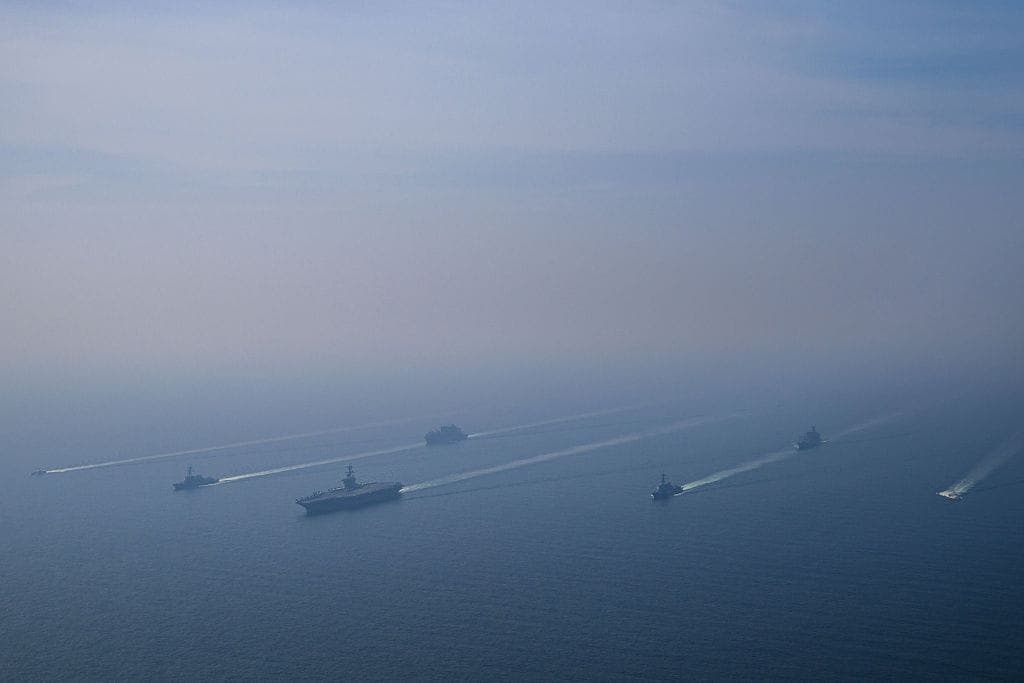
What is decidedly different about this round is that the United States is moving into position, in the Mediterranean and Arabian Gulf, a large contingent of warships, similar in numbers and capability to the force that was there for the 12-day war in June 2025. Currently, according to The New York Times:
“The Pentagon has been building up an ‘armada’ in the region, to use Mr. Trump’s word. That includes the USS Abraham Lincoln aircraft carrier, accompanied by three warships equipped with Tomahawk missiles. That is at the center of a dozen warships in the region, including in the Arabian Sea, the Persian Gulf, the Red Sea, and the eastern Mediterranean Sea.”
Additionally, the USS Gerald R. Ford Carrier Strike Group, with four to six support ships, has been directed to leave its position in the Caribbean and join the Lincoln. The Ford and its complement of guided-missile destroyers and cruisers are not expected to arrive for at least two to three weeks. However, when it does arrive, the combined capability of US forces in the Arabian Gulf region will be formidable.
While the United States has been positioning its warships, Iran has not been sitting on its hands. On Feb. 16, the Islamic Revolutionary Guard Corps (IRGC) conducted a naval exercise code-named “Smart Control of the Hormuz Strait.” As the name suggests, the live-fire exercise was designed to demonstrate how Iran’s naval force could control the Strait of Hormuz, a critical route for an estimated 20% of the world’s oil shipments. The Iranian naval training tested operational readiness and rehearsed responses to US threats.

The Hormuz Strait, 21 miles wide at its narrowest, connects the Arabian Gulf and the Gulf of Oman. According to The Jerusalem Post, “It is the only sea passage from the Persian Gulf to the open ocean, making it a strategically important choke point. Iranian hardliners have pushed for the Strait of Hormuz to be blocked in response to growing tensions with Washington.” It would seem that Iran is looking for a naval standoff. However, the IRGC's naval capability in the region, compared with that of the United States, especially when the Ford Carrier Strike Group arrives, leaves Iran holding the proverbial short straw — by a lot. Iran’s navy would be nothing more than targets.
So, against this backdrop, today’s talks will again be the stage for US negotiators to insist that Iran give up its nuclear ambitions and no longer seek to enrich uranium for weapons purposes. Iran will declare the enrichment is for civilian purposes and nothing more. In an X post, Araghchi said, “I am in Geneva with real ideas to achieve a fair and equitable deal. What is not on the table: submission before threats.” However, if past is prologue, what he means is that Iran will push these talks as far as it can without reaching an end state in which Iran must cede to US demands.
Former Army General Does Not Mince Words
In an interview with Fox News, former Vice Chief of Staff of the Army, retired Gen. Jack Keane, put into no-fuzz terms what US negotiators are up against:
“The Iranians are such diabolical, pathological liars that they don’t even admit that they are in pursuit of a nuclear weapon, despite the secret sites that they’ve had, despite the sites that we’ve bombed that are buried 250 feet underneath the ground … They have two objectives here. One is to continue to drag out negotiations, to forestall any combined attack with Israel, and to give them greater capability to prepare for such an attack and also retaliate. And the second thing, and they’ve actually put it on the table, is [that] their real objective is … to get sanctions relief.”
Trump has convincingly demonstrated that he has a method for advancing US imperatives. As he did in June, when tensions were high between Israel and Iran, Trump offered an opportunity to negotiate to avoid a conflict. He gave Iran 60 days to come to the table. On day 61, with US approval, Israel struck a decisive blow with 12 days of air attacks on Iran’s ballistic missile sites and warehouses, nuclear development sites, and IRGC command and control. The United States eliminated Iran’s underground nuclear facilities. Recently, Trump gave former Venezuelan President Nicolas Maduro the opportunity to leave office and the country under very generous conditions. Maduro scoffed and refused, and now he is sitting in a US prison in much less pleasant conditions.
Trump is basically offering Iran a similar opportunity to stop its nuclear program, end development and production of ballistic missiles, halt support to proxy terrorists, and cease the killing of Iranian protesters. The deadline for Ayatollah Khamenei and the rest of the Iranian leadership to agree is the time it will take for the Ford to arrive in the Gulf region. Asked by a reporter if he wanted regime change in Iran, Trump replied, “It seems like that would be the best thing that could happen.” If Iran continues to kick the can down the road, when America’s full armada is in position, regime change may very well be the result.
~
The views expressed are those of the author and not of any other affiliate.

.jpg&w=1920&q=75)
.jpg&w=1920&q=75)
.jpg&w=1920&q=75)