
The United States has stationed the USS Abraham Lincoln Carrier Strike Group in the Indian Ocean near the Strait of Hormuz, expanding the US armada’s position in a show of strength aimed at convincing Iran to stop carrying out its persistent carnage against civilian protesters. As the world waits to see how far the US will go to stop the violence, President Donald Trump is protecting his options for persuading Iran to come to the table to negotiate a halt to Tehran’s decades-long desire to develop nuclear weapons.
Since the violent protests in Iran began on December 28, reports claim thousands of Iranian protesters have been killed by the Tehran regime’s security forces. The exact number is not known; nearly all communication into or out of Iran has been cut off, but figures range from 16,000 to well over 30,000. Iran International reported: “The killing of 36,500 people in just two days represents a scale of violence without precedent in the history of repression under the Islamic Republic—and one that stands out even when compared with some of the deadliest episodes of state violence and full-scale wars worldwide.”
Consequently, President Trump has modified the focus of his warnings to address the threats the Iranian military poses. In a recent January 28 Truth Social posting, Trump put it bluntly:
“A massive Armada is heading to Iran. It is moving quickly, with great power, enthusiasm, and purpose. It is a larger fleet, headed by the great Aircraft Carrier Abraham Lincoln, than that sent to Venezuela. Like with Venezuela, it is ready, willing, and able to rapidly fulfill its mission, with speed and violence, if necessary. Hopefully, Iran will quickly ‘Come to the Table’ and negotiate a fair and equitable deal – NO NUCLEAR WEAPONS – one that is good for all parties. Time is running out; it is truly of the essence! As I told Iran once before, MAKE A DEAL! They didn’t, and there was ‘Operation Midnight Hammer,’ a major destruction of Iran. The next attack will be far worse! Don’t make that happen again.”
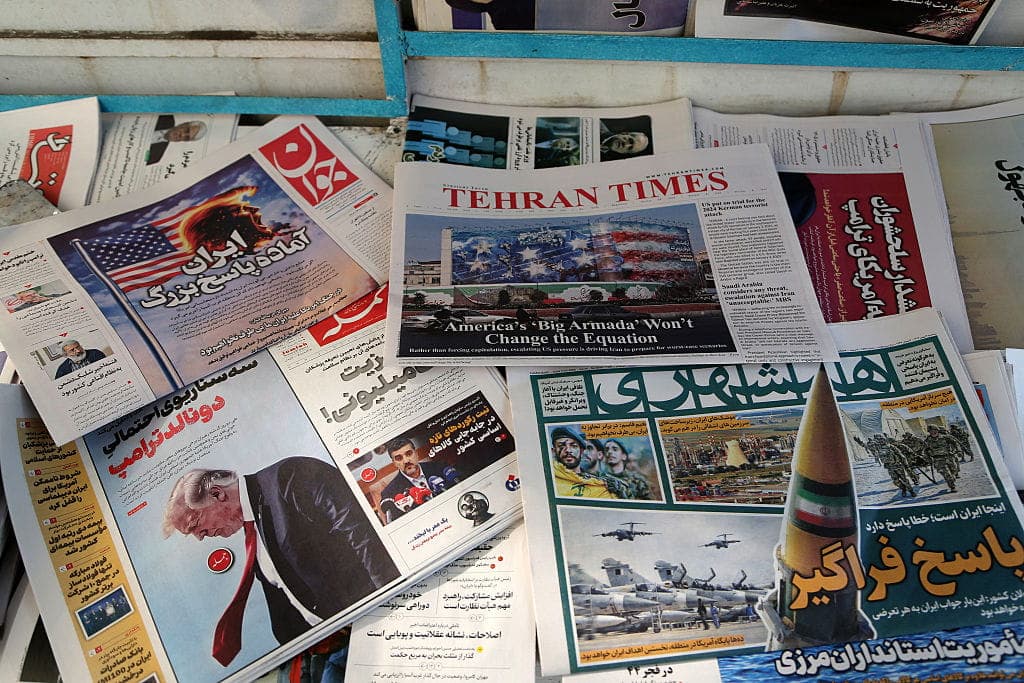
So far, Iran has not gotten the message. As one might suspect, instead of acquiescing to what is notably a significant naval flotilla on their doorstep, Iranian officials have instead responded with belligerent rhetoric and military posturing. “Iranian officials have long threatened to disrupt shipping in the Strait [of Hormuz] as a way to deter the United States from implementing sanctions or taking military action against Iran,” the Institute for the Study of War (ISW) reported in its Iran Update, January 29, 2026. In response to the USS Abraham Lincoln Carrier Strike Group’s positioning, Iran has announced a two-day (February 1 and 2) Islamic Revolutionary Guard Corps (IRGC) Navy live-fire exercise in the Strait of Hormuz. According to Fox News, “The U.S. military warned Iran it will not tolerate ‘any unsafe and unprofessional behavior’ surrounding U.S. forces in the Middle East as Tehran is gearing up for live-fire naval drills in the Strait of Hormuz.”
Again, according to ISW, the IRGC Navy has deployed “hundreds of fast, missile-launching, and support vessels” in the area where the USS Lincoln is located. The use of the fast attack craft is “consistent with Iran’s asymmetric naval strategy that counters larger and more technologically advanced naval forces through high speed and short-range missile capability.” Iran imagines this an effective strategy, with the high-speed vessels darting around close to the US armada and being engaged by US warships’ defenses. But in the meantime, strike aircraft from the big-deck carrier as well as cruise missiles from the Carrier Strike Group’s support missile destroyers and cruisers would be taking out the IRGC Navy’s port and docking facilities along with its command and control structure, leaving it leaderless and without support.
As in the past, US naval aviation would neutralize the Iranian anti-aircraft radar capability, leaving the Iranian military powerless to defend itself against follow-on attacks. One would think that the Iranian military and civilian officials would have learned a lesson from last June’s 12-day war.
Furthermore, the Iranian bravado may signal weakness rather than a legitimate capability to take on the US. “President Trump has received multiple U.S. intelligence reports indicating that the Iranian government’s position is weakening, according to several people familiar with the information. The reports signal that the Iranian government’s hold on power is at its weakest point since the shah was overthrown in the 1979 revolution,” The New York Times reported. Keeping the pressure up with increased sanctions, driving toward economic collapse, and pressing the Iranian military with overwhelming force close by could push the current regime out of power.
Whether the regime collapses or not, what Trump wants is compelling and verifiable evidence of an end to Iran’s nuclear weapons aspirations. He wants negotiations toward that end now. President Trump is not known for his patience.
~
The views expressed are those of the author and not of any other affiliate.
.jpg&w=1920&q=75)
.jpg%20Minnesota&w=1920&q=75)