


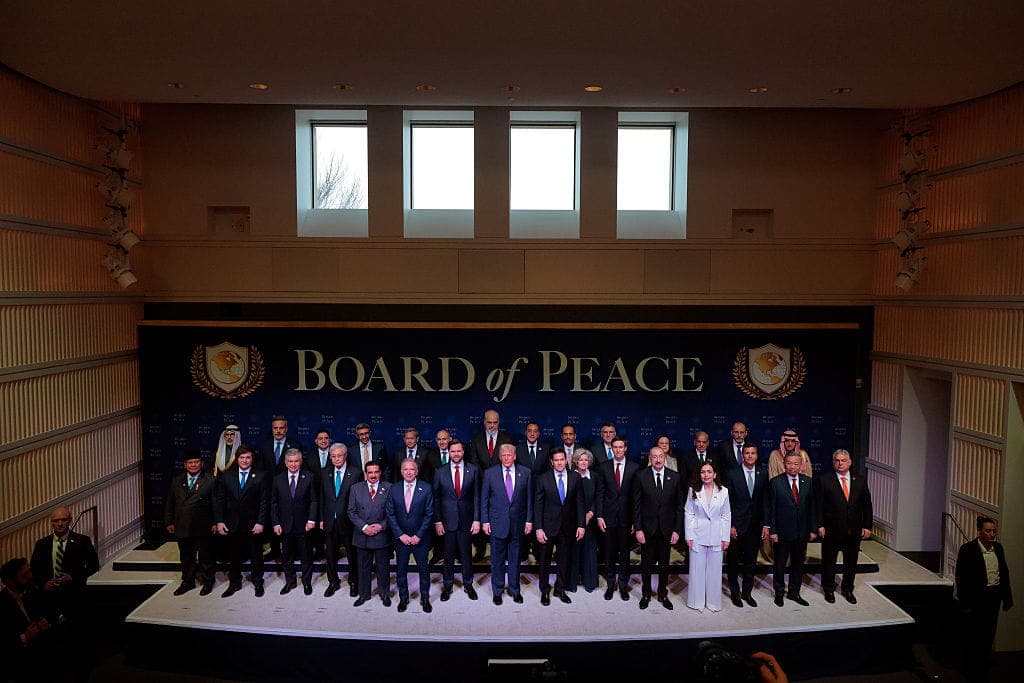

President Donald Trump held his first official Board of Peace meeting Thursday, and – for better or worse – the world had feelings. Leaders from nearly 50 countries attended the inaugural event on February 19 at the recently renamed Donald J. Trump U.S. Institute of Peace, with 27 nations already joining the board.
Worldwide reactions ranged from praise to skepticism and on into outrage. A lot of money and manpower were promised to rebuild Gaza, but criticism abounded among those who felt the UN was the only arbiter of peace or that there should be more Palestinian input into the process.
International Board of Peace, Trump Institute of Peace
The president revealed the name change at Thursday’s meeting, saying Secretary of State Marco Rubio had ordered the State Department to rename the U.S. Institute of Peace to include Trump’s name. “Marco named it after me,” he said, adding that it was a surprise.
The change, including one other, has been challenged in court and remains in litigation. The USIP was created as an independent entity by Congress in 1984, but the Trump administration seized it last year and fired most of its employees. For the last 35 years, its mission has been to resolve conflicts around the world without violence by facilitating dialogue in conflict zones and training peacebuilders.
From Liberty Nation News, Trivia, Facts, Check Us Out
Stay informed.
Today’s news, the Constitution and American history, written for young readers.
Visit GenerationLiberty.com
News, Trivia, Facts, Check Us Out
Stay informed.
Today’s news, the Constitution and American history, written for young readers.
Visit GenerationLiberty.com
In any case, the president’s new plan for the institute is much the same, but now it is open to the world – and not just national leaders.
Albania, Argentina, Armenia, Azerbaijan, Bahrain, Bulgaria, Cambodia, Egypt, El Salvador, Hungary, Indonesia, Israel, Jordan, Kazakhstan, Kosovo, Kuwait, Mongolia, Morocco, Pakistan, Paraguay, Qatar, Saudi Arabia, Turkey, United Arab Emirates, Uzbekistan, and Vietnam are the nations that have partnered with the US so far. Almost two dozen more sent observers, but remain either on the fence or won’t be joining at all.
President Trump pledged $10 billion to the Board of Peace on America’s behalf – though he did not specify where the funds would come from or what they would be used for – and a group of nine other countries promised to contribute a combined $7 billion to a Gaza relief package.
The Board of Peace also includes non-government actors. Billionaire investor Marc Rowan is a member of the executive committee. He said at the meeting that rebuilding would begin in the city of Rafah, near Egypt. 100,000 homes for 500,000 people – about 25% of Gaza’s population – are currently being planned, along with another $5 billion in infrastructure. Eventually, he hopes to scale that up to 400,000 homes for the entirety of the population and $30 billion in infrastructure projects.
FIFA President Gianni Infantino was there, as well, to outline his commitment to building a $50 million national football stadium in Gaza that would hold between 20,000 and 25,000 visitors in addition to a FIFA academy that would cost $15 million. The organization also promised 50 “FIFA arena mini pitches” and five full-sized pitches for another $7.5 million. “We don’t have to rebuild houses or schools or hospitals or roads,” Infantino said. “We also have to rebuild and build people, emotions, hope and trust. And this is what football, my sport, is about.”
For many, the sports complexes may seem frivolous to a project devoted to rebuilding homes, hospitals, roads, and schools. But each of those establishments also means jobs for locals – and maybe it really can help to “rebuild people, emotions, hope and trust.”
That’s the plan to rebuild infrastructure, but there would also be a “stabilization force” made up of international partners. Major General Jasper Jeffers, the leader of this newly created force, announced on Thursday that Indonesia, Morocco, Kazakhstan, Kosovo, and Albania have all pledged troops to the force. Egypt and Jordan, which both border the Gaza Strip, agreed to train police and security forces. In total, the stabilization force will include 12,000 police and 20,000 soldiers. “With these first steps, we help bring the security that Gaza needs for a future of prosperity and enduring peace,” Gen. Jeffers said.
UN and Palestine – Because There’s Just No Pleasing Everyone
The Board of Peace has been panned by those who oppose it for numerous reasons. For one thing, Trump invited Russia to the table. The Kremlin isn’t playing ball – but just the fact that he reached out is enough to enrage some. As well, the plan doesn’t seem to have enough Palestinian representation for others. “It’s a colonialist operation: others deciding for the Palestinians,” Cardinal Pierbattista Pizzaballa, the Latin Patriarch of Jerusalem, told Italian Newspaper Il Sole 24 Ore. Palestinian President Mahmoud Abbas’ adviser, Mahmoud Al-Habbash, called the Board of Peace a “temporary arrangement” that the “Palestinian leadership rejects under any circumstances,” according to Arabic outlet Asharq Al-Awsat.
Perhaps the biggest criticism, however, has been that it undermines the UN. The president’s invitation to the Vatican, for example, was rejected because Pope Leo XIV said “the U.N. is primarily responsible for managing these crisis situations.” Some key American allies felt the same, including the U.K., France, Norway, and Sweden.
But how has that been working out for the world? Russia and Ukraine are still at war, Israel and Hamas continue to fight, and China remains on the verge of invading Taiwan. How much has the UN accomplished on any of those fronts? As well, one cannot ignore President Trump’s deal-making abilities or his proven track record so far in other peace dealings – even if a resolution to those three still eludes him.
The Trump administration fired back, though. “This president has a very bold and ambitious plan and vision to rebuild and reconstruct Gaza, which is well underway because of the Board of Peace,” White House Press Secretary Karoline Leavitt explained on Wednesday. “This is a legitimate organization where there are tens of member countries from around the world.”
President Trump agreed the UN should have been more involved in conflict-solving around the world – but pointed out that it hasn’t. He hinted Thursday that the US will be “working with the United Nations very close,” and that there would be changes to the international body.

“Someday I won’t be here,” he explained. “The United Nations will be, I think, is going to much stronger. The Board of Peace is gonna almost be looking over the United Nations, and making sure it runs properly.” He closed out the meeting with a promise to bring the UN “back to health.”
Mike Waltz, US ambassador to the UN, said the board isn’t talking, it’s doing. “We are hearing the chattering class criticizing the structure of the board, that it’s unconventional, that it’s unprecedented,” he said. “Again, the old ways were not working.”
The president’s words are, perhaps, the most succinct way of describing the UN’s failure over the years: “The United Nations has great potential. They haven’t lived up to the potential.” One wonders if those opposed to the Board of Peace really think it’ll undermine the UN – or simply show how useless it has become.


.jpg%20noncitizen%20voting&w=1920&q=75)
.jpg%20Hillary%20Clinton&w=1920&q=75)