


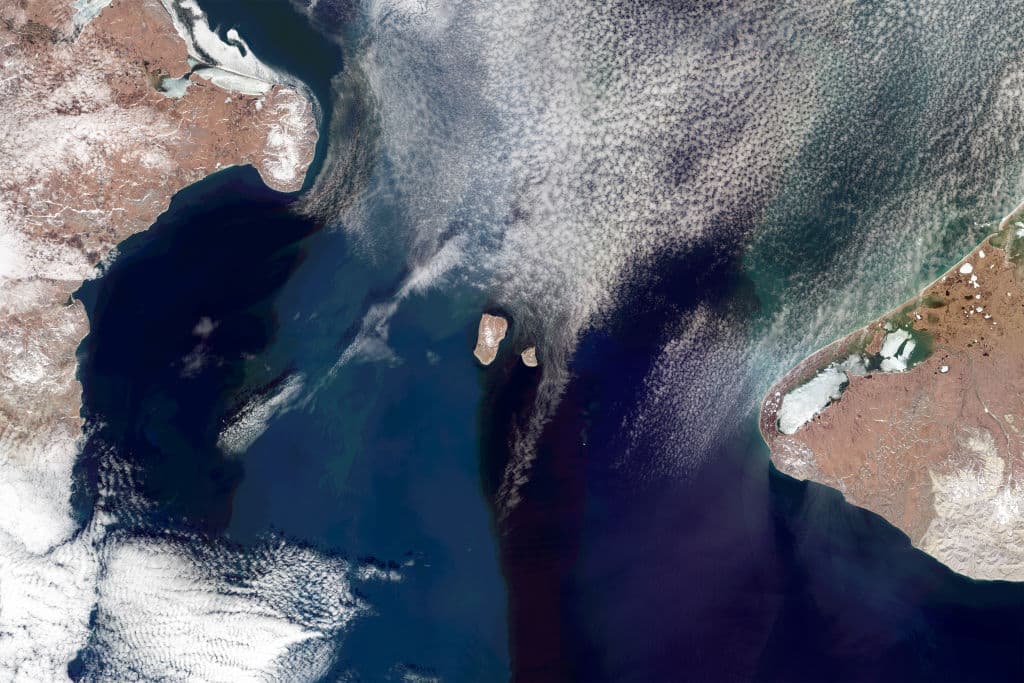

Ever thought about packing up the family and taking a Sunday afternoon train ride to Russia? Sound impossible? Well, not if Russian special envoy Kirill Dmitriev’s proposed Bering Strait tunnel becomes a reality. He alone seems convinced that it is possible, even though it would be a monumental undertaking. It would be twice the length of the Channel Tunnel linking Great Britain with France. Furthermore, construction would take place in an environment as harsh as any on Earth.
Tunnel to Russia Complicated
It seems odd that in the midst of Russia’s unprovoked invasion of Ukraine and the carnage that has resulted over the past four years, a prominent Russian would be talking about such a project. However, Dmitriev believes the timing is right because the geopolitical and economic issues are manifest. Not the least of which, should the United States enter into such an endeavor with Russia, it would signal a normalization of relations, which could easily be interpreted as rewarding Moscow for its devastating aggression against Ukraine. It would certainly portray the United States as at cross purposes with Western partners and allies that are sanctioning Russia and providing billions in support to allow Ukraine to keep up the good fight.
In October 2025, when the idea was raised, according to a CNBC Instagram post, “President Donald Trump said Friday [Oct. 17] that a Russian proposal for Elon Musk and his tunneling business, the Boring Company, to build an undersea rail tunnel through the Bering Strait was ‘interesting’ and he’d have to think about it.” In the same posting, as might well be expected, CNBC reported, “Ukrainian President Volodymyr Zelenskyy said he was ‘not happy’ with the idea following Trump’s response.” Clearly, embarking on such a project while intense fighting is underway in Ukraine would be complicated.

The proposal specifies two main parallel rail tunnels with a service tunnel between them. According to InterBering, LLC, a private Alaska-based company formed to promote and lobby for the Bering Strait tunnel, the rail line would go from Ulen on the Chukotka Peninsula in Russia to Cape Prince of Wales on the Seward Peninsula in Alaska near Nome. However, the project also includes building a rail system through Alaska, Canada, and into the United States, where none exists today.
Linking Russia to the United States via Alaska would benefit both countries economically. For Russia, it would provide greater access to North American markets, with some estimates that a rail and tunnel complex “could carry about 3% of global freight and make about $7 billion a year,” according to an NBC News report. Moving cargo by rail would be less costly, faster, and safer than oceangoing container ships. For the United States, many of the same benefits would result from reducing the length of the trade routes from Asia to North America.
From Liberty Nation News, Trivia, Facts, Check Us Out
Stay informed.
Today’s news, the Constitution and American history, written for young readers.
Visit GenerationLiberty.com
News, Trivia, Facts, Check Us Out
Stay informed.
Today’s news, the Constitution and American history, written for young readers.
Visit GenerationLiberty.com
Musk’s equipment can build “at a speed of 1 mile per week,” according to the Boring Company’s information brochure, which estimates that it would reduce the cost of the nearly 70-mile-long tunnel from more than $65 billion to Dmitriev’s wildly optimistic $8 billion. Costs would likely be subject to an increase, and Musk has not commented on the project.
Along with the downside of geopolitical problems and the upside of economic advantages, the tunnel faces geological and environmental hurdles. Extreme Arctic conditions, including subzero temperatures, permafrost, ice, and earthquakes, present difficult-to-overcome challenges. According to Wikipedia, an offshore fault zone in the Bering Strait region is associated with significant seismic activity, a major problem for tunnel construction and maintenance.
Tunnel Is Wishful Thinking
As it stands, the project is aspirational, with the most, if not the only, enthusiastic advocates residing in Moscow. It seems unlikely that any tunnel will be built as long as Russian President Vladimir Putin is unwilling to enter into serious peace talks with Ukraine. Nonetheless, in the “hope springs eternal” department, Newsbreak reported that Dmitriev announced on June 4 at the St. Petersburg International Economic Forum that a tunnel would be built. He told the Russian news outlet TV Zvezda, “As for the tunnel, we will have news tomorrow; we are signing an agreement that we will continue the design of the tunnel. There will be a tunnel.”
Reports indicate that there is no agreement between the US and the Russian government, just an internal document that indicates continuing design work. According to the Russian news outlet TASS, “US presidential envoy Steve Witkoff and the US president's son-in-law Jared Kushner are aware of the Bering Strait tunnel project,” but no US government official is endorsing the scheme. America has bigger fish to fry.
~
The views expressed are those of the author and not of any other affiliate.


.jpg&w=1920&q=75)