

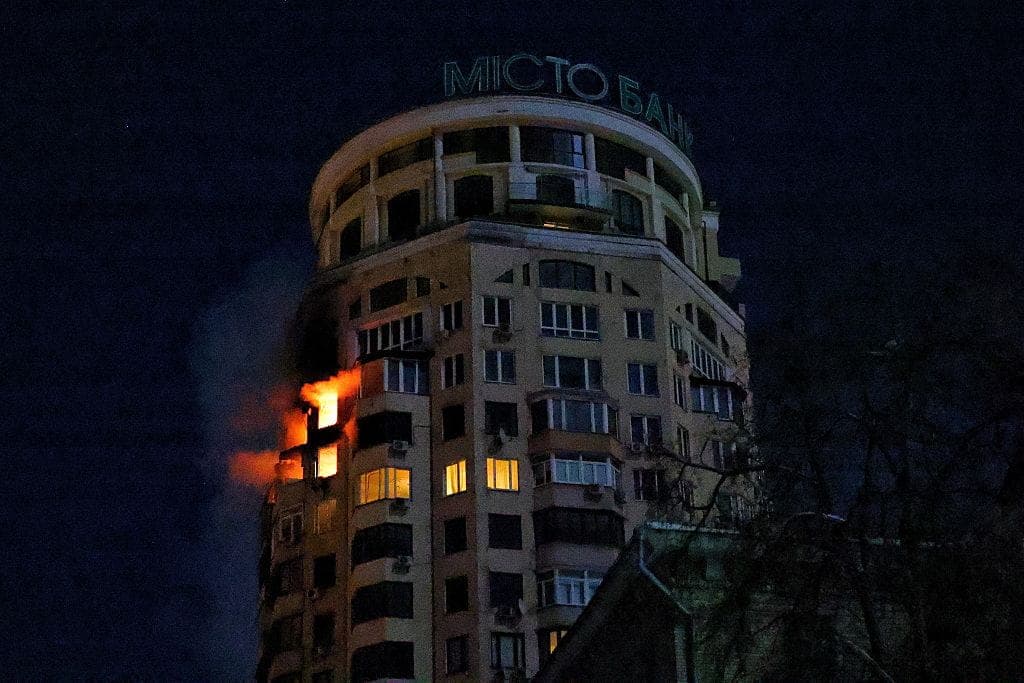
Abu Dhabi in the United Arab Emirates was the site of the second round of the US, Russia, and Ukraine trilateral talks on achieving peace in the nearly four-year-old Ukraine war. The two-day meeting began on February 4 and concluded on the 5th. Though day one was lauded as productive, talks came after a devastating Russian air attack on Ukraine’s energy infrastructure, leaving many Ukrainians at the mercy of frigid weather with no heat. The intensity of the air strike no doubt colored the Ukrainian negotiators’ approach to the talks.
Members of the US delegation included Special Envoy Steve Witkoff, President Trump’s son-in-law, Jared Kushner, the Secretary of the Army Daniel Driscoll, and General Alexus Grynkewich, Commander of US European Command. The Ukrainian negotiators were led by Rustem Umerov, Secretary of Ukraine’s National Security and Defense Council, accompanied by Kyrylo Budanov, head of Ukrainian President Zelensky’s presidential office, and Andrii Hnatov, the chief of the Ukrainian General Staff. The Russians attending the meeting were Igor Kostyukov, Director of the GRU military intelligence service, and Kirill Dmitriev, Moscow’s investment envoy.
As the carnage in Ukraine rapidly enters its fifth year, there is a greater sense of urgency to achieve peace. Russia’s momentum in the pitched battles for territory has become glacial, gaining, by some reports, no more than 70 yards a day at a horrific cost. A January 27 report published by the Center for Strategic and International Studies (CSIS) observed:
“Despite claims of battlefield momentum in Ukraine, the data shows that Russia is paying an extraordinary price for minimal gains and is in decline as a major power. Since February 2022, Russian forces have suffered nearly 1.2 million casualties, more losses than any major power in any war since World War II. At current rates, combined Russian and Ukrainian casualties could reach 2 million by the spring of 2026.”
Despite the extraordinary losses on both sides, there have been no significant breakthroughs in the talks. An encouraging outcome from the US-brokered peace discussions, however, was a prisoner of war exchange where 157 prisoners from each side were repatriated. It was the first such prisoner swap in nearly six months. According to ABC News, the exchanged Russian troops “were released into Belarus – which has provided extensive support for Moscow’s invasion of Ukraine.” Of the Ukrainian prisoners freed, 139 had been in captivity since 2022.
In an X post after the meetings, Special Envoy Witkoff, who led the US delegation, provided a more detailed explanation of the two-day discussions. He characterized the talks as “constructive and focused on how to create the conditions for a durable peace.” Additionally, the negotiations produce an agreement to re-establish a “military-to-military dialogue to be led by General Alexus Grynkewich, commander of US European Command. This channel of communication was suspended prior to the onset of this conflict and is crucial to achieving and maintaining peace.”
The discussions covered a wide range of topics, with “remaining open issues including methods to implement a ceasefire and monitor the cessations of military activities.” The negotiating teams agreed to “continue trilateral discussions in the coming weeks.” Two of the continuing issues that have been sticking points in the past and not mentioned in Witkoff’s X post were Russia’s insistence that Ukraine turn over portions of the Donbas region where Russians do not occupy territory, and provisions for Ukraine’s security following the end of hostilities. Moscow’s forces have been trying to capture the Western Donbas since the invasion began and have been unable to do so. The Ukrainian forces have put up a strong defense, losing thousands of soldiers, so it’s not likely that Ukrainian officials will concede that portion of the Donbas territory.
Except for the prisoner exchange, it’s not clear that the Russian position has changed. Russian President Putin appears willing to let the fighting continue, believing his soldiers will move forward, putting him in a better negotiating position. Putin has made no concessions. So far, that tactic has not done much besides cost the lives of Russian and Ukrainian soldiers. President Zelensky has no appetite for surrendering hard-fought-for sovereign territory. The fact that talks will continue is one ray of light.
~
The views expressed are those of the author and not of any other affiliate.
.png&w=1920&q=75)