
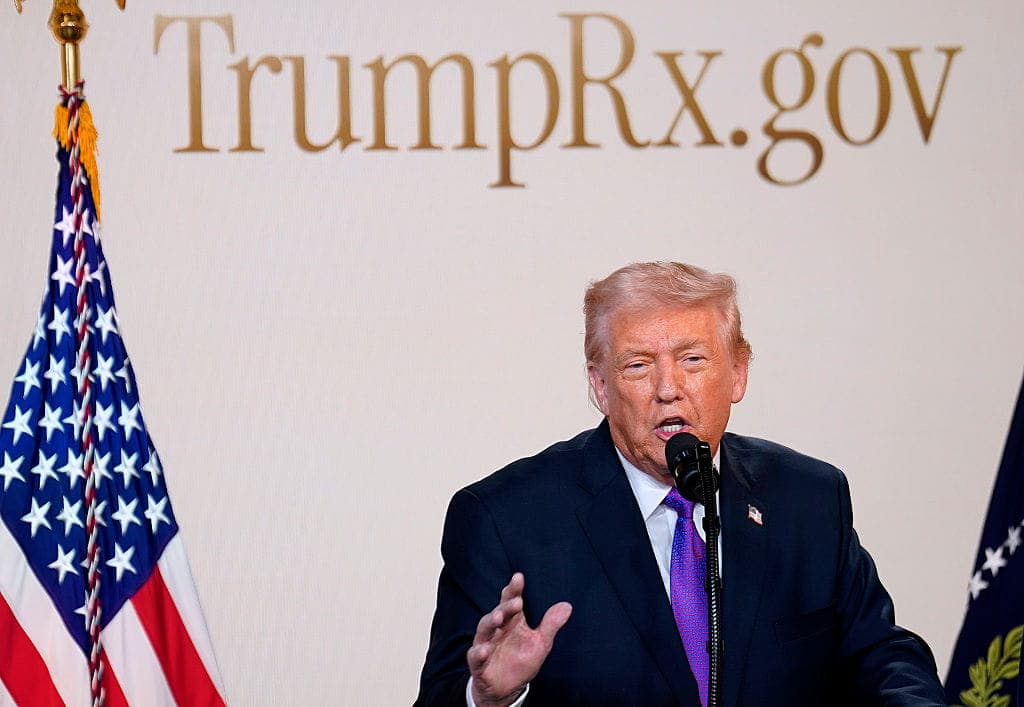
The much-ballyhooed TrumpRx website is live – and at first glance, the savings seem just as significant as President Donald Trump promised they would be. Can it stand up to scrutiny, though? After a thorough investigation into the actual numbers, will the savings still seem so impressive?
President Trump announced his TrumpRx initiative back in September of 2025, promising to create a “direct-to-consumer” platform to lower drug prices by partnering with manufacturers directly. Now that has come to fruition – though consumers can’t buy drugs directly from the new site. Instead, it lists nearly four dozen drugs with steep discounts off their cash prices and offers coupons that can be printed and taken into participating pharmacies – which, of course, are conveniently listed on each drug’s specific offer page.
Near the top of the landing page, the new TrumpRx site claims: “America was being overcharged for medicine. The same drugs made in the same factories, at the same dosages, are costing Americans up to 1000% more than in any other country. This is unacceptable.” Is there any truth to this, and will Americans see real savings under this new program? The math is impressive.
The site highlights Gonal-FU, a common fertility drug prescribed as an injectable, using the 450IU (International Units) per pen dose. TrumpRx claims this costs Americans $1,449 a dose. Shopping around for the drug, both in the US and in Canada, reveals the truth. The actual price is a range – which does include Trump’s number – from $1,130 to more than $1,500, depending largely on location. Liberty Nation depends on the support of our readers. Donate now!
In Canada, the site claims, this same pen would only cost $355. The real listings range from $425 and $543, Canadian – which is about $318 to $398 USD. Again, the administration’s numbers certainly fall in that range. What’s truly impressive, however, if it actually pans out, is that under TrumpRx, this same 450IU pen would only cost $252. That’s 93% off – favored nation status, indeed!
Other medications listed on the homepage are the Wegovy pill, from $1,349 to $149 a month (a savings of 88.9%); the Wegovy pen, from $1349 to $199 a month (85.25%); Ozempic from $1,028 to $199 a month (80.64%); and Zepbound, from $1,087 to $299 a month (72.49%). Big numbers – but without the same international comparison, so let’s add that back in. In Canada, the following drugs cost (adjusted from CAD to USD): between $280 and $300 for the Wegovy pill, $540 and $570 for the pen, $200 and $300 for Ozempic, and $215 and $300 for Zepbound. So, depending on where you are in Canada, you might still get a better deal on a couple of them – but the new lower prices still mark a significant savings over what Americans were paying.
While we’re nowhere near correcting the alleged 1,000% overcharge – and surely no one really expects to ever get a $1,000 medication for a buck a dose – savings between 70% and more than 90% are quite impressive. While the rest of the drugs listed in the program – of which there are many – aren’t discounted quite as much as those on the front page, an average of 50% to 60% off certainly still isn’t bad. The worst savings to be seen just browsing drugs was 33% off.
So, are the savings all they’re hyped up to be? Well, the numbers are presented in a way that might seem more advantageous than they really are for many Americans – but even at the worst ends of the price ranges, the savings carry a big impact. And rather than being funded by government subsidies – that is, the “hidden” cost of taxation – these are primarily deals negotiated directly between the Trump administration and individual pharmaceutical companies. Cash-paying Americans get Most Favored Nation pricing, while the compliant companies are exempted from tariffs.
But, of course, that tradeoff is simply unacceptable to some – like Democrats in Congress, for example. Sens. Dick Durbin (D-IL), Peter Welch (D-VT), and Elizabeth Warren (D-MA) went crying to the inspector general in hopes of killing the deals.
On January 29, the three signed a letter to Inspector General T. March Bell to “express concern with how the Department of Health and Human Services (HHS) Office of Inspector General (OIG) intends to conduct oversight of and apply the federal Anti-Kickback Statute to direct-to-consumer (DTC) prescription drug sales by manufacturers.”
“Last year, we released a report on an investigation of Eli Lilly’s and Pfizer’s DTC platforms, and their use of hand-picked telehealth companies to steer patients toward their own specific, high-cost medications,” the senators wrote. Indeed, that is a danger of ignoring the anti-kickback rules.
Allowing such behavior does tend to lead to inflated prices and overprescription – but one must wonder if the old way of doing things is really all that much better? Multiple studies show that many drugs are frequently overprescribed. And while insurance companies often negotiate a better deal than the cash price – including, in some cases, greater discounts than even those listed on TrumpRx – the consumer is still either paying a monthly premium that has to be factored into that cost or is being covered by the taxpayers. And while many of the more left-leaning, anti-Trump news outlets question the actual savings, they’re also reporting the benefits to cash customers, both in savings and exposure to other options. TrumpRx may not be a magic elixir to cure all that ails us, medically or economically, but – so far – it still seems a step in the right direction.


.png&w=1920&q=75)