
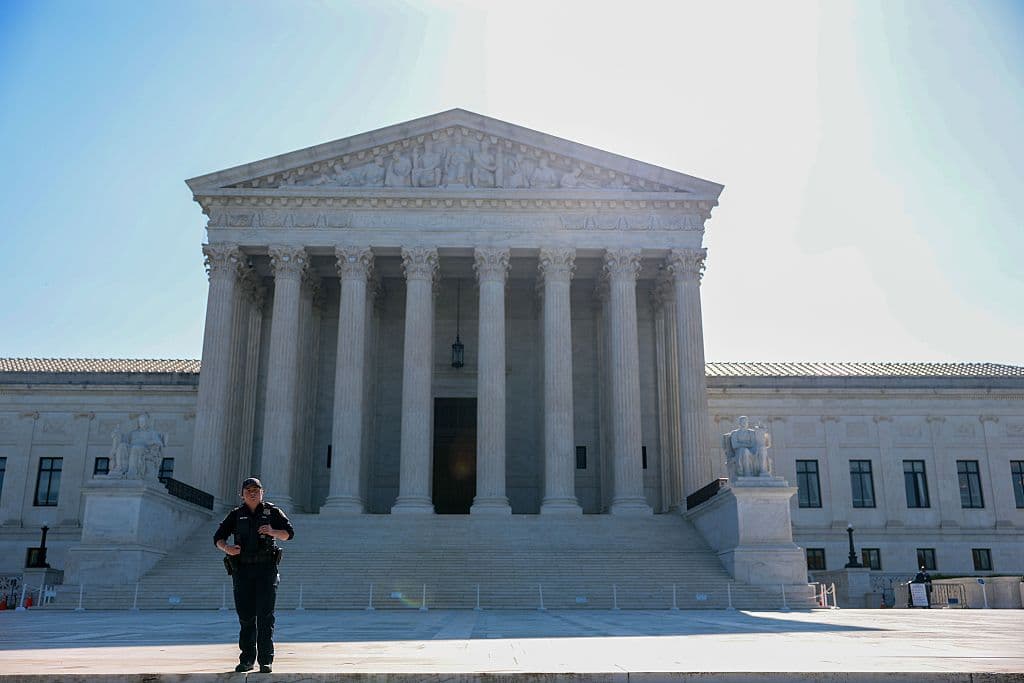

The Supreme Court is nearing the end of its 2025-2026 term and will issue decisions in a handful of cases from now through June. No oral arguments remain; all that's left is to write and announce the opinions. We'll hear rulings on several big cases, from immigration and guns to mail-in ballots and birthright citizenship. Some outcomes could have widespread implications, while others could affect the president’s agenda and the future of executive authority.
The Supreme Court Tackles Election Day Deadlines
In Watson v. Republican National Committee, a case that could have significant ramifications for the 2026 elections and beyond, the Supreme Court will decide whether election officials can accept mail-in ballots that are postmarked by Election Day but arrive up to five business days later, a practice that Mississippi lawmakers allowed during the pandemic in 2020. Republican leaders challenged the rule, arguing that federal law requires all ballots to be received by Election Day.
As the media often points out when referring to this case, the Constitution says that “the Times, Places and Manner of holding Elections for Senators and Representatives, shall be prescribed in each State by the Legislature thereof; but the Congress may at any time by Law make or alter such Regulations.” But the justices “are not focused on the elections clause as much as federal law,” explained Liberty Nation News’ Legal Affairs Editor Scott Cosenza, Esq. “All sides seem to agree that Congress does rightfully possess the power to regulate and govern these questions. The issue is whether they have.”
If the court strikes down the Mississippi law, it could impact more than a dozen other states with similar mandates and potentially reshape mail-in voting nationwide.
Birthright Citizenship
On his first day back in the White House, President Donald Trump signed an executive order to end birthright citizenship, meaning children born to illegal immigrants in the United States would not be automatically considered citizens, and neither would those born to immigrants who are living in the country legally but temporarily. In Trump v. Barbara, the justices will decide whether the executive order is constitutional.
Much of this case hinges on one sentence in the 14th Amendment: “All persons born or naturalized in the United States, and subject to the jurisdiction thereof, are citizens of the United States and of the State wherein they reside.” As Liberty Nation News’ John Klar put it, “The justices are tasked with interpreting and applying a vague, longstanding legal principle that has not aged well in an effort to address modern illegal immigration threats.”
Birthright citizenship has existed since the Reconstruction amendments, passed after the Civil War. The 14th Amendment was primarily meant to grant citizenship to freed slaves. We now live in very different times. The opinion in this case could redefine what it means to be an American.
Executive Authority
The first case here stems from the president’s firing of FTC Commissioner Rebecca Slaughter. The Supreme Court must decide whether to overrule a 1935 precedent that forbids the president from firing the FTC commissioner except for “inefficiency, neglect of duty, or malfeasance in office.”
The question in Trump v. Slaughter boils down to “Can the president fire any member of the executive branch he wants for any reason, or are some positions protected from his wrath?” explained Liberty Nation News’ Editor-at-Large James Fite in December 2025. “Mrs. Slaughter’s argument is that federal law forbids it, so it’s illegal. Trump’s argument is that any federal law prohibiting presidential action is unconstitutional and runs afoul of the separation of powers established by the Founders.” A ruling in Trump’s favor could expand presidential authority over independent agencies.
Next, the case of Trump v. Cook asks whether Trump’s attempt to fire Lisa Cook, a member of the Federal Reserve Board of Governors, satisfies the “for cause” requirement under federal law. The president terminated Cook over allegations that she committed mortgage fraud, which he said, “[a]t a minimum … exhibits the sort of gross negligence in financial transactions that calls into question [her] competence and trustworthiness as a financial regulator.” This case will determine how much control the president has over the Fed.
Gun Rights
Two decisions remain in which the justices will have to clarify the test that the majority set out in 2022 in New York State Rifle & Pistol Association v. Bruen, which expanded the right to carry firearms in public for self-defense.
In United States v. Hemani, the justices will decide whether a federal law that prohibits illegal drug users from having guns violates the Second Amendment. In Wolford v. Lopez, the justices will rule on whether Hawaii violated the Second Amendment when it told gun owners that they must obtain advance permission from property owners to carry weapons on private property that is generally open to the public.
The test that the Supreme Court outlined in Bruen explained that, in order to justify a regulation, the government must demonstrate that “it is consistent with the Nation’s historical tradition of firearm regulation. Only then may a court conclude that the individual’s conduct falls outside the Second Amendment’s unqualified command.” The decisions in these two cases could help clarify how to evaluate the constitutionality of gun regulations.
Immigration
The first case awaiting a decision here is Mullin v. Al Otro Lado, in which the Court is reviewing whether asylum seekers who appear at the US border can be lawfully turned away or whether immigration officials must inspect and refer them for processing. The policy to deny asylum claims at the border was in effect during Barack Obama’s administration and Trump’s first term, but Joe Biden’s administration stopped the practice, which the current administration reversed, claiming it is critical for managing the southern border.
Second, in Mullin v. Doe, the justices will examine the president’s efforts to remove the temporary protected status (TPS) of Syrian and Haitian nationals. The TPS program allows qualifying foreigners from certain troubled nations to live and work legally in the United States, but the president has moved to end the program as part of his immigration crackdown.
Transgender Athletes
The question in Little v. Hecox is “whether laws that seek to protect women's and girls’ sports by limiting participation to women and girls based on sex violate the Equal Protection Clause of the Fourteenth Amendment.” In West Virginia v. B.J.P., the Court must decide “whether Title IX prevents a state from consistently designating girls’ and boys’ sports teams based on biological sex determined at birth.”
The Supreme Court heard oral arguments for these cases in January; their outcomes will likely ripple across 25 other states with similar laws for athletes who compete in school and collegiate sports.
Final Word
The coming weeks will bring answers to these hot-button topics, some of the most contested legal questions since the start of Trump’s second term. The impact of the opinions will stretch far beyond 2026, shaping policy, politics, and executive power.
Dig Deeper Into the Themes Discussed in This Article!
Liberty Vault: The Constitution of the United States
Liberty Vault: The most significant Supreme Court cases

.jpg&w=1920&q=75)
.jpg&w=1920&q=75)