

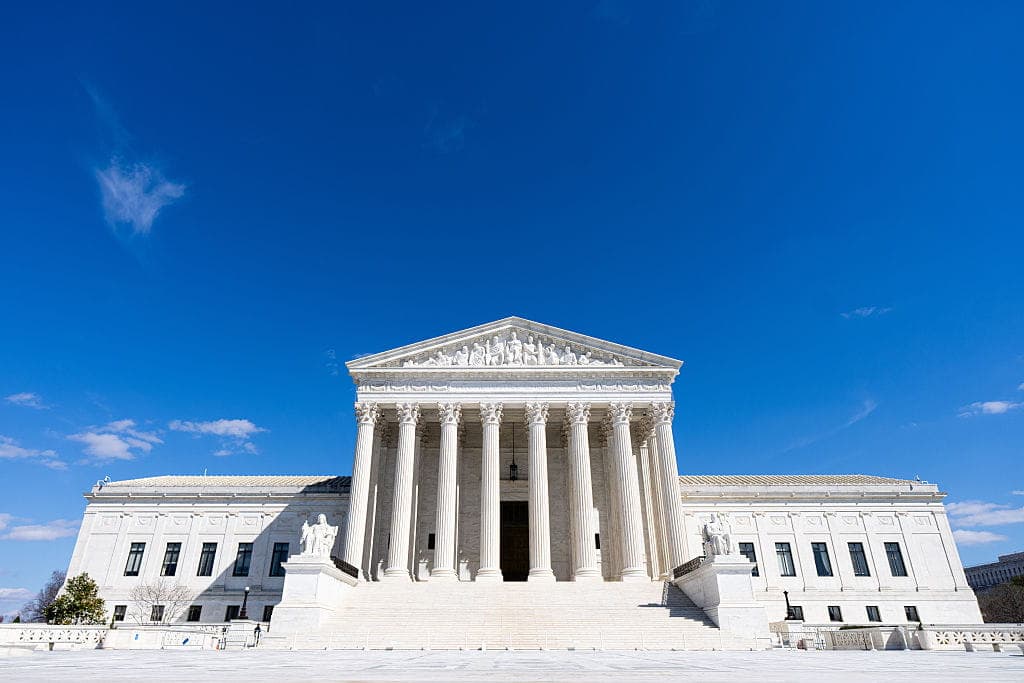

The Supreme Court heard oral arguments on Monday, March 23, regarding mail-in ballots and the deadlines – if any – that should be imposed on their acceptance. The case rests on whether ballots received after Election Day should or can be counted. Naturally, the ultimate ruling in this case will have major ramifications politically, but would it really make a difference electorally?
The question before the court in Watson v. Republican National Committee is whether federal statutes establishing Election Day in November preempt state laws that allow ballots to be counted if they are received after that day. We spoke with Liberty Nation News’ Legal Affairs Editor Scott Cosenza Esq. to examine what the court said, did, and hinted.
Supreme Court Back to Basics
Mark Angelides: In this case in Mississippi, if the justices rule in favor of those challenging the state, this wouldn’t be overturning decades of precedent, would it? Wasn’t this allowance introduced as a response to COVID-19? Which brings me to a follow-up: What is the justification for a state to continue applying and following COVID-era rules?
Scott Cosenza: The Court will be establishing a new precedent with this case, not overturning one. That is, of course, if they choose to rule on the merits. Often, justices avoid such rulings to avoid downstream consequences, something that could be true here. Mississippians did enact this law in response to COVID-19 in 2020. There is no justification needed or required to sustain a law – even if passed to alleviate a temporary issue. This law did not include a sunset provision limiting its duration, and it will persist until the Mississippi legislature makes changes or a court does.
Mark: Let’s dig a little into the constitutional aspects, Scott. The “Election Clause,” Article I, Section 4, Clause 1, states that:
“The Times, Places and Manner of holding Elections for Senators and Representatives, shall be prescribed in each State by the Legislature thereof; but the Congress may at any time by Law make or alter such Regulations, except as to the Places of chusing Senators.”
This is the quote being cited by the media, reiterating that the main aspects of a US congressional election are determined by the individual states. What were those suing arguing?
Scott: They are not focused on the elections clause as much as federal law. All sides seem to agree that Congress does rightfully possess the power to regulate and govern these questions. The issue is whether they have. That is, about preemption, a principle derived from the Supremacy Clause, establishing supremacy of federal law over state or local laws. Our Constitutional jurisprudence says Congress may preempt by expressly forbidding other laws, but that is not required. Did Congress preempt state actors from accepting ballots after the second Tuesday in November by establishing it as Election Day in federal law? That’s what the Court is wrestling with.
Mark: And how did the justices take this? Did it seem like there was a divide between the more conservative and liberal ends of the bench?
Scott: Yes, Mark – no surprises here. We seem to have a three-way split along familiar fault lines. That means a bloc of four conservatives, Justices Clarence Thomas, Samuel Alito, Neil Gorsuch, and Brett Kavanaugh. Then there are the three left-wingers: Justices Sonia Sotomayor, Elena Kagan, and Ketanji Brown Jackson. Finally, we have the newish two-member swing section of Chief Justice John Roberts and Amy Coney Barrett. The conservatives are poised to rule that the Mississippi law is invalid. The left bloc signaled they would uphold the law, and the swing votes, well, we’ll see.
Mark: It seems to me that, while the states can choose how to run the elections, there is absolutely a federal element involved in the collation and collection of votes. Just to run a hypothetical scenario: If mail-in ballots can be counted at any point (presuming they are postmarked no later than Election Day), then it’s theoretically possible that an election can never be fully decided – at least until it lands on Congress’ doorstep, right? Didn’t Justice Alito make a point on this?
Scott: Yes, Justice Alito drilled down on this point. He was rebuffed by Justice Jackson, however, who brought up current federal laws. She said laws incorporating the counting of late-arriving ballots cast by military personnel serving abroad show Congress knew about this practice and did not object.
Election Season Ahead?
Mark: While it’s never wise to try to guess the outcome in advance, can we assume that this will be decided sooner rather than later? And were any strong signals sent from the bench?
Scott: Justice Kavanaugh and Paul Clement – the lead attorney for the challengers – had an exchange right on point to your question. Kavanaugh asked him if there would be trouble if they issued a ruling in June? Clement said no, reminding the Court that this issue does not involve primaries, only general elections, and that June was far enough away from the federal election to institute any required changes pursuant to a ruling in the case.
Mark: So, if the Court rules in favor of the plaintiff, what will the immediate impact be in Mississippi and other states that have similar laws on the books? And more importantly, will we finally stop media pundits telling us the “results of this election might not be known for weeks”?
Scott: Well, sadly, no, to your last question. At least, it is not at all likely. The Court will probably not touch any question about how long counting may go on. They do seem poised to prevent the counting of any ballots received after Election Day, though. I’m sure our representatives in Congress will get together and hash out a sensible solution.
Mark: Finally, Scott, I’m wondering about your political take on this. If mail-in ballots have to arrive by Election Day, how will this impact turnout, specifically based on the recent uptick in absentee voting? Do you think it would encourage people to actually turn up to vote? Following on from that, would that historically be of benefit to a particular party?
Scott: An MIT report from its Election Data & Science Lab, titled “How We Voted In 2024,” said, “Thirty-seven percent of Democrats reported voting by mail, compared to 24% of Republicans. This is a decrease from 60% for Democrats and 32% for Republicans in 2020.” Even with that massive drop-off, it follows that if you can suppress participation by mail generally, you will favor Republicans. Keep in mind that when this law was passed, there were Republican supermajorities in both houses of the Mississippi legislature, and a Republican in the governor’s mansion in Jackson.
Dig Deeper Into the Themes Discussed in This Article!
Liberty Vault: The Constitution of the United States

.jpg&w=1920&q=75)