


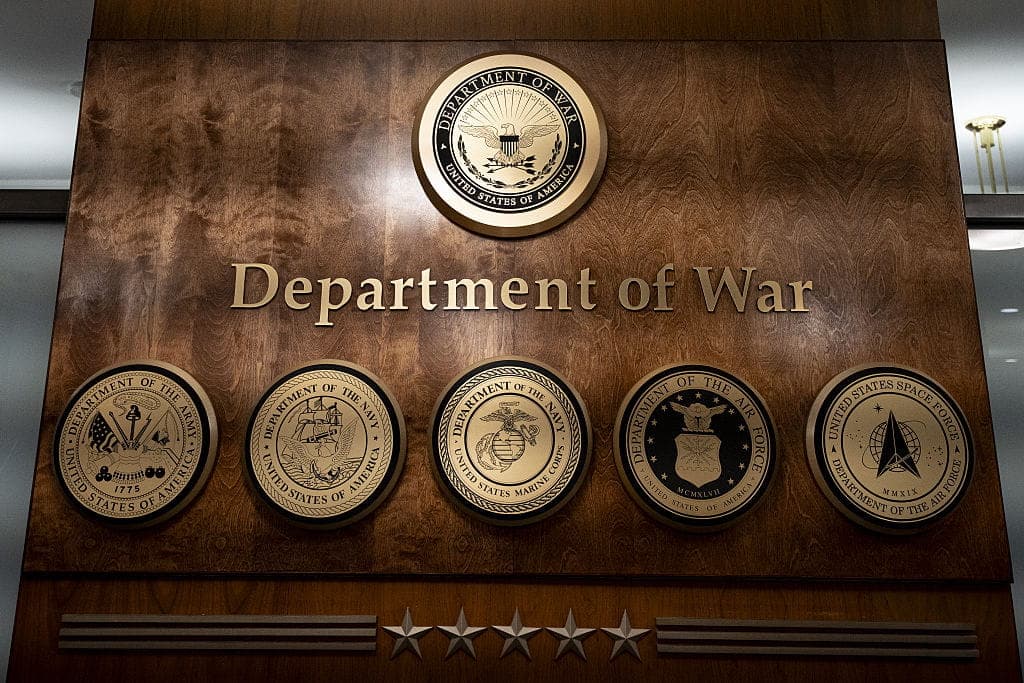

Past administrations have talked about the defense industrial base, but few have put money where the talk is. President Donald Trump’s FY2027 $1.5 trillion War Department budget request does that. According to the FY2027 Department of War Budget Overview Book, more than $100 billion is in the budget for “Supercharging America’s Defense Industrial Base.” Investments across the entire acquisition process are designed to “swiftly scale production, increasing capacity and flexibility, and rapidly fielding emerging technologies and new weapons so our warfighters can meet the challenges of the evolving nature of warfare.” Much of the investment will be in shipbuilding infrastructure.
The Expansion of US Industrial Base During World War II
The US industrial base during World War II is the gold-standard example for mobilizing all of America’s industrial production to meet wartime demands. According to statistics, by the end of the war, American industry had produced 296,000 combat, training, and transport aircraft. US heavy industry had manufactured between 100,000 and 109,000 light, medium, and heavy tanks, as well as an equal number of armored vehicles. Most impressive was the number of naval vessels built. American shipyards produced 99 aircraft carriers, eight battleships, 200 submarines, 350-400 destroyers, and 35,000 landing craft, including thousands of merchant vessels. West Coast shipyards produced 2,700 Liberty ships, and, at peak, several ships were launched per day.
These numbers show what the United States can do when it must. Looking at the world today and the quantity of arms being produced by China, the time has come when we must. China’s “People’s Liberation Army Navy (PLAN) commissioned more than 18 new warships last year,” including one aircraft carrier, Asian Military Review reported. Additionally, China’s four major shipyards “alone produced 39 warships” from 2019 to 2023, according to the BBC. Contrast that number with the eight to ten battle force ships the United States, on average, commissions annually. Americans for a Stronger Navy released data showing the US Navy was projected to commission only two ships in 2025, marking the steepest decline in naval shipbuilding in modern history.
Consistent with the latest National Defense Strategy document, the United States is investing in and expanding its defense industrial base to meet the challenge posed by China. At an April 21 Pentagon press briefing, performing the duties of Undersecretary of Defense and Chief Financial Officer Jay Hurst made the War Department’s FY2027 defense industrial base priorities very clear, explaining, “This is a generational investment in the United States military, the arsenal of freedom. This 42 percent increase will supercharge our defense industrial base by expanding production of major weapons systems, while strengthening supply chains and supporting tens of thousands of small- and medium-sized businesses.”
The FY2027 Department of War Budget Overview Book lays out the War Department’s intention to do the following:
“Rebuild Our Military by Supercharging America’s Defense Industrial Base – matching capabilities to threats, reforming our acquisition processes to swiftly scale production, increasing capacity and flexibility, and rapidly fielding emerging technologies and new weapons so our warfighters can meet the challenges of the evolving nature of warfare.”
To that end, the War Department is requesting more than $100 billion to invest in the defense industrial base. Those investments include $8.7 billion for the Submarine Industrial Base, including $1.8 billion for the Shipyard Infrastructure Optimization Program (SIOP). The SIOP will improve the US Navy’s sustainment funding to include enhancing its “organic maintenance capabilities and expanding shipyard capacity, optimizing shipyard configuration, and enabling the fulfillment of nuclear fleet maintenance requirements.”
To address critical shortages in essential minerals and domestic supply chains, the department has requested $48.8 billion to support “transformative investments in our Nation’s critical minerals industry.” Among the investments is $20.2 billion to fund the Office of Strategic Capital, whereby the War Department can use “federal credit tools” to motivate private investors to “invest along with the DoW [Department of War] in national security projects.”
Investments to Expand Weapons Production
Furthermore, investment in expanding weapons production, such as $102.2 billion for developing and fielding air power, addresses the growing China threat. Aircraft production and development, such as the F-15EX, F-35, and the newest air power development program, the sixth-generation jet fighter, the F-47, will drive the defense industrial base to expand capacity to meet the demand. Likewise, $87 billion is going toward sea power investments that include “new construction of 18 battle force fleet ships,” submarines, guided-missile destroyers, and numerous support vessels. Increasing production will correspondingly require investing in the manufacturing capability to field the weapon systems.
Clearly, the Trump administration wants to strengthen the defense industrial base to meet the threats America faces. Investing in a robust future weapons development and production capacity will spur the defense industry to grow. The $1.5 trillion defense budget request will go far in achieving this end, particularly in warship building.
~
The views expressed are those of the author and not of any other affiliate.



.jpg&w=1920&q=75)
.jpg&w=1920&q=75)