

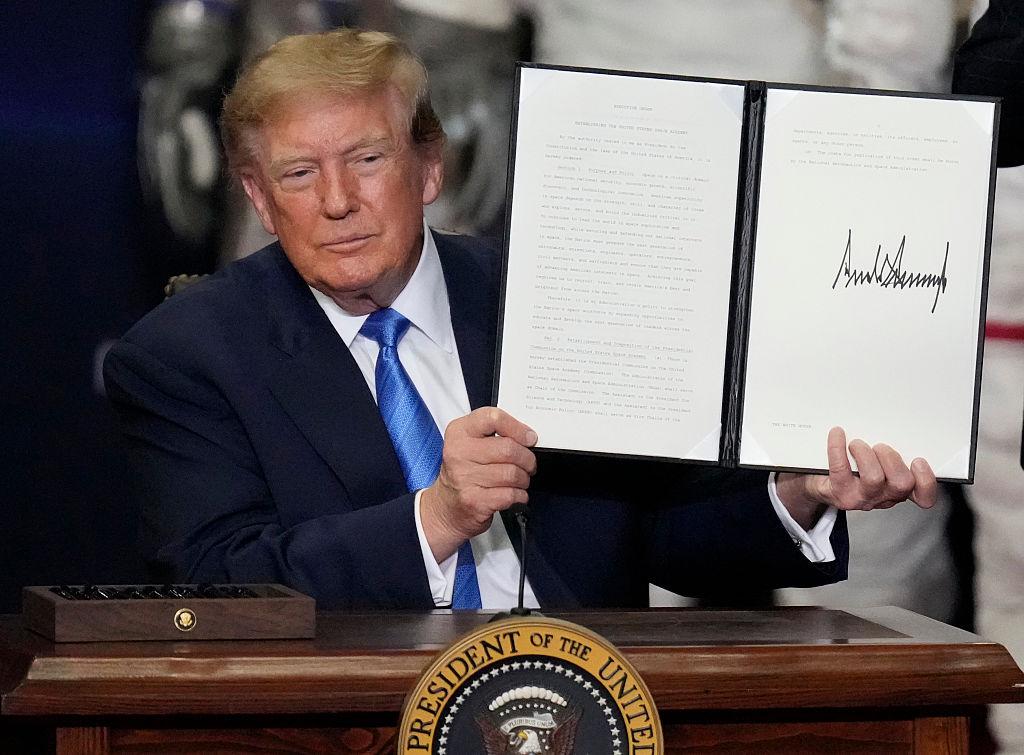

“I've got a pen and I've got a phone,” said then-President Barack Obama on Jan. 14, 2014. He went on, “And I can use that pen to sign executive orders and take executive actions and administrative actions that move the ball forward." He was talking about using executive orders (EO) to advance his agenda in the face of a Republican-controlled House of Representatives. At the time, Republicans criticized Obama for the comment, accusing his "imperial presidency" of trying to circumvent the legislative branch. Today, President Donald Trump, staring down his final two years in the White House with a Democrat-dominated Congress, will be taking up that pen and phone to advance his agenda and secure his legacy, but just how far will executive action get him?
Executive orders, as we know them today, are but one of several executive actions a president can take, the others being memoranda and proclamations. The State Department began assigning numbers to executive orders in 1907 but did so retroactively. Thus, Executive Order 1 dates to President Abraham Lincoln in 1862, establishing a provisional court in Louisiana — an occupied Confederate state at the time. Prior to that, however, American presidents, going back to George Washington, have used their Article II powers to issue various directives.
Still, the authority of presidents to issue executive orders is not explicitly granted in the Constitution, as the Congressional Research Service has observed.
Executive Orders by the Numbers
How many "unnumbered" executive orders had been issued prior to 1862 is in dispute since not all of them were officially recorded. And even the number of executive orders issued by each president since 1862 is open to debate. It all depends on which source one uses.
Additionally, no single president can be judged according to how many executive orders he issued. It often depended on how friendly the Congress of the time was toward that president. Trump, for example, has signed 513 executive orders in the roughly six total years he's been in the White House. By contrast, Joe Biden issued just 162 in four years and Barack Obama, 276, over his two terms.
The president who really stands out from the crowd is Franklin D. Roosevelt, arguably America's first truly progressive president, who issued more than 3,720 executive orders. These numbers come from the University of California, Santa Barbara's American Presidency Project, updated Nov. 21, 2026.
The official total of numbered executive orders currently stands at more than 14,435. In fact, the president recently signed No. 14438, which has set up a legal battle with congressional Democrats.
Trump vs. Democrats: The EO Battle Begins
With the Democratic Party set to command significant majorities in both the House of Representatives and the Senate come January 2027, President Trump has already signaled his intention to use executive orders as often as necessary. That said, a lot of what the current president would hope to achieve in his final two years centers around spending — but a president cannot authorize new spending by executive order. Neither can he use executive orders to override congressional legislation or, of course, to exceed his Article II authority.
Whatever executive orders Trump issues in the next two years, Democrats in Congress have two options: They can attempt to pass a law overriding an EO, but Trump can always veto that law. Or they can take the president to court and have the order struck down by a judge.
There is, of course, a third way, and that would be to get their presidential candidate elected in 2028. Then, as has often happened in the modern era, that Democrat president could, on day one, take executive actions that cancel any of Trump's executive orders.