

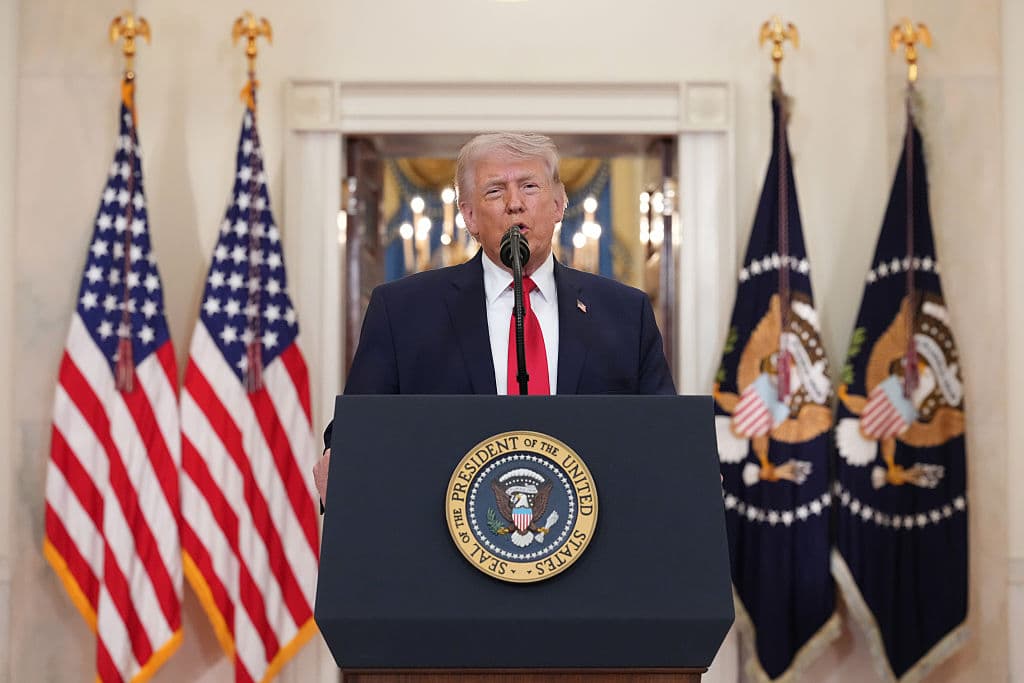

President Donald Trump, during a primetime speech on Wednesday, April 1, said the war in Iran is nearing its end, just over a month since Operation Epic Fury began. Facing growing opposition from Americans, Trump outlined the next phase of the operation, which he predicted would be complete within two to three weeks.
Iran ‘No Longer a Threat’
Trump explained that the United States is “on track to complete all of America’s military objectives shortly” in Iran, which he noted is “essentially really no longer a threat.” Still, the president indicated that negotiations to end the war are underway as the US military prepares to “hit them extremely hard over the next two to three weeks” to “bring them back to the Stone Ages where they belong.”
Though Trump previously insisted he wasn’t concerned about Iran’s enriched uranium stockpile, he addressed questions surrounding the nation’s possession of the radioactive material, saying, “The nuclear sites that we obliterated with the B-2 bombers have been hit so hard that it would take months to get near the nuclear dust. If we see them make a move, even a move for it, we’ll hit them with missiles very hard again.”
Economic Concerns
Trump also acknowledged Americans’ concerns over rising fuel costs, which he said “has been entirely the result of the Iranian regime launching deranged terror attacks against commercial oil tankers and neighboring countries that have nothing to do with the conflict.” He continued:
“This is yet more proof that Iran can never be trusted with nuclear weapons. They would use them and they would use them quickly. It would lead to decades of extortion, economic pain and instability worse than we can ever imagine.
“The United States has never been better prepared economically to confront this threat. You all know that we built the strongest economy in history. We’re going through it right now. The strongest in history. In one year, we’ve taken a dead and crippled country … and made it the hottest country anywhere in the world by far with no inflation, record-setting investments coming into the United States – over 18 trillion dollars – and the highest stock market ever.”
The president noted that the United States imports “almost no oil” through the Hormuz Strait – which has been disrupted by the war in Iran – and urged nations that rely on the waterway to take responsibility for securing it. “We’ve beaten and completely decimated Iran. They are decimated. Both militarily and economically. The countries of the world that do receive oil through the Hormuz Strait must take care of that passage,” Trump said, adding that the strait will “open up naturally” once the conflict is over, causing gas prices to fall.
An Open Letter from Iran
Early Wednesday, Trump said Iran asked the United States for a ceasefire – but just a few hours later, Iranian President Masoud Pezeshkian posted an open letter to the American people on X, warning of “consequences that extend far beyond Iran’s borders.”

The messages follow weeks of similarly confusing communications over alleged talks to end the conflict. As Liberty Nation News previously reported, “Iran continued publicly denying negotiations … even after it issued a counterproposal to Trump’s ceasefire plan.”
Boots on the Ground?
Thousands of US troops, including Special Operations forces, have deployed to the Middle East since the US launched Operation Epic Fury, The New York Times first reported. While the Navy SEALs and Army Rangers have not been “assigned specific missions,” their deployment signals that the Trump administration is still considering putting boots on the ground in Iran – an option that is very unpopular with Americans.
According to the latest Economist/YouGov survey, 62% of American adults oppose sending US ground troops into Iran, while just 14% say they are in favor of such a move. When broken down by party, the majority of both Democrats and Independents oppose deploying ground troops, while 37% of Republicans say they are against it. Notably, only 30% of Republicans support sending troops into Iran, and 33% say they are “not sure.” While President Trump didn’t specifically address the question of deploying ground troops, his remarks suggest the administration is focused on using air strikes to bring the conflict to a close.

.jpg&w=1920&q=75)