
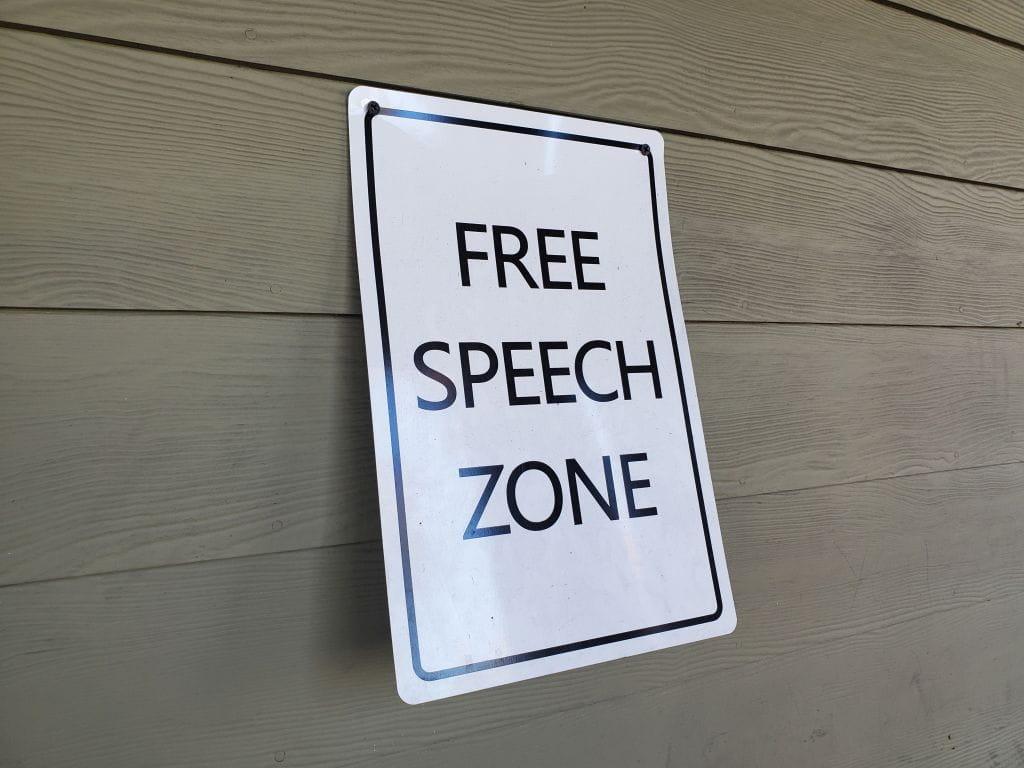

The Foundation for Individual Rights and Expression (FIRE) recently released its quarterly National Speech Index findings, showing that Americans have little confidence in either party to protect free speech. Additionally, “a staggering 73% of Americans believe that when it comes to whether people are able to freely express their views, things in America are heading in the wrong direction.” How the respondents define “protect” and “wrong direction” in this scenario is unknown, but other surveys suggest not everyone is on the same page.
Free Speech and the Road to Discontent
Why would so many people think free speech is headed in the wrong direction? The most-cited reason was the current administration, though views on that explanation were split sharply by ideology. The one cause a majority across the spectrum agreed on was political polarization, a point unintentionally underscored by the fact that respondents mostly disagreed on where else to lay the blame. Other top reasons included surveillance technology, political violence against public figures, treatment of protesters, and some of the FCC’s actions.
Notably, the current administration is probably not the only one that has caused Americans to distrust the federal government to protect free speech. “The Biden White House,” explained Reason, “pressured social media platforms to censor content officials found inconvenient in a behind-the-scenes campaign that a federal judge likened to an Orwellian ‘Ministry of Truth.’” Meta CEO Mark Zuckerberg admitted as much in an August 2024 letter to the House Judiciary Committee. “Senior officials from the Biden administration,” he said, “including the White House, repeatedly pressured our teams for months to censor certain COVID-19 content, including humor and satire.”
Lawmakers, too, have expressed a readiness to curb speech. Nearly a week after the events of Jan. 6, 2021, Rep. Alexandria Ocasio-Cortez (D-NY) said on social media, “We’re going to have to figure out how we rein in our media environment so that you can’t just spew disinformation and misinformation.” In 2024, California Gov. Gavin Newsom signed bills to restrict “deceptive” content online, which a federal judge later blocked, finding one of them unconstitutional.
So it’s no surprise that “only 9% of Americans are fully confident that the Democratic Party will protect their First Amendment rights, and 10% feel the same about the Republican Party,” FIRE noted.
Americans are quick to blame Washington, and for good reason, but when asked what they actually think about freedom of expression and the First Amendment, the picture gets more complex.
The Paradox
Freedom Forum released a survey in September 2026 that found “an increasingly complicated relationship between Americans and their First Amendment freedoms.” Ninety-one percent of respondents think the First Amendment is vital to America, yet 24% believe it “goes too far in the rights it guarantees,” an 11-point increase from 2025 and a record-high since 2020.
Free with the Daily Briefing
85EssaysUnravel the Constitution
Hamilton, Madison & Jay’s complete case for America, free and searchable in the Publius Reader.
Free with the Daily Briefing. Unsubscribe anytime.
In a 2024 survey, researchers at the Future of Free Speech think tank and at Vanderbilt University’s Project on Unity and American Democracy found “large majorities of Americans passionately uphold free speech as a cornerstone of democracy, but fewer of them are supportive of free speech when faced with specific controversial speakers or topics.” A 2022 Siena poll for The New York Times found that 30% of Americans believed “sometimes you have to shut down speech that is anti-democratic, bigoted, or simply untrue.”
The point is that many Americans don’t seem interested in letting everyone express themselves openly. Online mobs still pounce on people they disagree with in an effort to silence them or to diminish sales of albums and books. Meanwhile, a majority of the respondents in the Freedom Forum survey said they don’t speak freely. The federal government might not be doing enough to protect freedom of expression (and in some cases may be stifling it), but Americans themselves seem to be part of the reason so many people believe this constitutional right is headed in the wrong direction.
On top of that, Freedom Forum also discovered that Americans’ confidence in their First Amendment knowledge doesn’t match their actual familiarity with it. Eighty-six percent believed they were informed about their rights, but only 11% could name all five freedoms (religion, speech, press, assembly, and petition) without prompts; 26% couldn’t name one. How can freedom of expression flourish when so few Americans even understand the right?
Overall, too many people seem to think protecting free speech means protecting them from speech, so when they say it’s “headed in the wrong direction,” they might mean more viewpoints should be shut down. Yet history has shown that censoring hateful opinions and ideas is often a cure worse than the disease. As Justice Louis D. Brandeis wrote in his classic concurring opinion in Whitney v. California (1927), “If there be time to expose through discussion the falsehood and fallacies, to avert the evil by the processes of education, the remedy to be applied is more speech, not enforced silence.”