


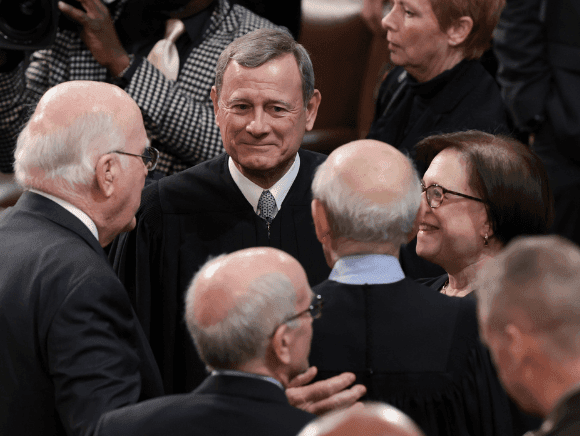

In every family, there is the peacemaker, the one who tamps down the vitriol and works to find a middle ground in the hopes of avoiding an argument. This personality profile usually includes someone who will do almost anything to avoid conflict. In fact, conflict avoidance is often a substantive driver of the peacemaker's actions. The conduct of United States Supreme Court Chief Justice John Roberts suggests such a personality hidden beneath that long, black robe. His take on the Court’s landmark decision to overturn Roe v. Wade – a somewhat reluctant agreement – set that personality trait in stark relief for all to see.
Throw Ideology Out the Door
The 17th Chief Justice of the high court has been infuriating conservatives almost since his appointment by President George W. Bush in 2005. His pivotal fifth vote to save Obamacare put Roberts in the category of persona-non-grata, and conservatives have nurtured an active dislike of the Republican-appointed Justice since that time. It is doubtful his vote to overturn Roe with the majority will do much to repair that assessment of him, and perhaps for good reason.
While the Chief Justice voted with the majority in a 6 – 3 decision, he wrote a separate concurring opinion. Within that document, Roberts asserted, "I would take a more measured course." He went on to discuss "judicial restraint" and said:
"Surely we should adhere closely to principles of judicial restraint here, where the broader path the Court chooses entails repudiating a constitutional right we have not only previously recognized, but also expressly reaffirmed applying the doctrine of stare decisis [court precedent]. The Court's opinion is thoughtful and thorough, but those virtues cannot compensate for the fact that its dramatic and consequential ruling is unnecessary to decide the case before us."
In a recent interview, constitutional scholar, Jonathan Turley, cut to the heart of the Roberts opinion asserting the Chief Justice is really an incrementalist, i.e., he is someone who prefers to tackle big issues little by little in an orderly fashion rather than make sweeping changes. In other words, Justice Roberts believes the decision to overturn Roe lacks judicial restraint. The language in his opinion of concurrence with the majority is quite revealing. For example, he uses the words "dramatic" and "unnecessary" in the same sentence. Drama to a peacemaker is anathema. They seek to keep things calm and cool and avoid hot and heavy – but at what cost?

Chief Justice John Roberts (Photo by Erin Schaff-Pool/Getty Images)
Turley argues – as will others -- that the Bush appointee's approach to Roe exposes a man without solid convictions who cannot be considered an ideologue. But having no set of firmly held beliefs with an almost pathological desire to seek the middle ground seems an unusual characteristic for a Chief Justice.
At the heart of a peacemaker like Justice Roberts lies the belief that conflict is harmful and should be eschewed at all costs. The peacekeeper labors under the illusion that everything and anything can be solved by not upsetting the apple cart. However, there are times in life when drama and chaos or anger and upset cannot be avoided.
The history of this nation, and the men who intoned expansive liberties on paper, would not have been able to write the very document Roberts is empowered to uphold had it not been for great conflict. Battles were waged and blood was spilled in the struggle to be free. An incremental approach was not an option.
Roe v. Wade was decided almost a half-century ago. Since then, technology has influenced the abortion debate by revealing a baby's unmistakable characteristics in utero. This inability to deny the presence of human life put a stake in the heart of the Roe decision that could no longer be abided. At some point – just like in 1857 when the high court wrongly decided the Dred Scott case – the band-aid needed to be ripped off.
Those who lost the Roe battle yesterday will register their displeasure through protests and perhaps even violence, as the left is wont to do. It is a necessary evil that results from correcting a wrong that must be made right. What Supreme Court Justice John Roberts can't seem to comprehend is that there are times when conflict can be productive and cannot be side-stepped.

-4.png&w=1920&q=75)

.jpg&w=1920&q=75)