

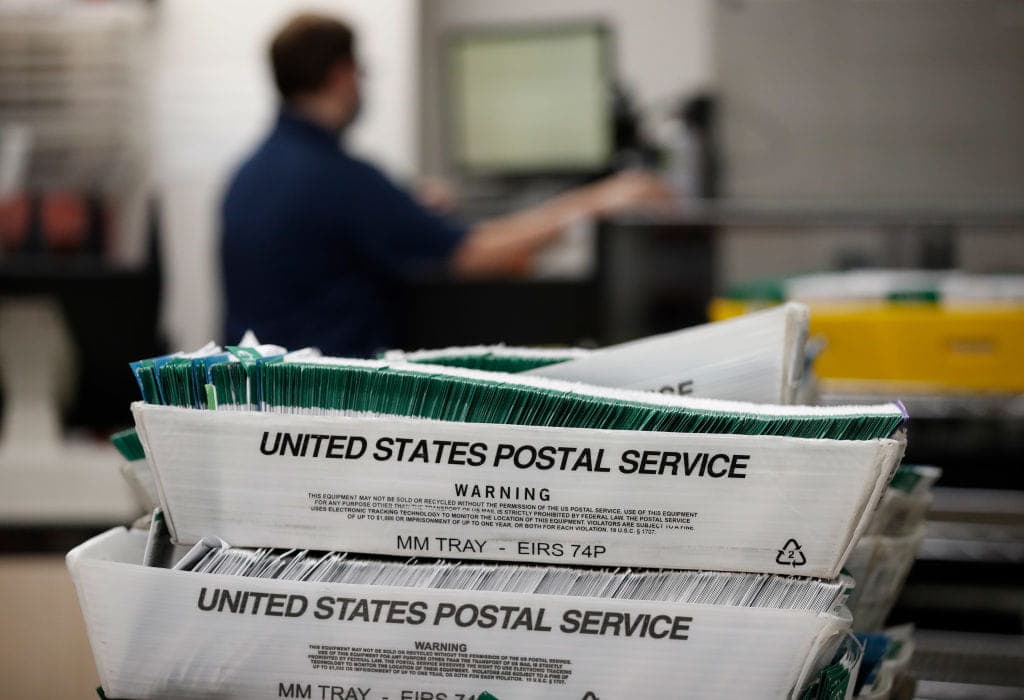

Democrats' knee-jerk opposition to President Donald Trump’s initiatives apparently even extends to the most sensible policies, including efforts to ensure that US elections are honest and transparent. Frustrated by congressional dithering over passage of the SAVE America Act, Trump issued an executive order that directed federal agencies to create a database of eligible voters to be provided to the states and correlated with mail-in ballots tracked by USPS, the United States Postal Service. At least three federal suits have been filed seeking to block the plan on various grounds, and the Trump administration has called on the US Supreme Court to settle the matter posthaste.
Midterms – and Chaos – Loom
With midterm elections fewer than 100 days away, the urgency to resolve this dispute is apparent, compounding the legal maneuvering. Both sides argue the courts must rule in their favor to avoid irreparable harm. Those supporting the administration assert that blocking the USPS from ballot tracking would heighten the potential for election fraud and weaken voter trust in the electoral system. The various plaintiffs argue that implementing the executive order would undermine elections, disenfranchise voters, and subject state officials to potential criminal sanctions. Some of the latter claims rest on speculative assertions that the Trump administration would violate the law after the order was executed.
Those who thought the courts had already resolved this issue in President Trump’s favor may be forgiven for their confusion: Several high-profile suits have been filed; two have failed in federal appellate court. The suits also involve different plaintiffs and causes of action.
Free with the Daily Briefing
85EssaysUnravel the Constitution
Hamilton, Madison & Jay’s complete case for America, free and searchable in the Publius Reader.
Free with the Daily Briefing. Unsubscribe anytime.
The NAACP sued the USPS in federal district court in Washington, DC, alleging the USPS proposal to track election mail violated a December 2021 settlement agreement. District Judge Emmet Sullivan, a Bill Clinton appointee, sided with the NAACP, but a three-judge panel of the DC Circuit Court of Appeals unanimously overruled him on July 17. The panel found that the USPS was likely to prevail in the case and had demonstrated it would suffer irreparable harm if Judge Sullivan’s stay were allowed, noting in their opinion that there “can be no do over” post-midterms.
Another suit was filed by various Democratic entities, accusing the Trump administration of prospective harms, which were entirely conjectural. This suit fared even worse than the NAACP filing: The district court refused to issue an injunction blocking the administration’s efforts to safeguard federal elections. A three-judge DC Circuit Court of Appeals affirmed that view on July 28.
USPS in the Crosshairs
Then there's a prominent suit filed by 23 states and the District of Columbia, which is the subject of the Trump administration’s outreach to the US Supreme Court on July 27. This case commenced in Massachusetts, where US District Judge Indira Talwani, a Barack Obama appointee, accepted the states’ argument on June 25 that the Constitution gives them the power to determine voter eligibility and to set the “Times, Places, and Manner” of congressional elections. The Trump administration filed a motion to intervene in that case, which a divided panel of the US Court of Appeals for the First Circuit denied on July 25.

The nation is now in uncharted legal waters, with potentially dramatic effects not seen since Americans learned about “dangling chads” in the controversial 2000 election. If the Supreme Court declines to hear the Trump administration’s filing to void Talwani’s stay, President Trump’s USPS executive order will remain in effect in all but the 24 plaintiff jurisdictions. It is unclear whether the USPS could implement the planned ballot tracking in the remaining jurisdictions. But if it did so, the nation would witness a midterm patchwork in which red states could enforce election-integrity efforts, while progressive states could defiantly allow illegals to vote in elections, or at least present that risk due to a lack of accountability.
The Supreme Court is almost certain to hear the administration’s emergency plea. The Court has instructed the states to file their responses by 4 p.m. on Aug. 3, exactly three months from Election Day 2026. The nation battles not only for who wins the next election but also who determines the rules. It is possible that a SCOTUS decision could overrule the First Circuit’s far-stretched rationalization: The country needs one set of rules to guarantee election integrity and the critical public trust it engenders. Sensible election safeguards seem long overdue.
Dig Deeper Into the Themes Discussed in This Article!
Liberty Vault: The Constitution of the United States

.jpg&w=1920&q=75)
.jpg&w=1920&q=75)
.jpg&w=1920&q=75)