


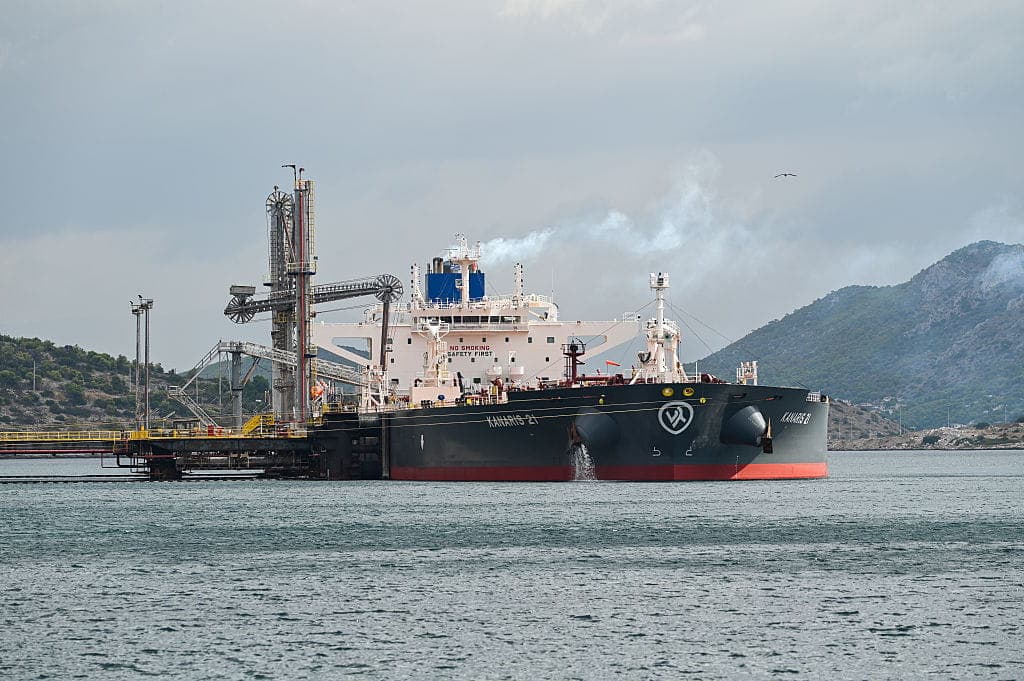

It has been over seven months since the war in Iran upended global energy markets, disrupting international shipments of crude oil, liquefied natural gas, and an array of petroleum products. The situation appears to be stabilizing as the world adapts to shifting circumstances in the Persian Gulf, mainly by relying less on the Strait of Hormuz.
Bypassing the Strait of Hormuz
Marine tracking firm Kpler recently declared: "The barrels are back, but the export system moving them is fundamentally different."
Kpler estimated that Middle East oil shipments (omitting Iran) climbed to at least 16.5 million crude barrels per day in September. The rebound has been fueled by regional producers altering how they export oil and gas, with 40% of Gulf oil bypassing the Strait of Hormuz. That was just 17% prior to the war.
Other market watchers have observed similar trends. Goldman Sachs estimated regional exports above 23 million barrels per day, matching last year's averages. Flows through the strait itself have almost "returned to late-June highs of nearly 13 million barrels a day, led primarily by Saudi Arabia," according to JPMorgan Chase.
Getting the Facts Strait
The recent rebound reflects greater pipeline capacity, and the construction of new ports and container terminals. As Liberty Nation News reported, the likes of Saudi Arabia and the United Arab Emirates have been expanding pipeline capacity, and it could top 14 million barrels per day by the end of 2028.


Free with the Daily Briefing
85EssaysUnravel the Constitution
Hamilton, Madison & Jay’s complete case for America, free and searchable in the Publius Reader.
Free with the Daily Briefing. Unsubscribe anytime.
But these are long-term projects, forcing countries to adopt short-term fixes, including ship-to-ship transfers. Shuttle tankers carry crude through the Strait of Hormuz to the Gulf of Oman, then transfer it to oceangoing tankers headed for Asia.
Some are skeptical that this will persist without a negotiated peace agreement between Washington and Tehran.
Iran has bolstered its attacks on commercial ships transiting the Strait of Hormuz, the Persian Gulf, and off the coast of Oman. The Joint Maritime Information Center, a group of US-allied militaries that provides security updates to merchant vessels, says almost 20 have been attacked over the past month. The United States has committed to protecting tankers militarily.
But is it sustainable? Neither Washington nor the financial markets think so, says Bob McNally, president of Rapidan Energy and a former energy adviser to President George W. Bush.
From Liberty Nation News, Trivia, Facts, Check Us Out
Stay informed.
Today’s news, the Constitution and American history, written for young readers.
Visit GenerationLiberty.com
News, Trivia, Facts, Check Us Out
Stay informed.
Today’s news, the Constitution and American history, written for young readers.
Visit GenerationLiberty.com
"Nobody in Washington thinks this is sustainable financially. It’s an inefficient way to move commodities, not just oil, out of Hormuz," McNally told CNBC. "If the market believed that this was sustainable, I think you would be seeing much lower prices. It’s still costly to deliver and insure and land crude in consuming regions where benchmark prices are set."
Global energy prices have stabilized, but they remain elevated. A barrel of US crude oil is below $90, Brent prices are stuck at around $100, and global super tanker spot freight rates have surged to a record high of $1.3 million per day.
The Wrong Type of Fuel
Industry figures suggest that while oil exports have recovered, refined products have not followed a similar path. Diesel and gasoline shipments have returned to about three million barrels per day, or around 60% of pre-war levels. Additionally, crude oil traversing the Gulf channel is heading to China, Japan, and South Korea, countries that keep their refined petroleum products at home, meaning little global supply recovery.
The strait shutdown has contributed to record diesel prices, but the escalation in tit-for-tat strikes by Ukraine and Russia has had a measurable effect. Until the US-Iran and Ukraine-Russia conflicts are resolved, businesses and consumers could still be paying $6 per gallon for diesel, which will eventually filter through the broader economy.


.jpg&w=1920&q=75)