
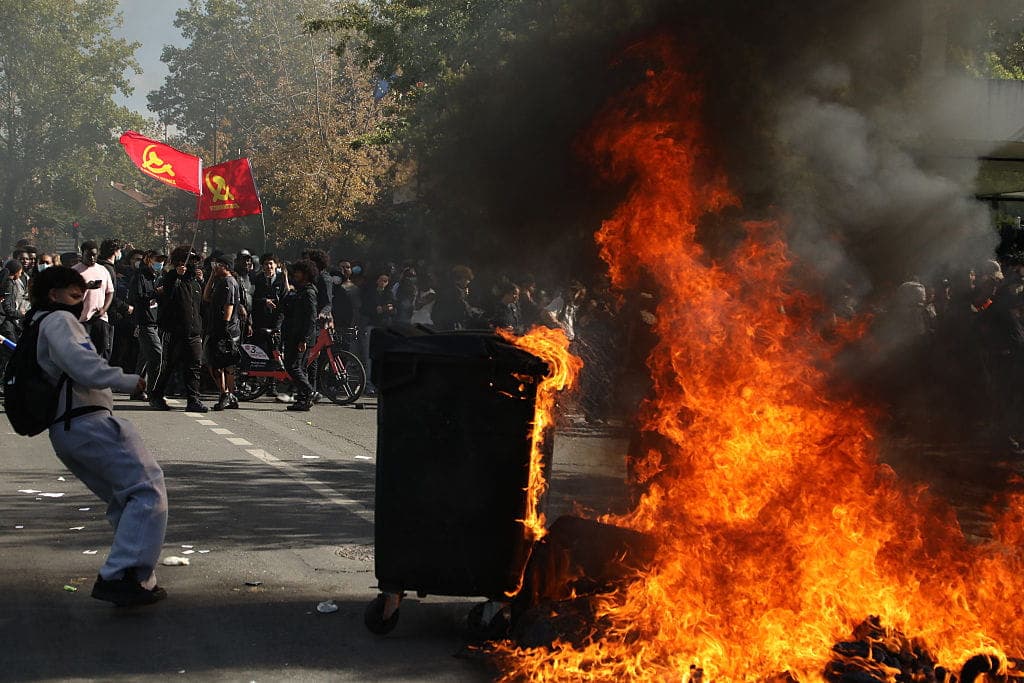

Authorities in dozens of French cities valiantly tried to calm the unrest of students protesting in the capital and around the country yesterday (Oct. 6). The unrest began two weeks ago as students blockaded schools at a lycée in the Paris suburbs and grew from there, while other protests erupted, shutting down hundreds of schools across the nation. Their grievances include crowded classes, so-called inequalities in education, and a shortage of available teachers. The civil unrest grew exponentially yesterday as French labor unions joined in the chaos.
It appears that a toxic mixture of massive immigration and a deeply indebted social welfare state has caused French schools to be underfunded. As Mark Landler of The New York Times observed:
“French public finances, already fragile, continue to deteriorate, fanning fears in financial markets that France could be the next European country to tumble into a full-blown financial crisis. The fiscal jitters were amplified by recent polls that show the far-right candidate, Marine Le Pen, would beat all her rivals in presidential elections that will be held next spring.”
France's unstable financial situation has been adding hot lava to its economic volcano for decades. Many economists believed an eruption was inevitable. Liberty Nation News Economics Editor Andrew Moran explained:
“France has not been immune to the global government bond market rout. Like other advanced economies, France's fiscal health has been deteriorating, and the government forecasts that debt interest costs will surge 15% next year to 91 billion euros ($102 billion). The ten-year bond has climbed to above 5%. But there was a sort of ‘Le Pen Bounce’ ... as the right-wing presidential candidate unveiled her shadow budget that she says will lower the deficit by almost 4% of GDP next year.”
Without a doubt, politics has played a significant role in this financial miasma as France shifts into high gear in the run-up to a presidential election scheduled to take place as two-term President Emmanuel Macron steps down. The French constitution prohibits Macron from running this time around because presidents are permitted only two consecutive terms. Round one of the French elections takes place on April 18, 2027.


Free with the Daily Briefing
85EssaysUnravel the Constitution
Hamilton, Madison & Jay’s complete case for America, free and searchable in the Publius Reader.
Free with the Daily Briefing. Unsubscribe anytime.
Most believe the country’s unbridled spending has put it into a downward economic spiral, and it can’t seem to find a way to dig out. As The Wall Street Journal asserted, “France’s Appetite for ‘Magic Money’ has turned into a debt bomb,” and it claims the country “is on the precipice of a dangerous financial spiral.”
In a WSJ interview, Carmignac portfolio adviser Kevin Thozet put the country’s economic situation bluntly: “France has been this free rider in Europe for years, if not decades. It has gotten away with fiscal murder. It worked as long as people were not noticing. Now people have started to notice.”
French Fracas Gets Ugly
Reports say hundreds of thousands have taken to the streets across urban and suburban locations; French authorities claim to have arrested more than 6,000 individuals – mostly students -- in connection with the protests. Authorities used water cannons, rubber bullets, batons, and tear gas to quell the uprising of mostly young people. French students, meanwhile, described their learning environments as rat-infested buildings with little or no supplies and not enough teachers to go around.
President Donald Trump laid the blame for France’s protests at the feet of French politicians who have permitted unrestrained immigration. It appears those leading France have built a financial trap from which it cannot recover – an eerie foreshadowing of things to come in the United States, should rampant spending continue apace. But for now, it would be wise for American authorities to watch and learn.

.jpg&w=1920&q=75)