

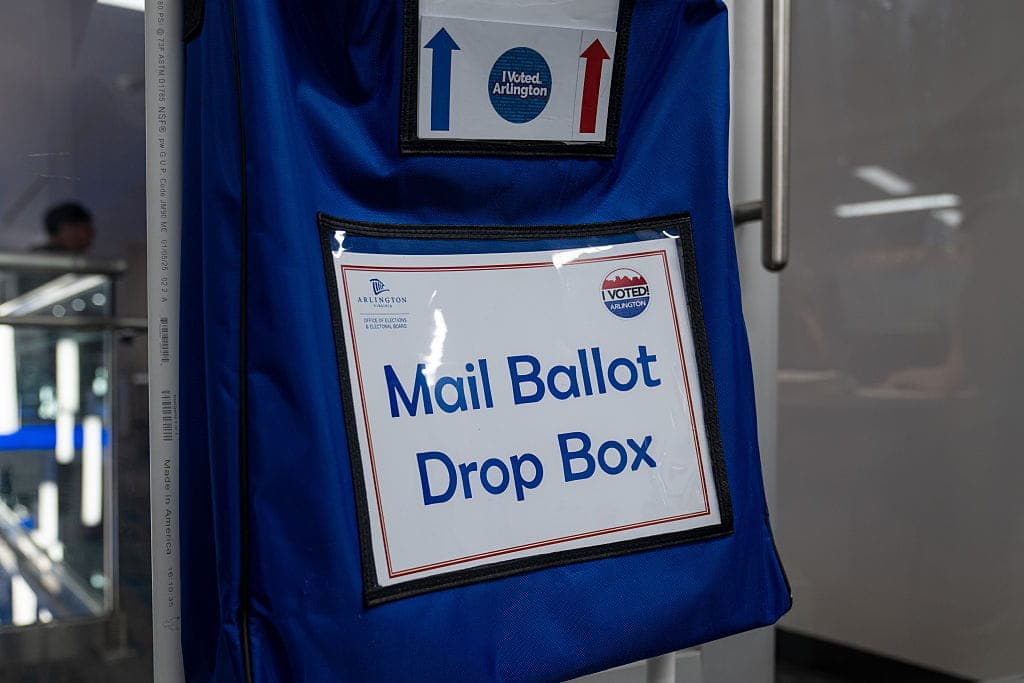

Election Day is right around the corner. Congress is in recess to let lawmakers do last-minute campaigning, polls are coming in rapid fire, and betting markets are heating up. But early voting has gradually become the new normal over the last decade, and November 3 is just the deadline. Election Day doesn’t mean what it once did; if the trend continues this cycle as it has since 2016, most ballots will already be in.
The Ever-Growing Early Voting Trend
According to the Center for Election Innovation & Research (CEIR), early and absentee voting has been steadily rising – with the COVID election cycle in 2020 being the noteworthy exception to the whole “steadily” part. In 2016, 40% of voting Americans cast their ballots early. The number rose to 42% in 2018 and rocketed to 69% in 2020. It normalized somewhat at 51% in 2022, then jumped to 61% in 2024.
A look at the CEIR figures shows that, even if we correct for the 2020 anomaly, the trend is both rising and accelerating. It isn’t just going up each cycle; it’s climbing faster each time. If that trend holds this year, the midterms may see as many, or more, early and absentee votes as were brought on by the pandemic panic.

Free with the Daily Briefing
85EssaysUnravel the Constitution
Hamilton, Madison & Jay’s complete case for America, free and searchable in the Publius Reader.
Free with the Daily Briefing. Unsubscribe anytime.
CEIR also separates the numbers into absentee, early in-person, and general early voting without the actual method being specified. For years, mail-in ballots made up the majority of early votes, with the lines moving almost exactly parallel to each other – until 2024, that is. In the last election, the lines crossed, with in-person early voting surpassing absentee ballots by five percentage points.
In that same span, we’ve seen the number of states that allow early voting grow as well. In 2016 and 2018, a full dozen states had no in-person early voting options or excuse-free absentee ballots at all, while another seven did allow early in-person voting but still required special reasons to vote by mail. Again, even if we ignore 2020 for the sake of the trend, change still came. In 2024, 36 states and the District of Columbia allowed in-person and mail-in early voting without excuse, while only three required in-person voting on Election Day.
Death of the October Surprise and Election Night Fright?
In this midterm cycle, just three states – Alabama, Mississippi, and New Hampshire – won’t allow early voting. Every other state and the District of Columbia will allow some sort of early voting – either in person or by mail – and some are already casting votes!
Illinois, Minnesota, South Dakota, Vermont, and Virginia have been accepting ballots since September. Five more states will be voting by Monday, and by Friday, October 9, another four will as well.
Watchers of modern politics are likely familiar with the term “October surprise.” The term was popularized in the 1980 presidential showdown between Ronald Reagan and Jimmy Carter, when the tense Iran hostage situation likely tanked whatever chances Carter had of re-election.
From Liberty Nation News, Trivia, Facts, Check Us Out
Stay informed.
Today’s news, the Constitution and American history, written for young readers.
Visit GenerationLiberty.com
News, Trivia, Facts, Check Us Out
Stay informed.
Today’s news, the Constitution and American history, written for young readers.
Visit GenerationLiberty.com
Then, in 1992, the October 30 indictment of former Defense Secretary Caspar Weinberger regarding the Iran-Contra scandal impacted George H.W. Bush’s campaign. Surprise! In 2000, news of Bush the Younger’s DUI arrest surfaced just before the election, though it had little effect on the outcome. Surprise! In 2016, the Hillary Clinton email scandal may have helped derail her campaign. Surprise yet again!
But in those earlier years, the newly coined "October surprise" still landed with plenty of time for voters to change their minds and choose the other candidate in a knee-jerk reaction to a scandal. This hit Carter and probably the elder Bush especially hard. In 1980, California – Reagan's home – was the only state with any form of early voting, and even that was limited. The Golden State had only just begun allowing no-excuse mail-in voting in 1978. Texas was the first state to implement in-person early voting, but that didn’t happen until the late ’80s, so by the time George H.W. Bush faced his own October surprise, there were still very few states that didn't require people to wait until Election Day – and one of them was his home state as well.
By 2000, though, around two dozen states allowed early voting, potentially blunting the effects of George W. Bush's October surprise. The various scandals of the election that followed – hanging chads and all – then spurred the trend even more.
This year, more than a dozen states have ballots coming in by the first full week of October – and most others by week two or three. And if two-thirds or more of the votes are cast early, how much change can a late-breaking scandal still bring? How long until October surprise becomes September shock or even August astonishment?
Even a third of the electorate waiting for Election Day is enough to sway the outcome on the big night – but the new normal of early voting certainly seems to be removing the mystery from the whole affair.


.jpg%20Midterms&w=1920&q=75)