

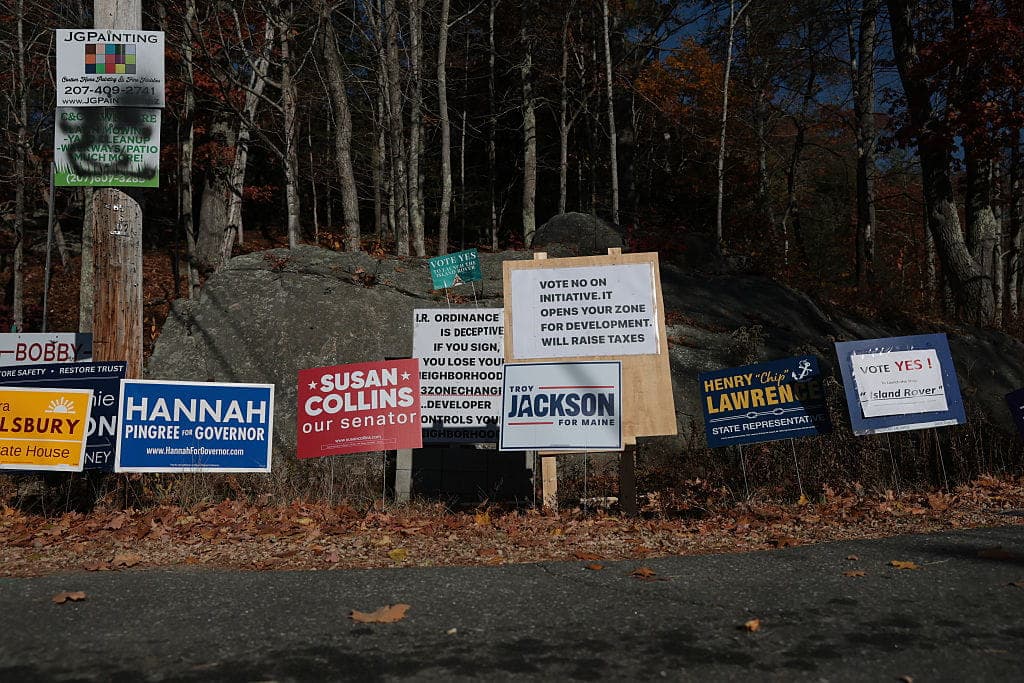

Two-party, hyper-partisan polarization is a breeding ground for bad candidates. We are seeing this to a marked degree in 2026. There is much less focus on candidate quality in today’s political landscape now that elections have become entirely a case of red numbers vs. blue numbers on an overall tote board. What this means for tens of millions of Americans on either side of the divide is a sweeping return to that unhappy norm of pre-2016 elections: grit your teeth and vote for the perceived “lesser of two evils.”
This is especially common in congressional races where the party leadership rules supreme and all that matters is securing that numerical majority. But it has also been oddly true this year in state governor races. Byron Donalds in Florida is the Republican nominee, and apparently that is all that is supposed to matter if you are red. Jocelyn Benson in Michigan is the Democrat, and that’s all that matters if you are blue.
All four of these candidates are severely flawed for various reasons that we won’t get into here, yet all four carry an enormous advantage heading into Election Day. The nationalization of American politics into a constant red vs. blue war allows them to portray a victory for “the other side” as a calamity that must be avoided at all costs. In order to avoid the catastrophe, there is only one choice, like it or not. It doesn’t really matter how you feel.
This is the “where else are you gonna go?” argument, and it feeds a deeply disturbing incongruity for a representative form of government: the citizens of this nation utterly despise the very people they vote into office again and again.
A Smoldering Resentment of Those Who Are Elected
A 2023 Pew survey highlights the complete lack of respect Americans have for their elected officials. Among the findings:
- “Today, 63% say that all or most elected officials in local, state and federal government ran because they wanted to make a lot of money....”
- “Majorities also say all or most officials ran with the intention to run for higher-level office in the future (57%) and to get fame and attention for themselves (54%)....”
- “Just 15% say all or most elected officials ran because they wanted to serve the public....”
This view has only become more reinforced in 2026. A Gallup poll released Sept. 2 found that 89% of those surveyed said corruption in the US government is widespread. The result cuts across all party lines.
“Perceptions of government corruption are now higher in the US than at any point in the past two decades and outpace most other countries, including advanced economies,” Gallup wrote. “In a country where many are polarized across a wide range of issues, this is one case where bipartisanship reflects shared alarm as much as shared consensus.”
Putting Party Over Candidate Character Spurs Perpetual Incumbency?
The greatly inflamed divisiveness of partisan American politics makes it easier for transparently self-serving candidates to win election. Networked progressive organization the Brennan Center is a terrible source to cite, but a March opinion piece it ran on political corruption nevertheless hits the mark. “[A]s polarization hardens, corruption becomes even more entrenched. Citizens grow increasingly willing to excuse corrupt behavior within their own party as they come to prioritize partisan ends over governance with integrity,” authors Lisa J. Danetz and Alex Brunet assert.
They’re not wrong. All kinds of individual warning signs are set aside when electing the red or blue candidate and defeating the blue or red foe becomes the only outcome worth caring about. For many Americans, the rise of political outsider Donald Trump was supposed to represent a decisive break from this suffocating two-party box. Yet nearly two years into a second White House term and more than 11 years since he first strode down that escalator to announce his initial run, the dominance of the red-blue dichotomy seems stronger than ever.
Big money makes it increasingly difficult for genuine political novices to stage primary challenges for party nominations. When Republican voters cheer the largesse of an Elon Musk or Democrats hail a George Soros dropping $100 million on the midterm elections, they fail to realize that all that financial heft comes with a steep narrowing of their candidate options.
Or perhaps they are simply forgetting in the heat of the electioneering moment how they really feel about the power of money in American politics. “Around eight-in-ten Republicans and Republican-leaning independents (83%) say people who donate a lot of money to campaigns have too much influence on decisions made by members of Congress. A nearly identical share of Democrats and Democratic leaners (80%) say the same,” Pew found in a September 2023 report.
Yet these same officials who are widely seen as compromised in the eyes of Americans keep getting put back into office.
“In the 2024 general elections, 95% of incumbents nationwide were re-elected,” Ballotpedia states. “In 2022, 94% of incumbents who ran for re-election won, and 93% won in 2020. This data accounts for congressional, state executive, state legislative, state judicial, and local offices within our coverage scope.”
The two figures should be shattering. When 89% of Americans surveyed believe their government is corrupt and 95% of incumbent officeholders in that government are re-elected, the Founding vision of the Republic is clearly not being upheld.