

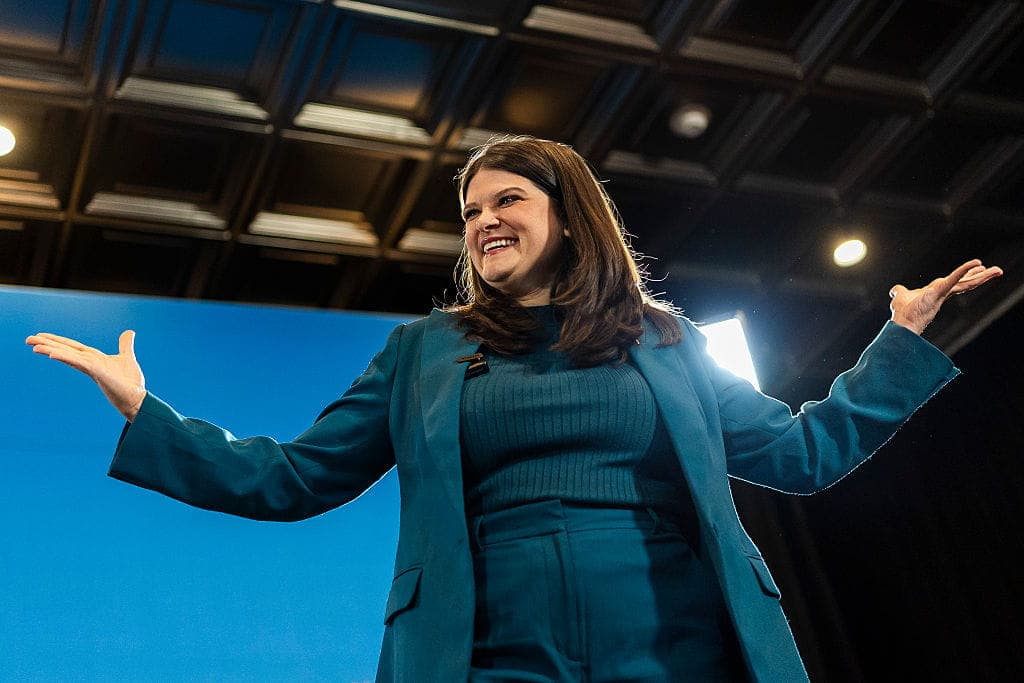

The path to upper-chamber dominance for the Democratic Party was always narrow. With Haley Stevens now endorsing Republican contender Mike Rogers, that pathway may be even slimmer. The November 1 surprise announcement from Stevens – who narrowly lost the Michigan Democratic primary to now-Senate candidate Abdul El-Sayed – has the potential to derail a once-insurgent campaign.
Not Welcome?
In an X post, Stevens explained that she was no longer welcome in El-Sayed’s campaign, and that “He’s right, and that’s why I am endorsing Mike Rogers.” She went on to criticize his association with notorious Twitch streamer Hasan Piker (who has notably appeared in public with embattled Congresswoman Ilhan Omar).
There’s almost certainly an element of political posturing in play, but what does her decision mean for El-Sayed’s campaign and for Democrats’ Senate chances?
The August 4 primary saw Abdul El-Sayed win by less than 1%, fewer than 15,000 votes. Senator Bernie Sanders described it as “the most extraordinary victory that I can think of in modern American politics.” And the Vermont senator may have a point. El-Sayed was rejected by almost all the party mechanics, and yet toppled Stevens, who was the establishment favorite to become the next US senator for the state.
A Republican has not won a US Senate race in Michigan since 1994.
Michigan Math
Liberty Nation News’ Public Square polling aggregator currently has El-Sayed leading Rogers by more than four points (49.3% to 45.1%); it’s a margin that has expanded in the last few weeks. But this is not a normal Wolverine State contest, and even El-Sayed’s fellow Democrats are nervous about his potential win.
A significant number of voters will cast their ballots for whichever candidate has a D or R after their name; it’s a natural element of party politics. So even though Stevens has decided to cast her individual vote for Rogers, it does not mean that those who backed her in the August primary will follow her now. There are, however, some data points worth considering.
The volatile odds tracker, Kalshi, noted that just after Stevens’ cross-party endorsement, El-Sayed’s chances of winning slipped eight points to just 68%. There was some recovery as Sunday slipped into Monday, but the dip suggests that the Senate candidate’s position is not quite as stable as pollsters thought.
Stevens has a huge base in Detroit. El-Sayed is the first Michigan Democrat since 2018 to win a statewide primary without carrying the state’s largest city. As election followers know all too well, it’s the major conurbations that often sway the outcome. If even a fraction of her Motor City base fails to turn out for El-Sayed, it could prove a significant upset.
Also, a fascinating point from Nate Silver. He writes that El-Sayed “was actually trailing Rogers back when he and Stevens were fighting in the summer before the primary was complete. So there’s at least some evidence that voters in Michigan are sensitive to Democratic unity, or the lack thereof.” This vision of party unity could become a flashpoint on Election Day.
On the plus side for El-Sayed is that almost two million Michiganders have already cast a ballot. So for those who might have cold feet regarding the nominee, it’s already too late to take chilly toes out of the water.
Democrat Calculations
Currently, Republicans hold a 53 to 47 majority, meaning Democrats need a net gain of four seats to secure power. Should Michigan flip from Democrat control, the party would need to pick up an extra seat in much redder territory.
A loss in Michigan means that somewhere like Texas or Alaska would need to flip blue. Although polling has put both states into play, Democrat James Talarico only has a roughly two-point advantage over Republican Ken Paxton in the Lone Star State, according to a Quantus Insights poll. It seems like an edge, but in terms of it flipping, well, that would be as seismic as the Wolverine State turning red.
Alaska is also a big story right now, with the double Dan Sullivan debacle unfolding, and alleged “dirty tricks” aplenty courtesy of the Mary Peltola campaign. The Democrat hopeful currently leads by under two points, but a recent article by none other than The New York Times outlining her campaign’s culpability in getting a second “Dan Sullivan” on the ballot could cost her on Election Day.
The public has become used to the traditional October Surprise. This year’s came a couple of days late out of Michigan, but could prove decisive in terms of which party leads the Senate.