
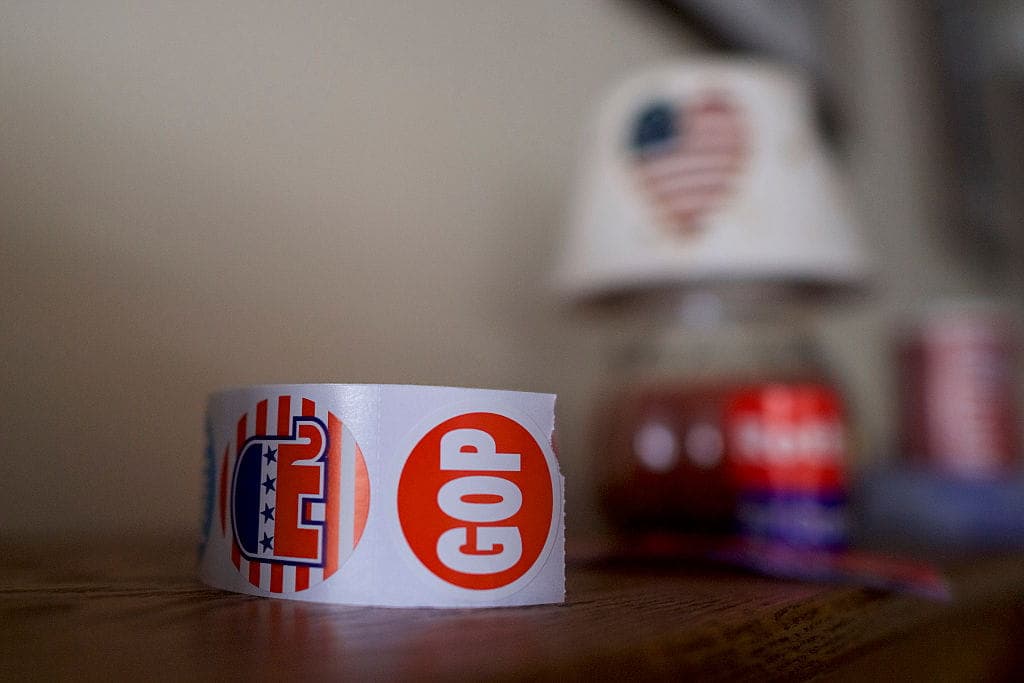

All roads to a House majority run through four Pennsylvania races, three of which the Cook Political Report currently lists as toss-ups. Right now, Republicans hold all four seats – and with the GOP’s slim majority, Democrats only need a net gain of three seats to take back the lower chamber. Neither side is taking chances. Governor Josh Shapiro launched a $3.3 million endeavor in July targeting the four GOP incumbents.
Around the same time, House Minority Leader Hakeem Jeffries (D-NY) visited the state to show support for Democrat Bob Brooks. More recently, House Speaker Mike Johnson (R-LA) swept through the state to campaign for Brooks’ opponent, Republican Rep. Ryan Mackenzie. Both sides are fighting over an electorate that is increasingly losing faith in the two major parties, meaning the political winds could blow either way. With that said, evidence suggests many Pennsylvania voters are ready for change.
Midterm Mania in Pennsylvania
First, let’s meet the players. In the 1st District, Democrat Bob Harvie faces Rep. Brian Fitzpatrick, a former FBI agent married to Fox News senior White House correspondent Jacqui Heinrich. The two candidates have traded jabs during the last couple of months, most recently arguing over potential debates. Harvie even filed a lawsuit against a political action committee aligned with Fitzpatrick over an advertisement alleging that Harvie is the subject of an FBI investigation.
The 7th District is where Bob Brooks, a firefighter and union official, is challenging Rep. Ryan Mackenzie. Brooks is leaning into the blue-collar schtick, presenting himself as the everyday working man fighting for the people. The word “affordability” gets thrown around a lot. Mackenzie is pitching term limits for lawmakers, a stock-trading ban for congressional members, and a bill ensuring data centers pay for their own electricity.
Free with the Daily Briefing
85EssaysUnravel the Constitution
Hamilton, Madison & Jay’s complete case for America, free and searchable in the Publius Reader.
Free with the Daily Briefing. Unsubscribe anytime.
In the 8th District, Scranton Mayor Paige Cognetti faces GOP Rep. Rob Bresnahan. Cognetti’s resume is the epitome of an establishment Democrat: She graduated from Harvard Business School, did a stint as a wealth manager at Goldman Sachs, and worked in the Obama administration’s Treasury Department. She won the mayor’s office in 2019 as an independent and then switched affiliation in 2021; now she hopes voters look at her governing record and ignore the party label. “People vote for the person, not the party,” she told The Washington Post. Bresnahan won his seat in 2024 and has secured nearly $6.5 million for seven community projects in Northeastern Pennsylvania.
In the 10th District, Democrat Janelle Stelson, a former broadcast journalist, is challenging Republican Rep. Scott Perry. As with many others in her party, Stelson is leaning into affordability and political corruption; she even sold her stock holdings before launching her campaign. Perry, on the other hand, is letting his record speak for itself. “You know me by now,” he told The Washington Post. “Kind of what you see is what you get.” But pointing to his record may not be as helpful as he thinks. In fact, all four GOP incumbents may have one big, beautiful problem.
The Cost of Ruling
The Republicans in these crucial swing seats are apparently struggling to break through to voters on their signature economic achievement: last year’s One Big Beautiful Bill Act. Though the tax-and-spending bill gave many Americans bigger refunds this tax season, numerous Pennsylvanians are struggling because the measure also reduced federal funding for some programs, including Medicaid and the Supplemental Nutrition Assistance Program (SNAP). Seven months after the bill was signed, the number of Pennsylvanians receiving SNAP benefits fell by almost 200,000, according to the Center on Budget and Policy Priorities. Whether all those people actually needed the benefits is a subject of an entirely different article. From a political perspective, however, these cuts could hurt the GOP’s 2026 success rate.

On top of all that, the Joint Economic Committee released a fact sheet in June stating that the average household in Pennsylvania has spent $3,900 more on goods and services under Trump, including $842 more on housing costs, $395 more on gas, and $210 more on electricity.
A recent nationwide poll by the Financial Times found that more than 53% of registered voters said their finances had worsened under Trump’s second term. Voters also said they’re more likely to trust Democrats than Republicans to handle the cost of living. Polls by Politico and Navigator Research showed similar results in July. In a swing state where voters’ party loyalty tends to shift, the economic frustration will only make the GOP’s job much harder. Still, these four races are tight and unpredictable.
Tea Leaves
The averages on Liberty Nation News polling aggregator show Fitzpatrick and Harvie locked in a dead heat; Mayor Cognetti leads Bresnahan by nearly a point and a half; Brooks has a four-point lead over Mackenzie, and Stelson is up six points on Perry. Meanwhile, Democrats have added nearly 25,500 registered voters since January, according to the Pennsylvania Department of State, while Republican registrations have declined by nearly 4,500.
A Democratic wave was laughable two years ago, back when Bresnahan upset six-term Democratic Rep. Matt Cartwright and Mackenzie defeated three-term Democratic Rep. Susan Wild. Even Democratic Sen. Bob Casey was ousted after holding his seat since 2007. But the tide started to turn in 2025. Democrats retained three vulnerable state supreme court seats in retention elections and flipped a wide range of down-ballot offices.
But history suggests Pennsylvania's political mood can turn fast, and with nearly two months until Election Day, both parties have plenty of time to persuade voters. In the end, however, the outcome will likely have less to do with political messaging and more to do with whether voters think they're better off now than two years ago.

.jpg&w=1920&q=75)
.jpg&w=1920&q=75)