


The House map for the 2026 midterm elections is coming into focus, with numerous strategists and pollsters predicting the Democratic Party will win control of the lower chamber. While Democrats are counting on voters who are fed up with the GOP-controlled White House, Republicans are counting on Democrats’ unpopularity and hoping voters are repulsed by the socialists taking over their party. A lot of finger-pointing is happening on both sides; beyond all the noise, however, are deeper issues both must reckon with for success in November. Of course, Republicans must contend with the cost of ruling, so they have an uphill climb. Regardless, they have several factors working in their favor, even as obstacles abound.
House of Cards
A lack of enthusiasm among Republican voters is worrying the party, according to an analysis by Americans for Prosperity Action (AFP), a conservative super PAC. “This is a big chunk,” the organization’s executive director, Nathan Nascimento, told The Washington Post. “This is a scary number.” About one-fifth of reliable GOP voters in Iowa, Ohio, North Carolina, Montana, New Hampshire, and Michigan are either planning not to vote in November or to possibly go blue.
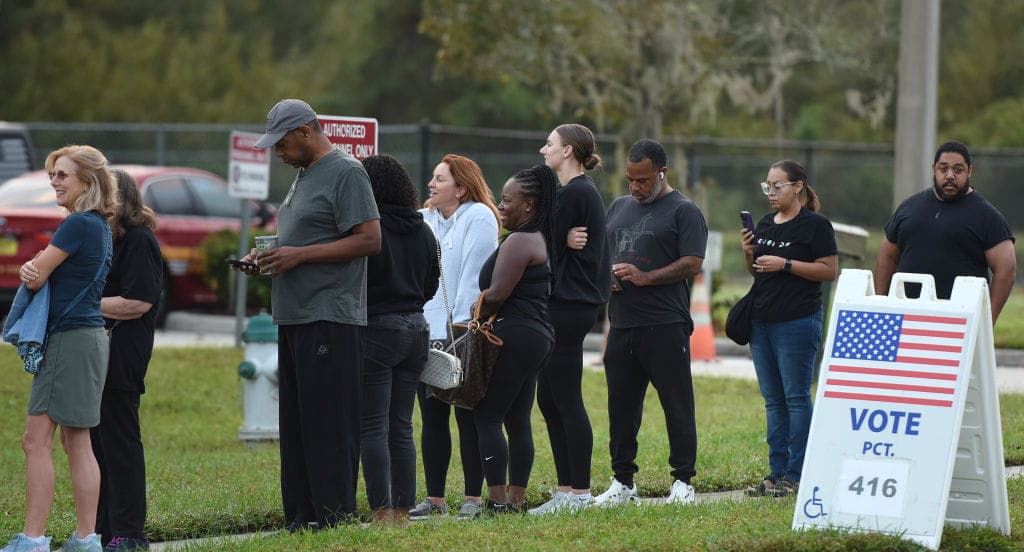
Democrats, on the other hand, are seeing a surge in voter turnout in this year’s primaries. In Wisconsin, the party saw nearly 800,000 ballots in the gubernatorial primary, a 58% increase from 2022, yet turnout in the Republican gubernatorial primary decreased by 20%, according to the Associated Press. A week before Wisconsin’s primaries, Democratic voters in Michigan broke a state record with 1.5 million votes cast. Texas and Georgia also saw a rise in Democratic turnout earlier this year.


Free with the Daily Briefing
85EssaysUnravel the Constitution
Hamilton, Madison & Jay’s complete case for America, free and searchable in the Publius Reader.
Free with the Daily Briefing. Unsubscribe anytime.
While Republicans will need to energize their base to increase participation, they will also have to figure out how to appeal to the “double haters,” a crucial group of voters who dislike both parties and helped carry Trump to victory in 2016 and 2024. In May, Pew Research Center found that 26% of adults hold a negative view of both Republicans and Democrats.
After analyzing data from several surveys, pollster G. Elliot Morris, author of Strength in Numbers, revealed that “double haters favor Democrats for 2026 by 26 points.” Sixty-four percent of this group identified as independent or unaffiliated. “The Democratic advantage for the midterms is not built on voters who like the Democratic Party,” said Morris, “but on those who call themselves independents and can’t stand either major party.”
This could be a cause for concern for the GOP. According to Gallup’s tracker, nearly half of adults consider themselves independents, and a majority of them view both parties negatively. Additionally, less than 30% of independents approve of Trump’s job performance, according to pollster FiftyPlusOne, which found the number of independents who plan to vote blue recently increased by nearly five points.
On top of all this, abuse and misconduct allegations have ensnared some GOP representatives. Chuck Edwards (NC) ended his re-election bid after an ethics investigation recommended he be censured due to “persistent unprofessional and inappropriate conduct towards two young female staffers.” In Ohio, Max Miller refused to drop his reelection bid after his ex-wife accused him of assaulting her and their child, and Cory Mills (FL) is under an ethics investigation while remaining in the primary.
Republicans may have to do some image control and find a way to swing independents to the right, which may be a tough feat with an ongoing quagmire in the Middle East, soaring prices, and the president’s low approval rating. But the other party has problems of its own, and the GOP is far from a sitting duck.
Silver Lining for the GOP
Challenges persist, but Republicans have many things that could benefit them heading into the home stretch. For starters, they have a favorable House map after mid-decade redistricting efforts in several states that could yield up to 16 additional seats. But with Democrats’ redistricting in California and a map change in Utah, the GOP’s net gain might be about ten if the maps perform as expected. This means that even with a political environment in the Democratic Party’s favor, the battle for control of the House will likely be closer than many people anticipate. Cook Political Report currently lists 38 districts as competitive: 19 tossups, ten lean Democrat, and nine lean Republican.
The next thing working in the GOP’s favor is money. Recent filings show Republican committees and their aligned super PACs hold about $1 billion for the coming months, compared with $404 million for their Democratic counterparts. And earlier this year, the Supreme Court struck down limits on how much party committees can spend in coordination with their own candidates, clearing the way for both parties to put more money into candidate advertising.

Notably, however, several primary winners this year were drastically outspent, suggesting money may not be as helpful as some think. In Michigan, for example, Rep. Haley Stevens and her backers outspent Abdul El-Sayed and his allies nearly 12-to-1 in the Democratic Senate primary; El-Sayed won by roughly one point. In the Texas GOP primary for the Senate, Sen. John Cornyn and his allies outspent state Attorney General Ken Paxton by an eye-popping amount, according to The Texas Tribune; around $120 million was spent on ads, most of it backing Cornyn, yet Paxton still won the runoff by nearly 30 points.
Another factor that could benefit the GOP in several districts is the primary victories by far-left candidates: ultra-progressives and socialists who the Democratic establishment fears aren’t fit to win general elections, an opinion held by the opposition as well. While it seems many Democratic voters are veering further left in deep-blue cities and states, the broader electorate is likely more moderate. Republicans will no doubt use this to their advantage. They might not have to do much, however, because there’s a strong likelihood that some registered Democrats are already planning to vote Republican in districts where ultra-progressives won primaries.
For example, in a poll by SoCal Strategies just before the Michigan primaries, El-Sayed had a 17-point lead over Stevens; however, for hypothetical matchups in the general election, Stevens led former Rep. Mike Rogers by four points – but El-Sayed led Rogers by only one point, partly because 12% of the voters who supported Stevens in the Democratic primary poll said they’d vote for Rogers if El-Sayed were his opponent. After the primary, Fox News conducted a survey that showed Rogers ahead of El-Sayed by four points, with 8% of likely Democratic voters saying they would cast their ballots for the Republican. Though this example is for a Senate race, it suggests far-left candidates could push some registered Democrats to vote Republican in the fall.
Tug-of-War
Liberty Nation News’ polling aggregator shows Democrats have a six-point advantage over Republicans in the congressional ballot, slightly higher than it was a month ago. Both parties’ hopes probably hinge on turnout and independent voters, as usual. The House is certainly within Democrats’ reach, but a favorable political environment probably won’t help them much if Republicans can overcome their turnout problem and capitalize on Democratic divisions.

.jpg&w=1920&q=75)