
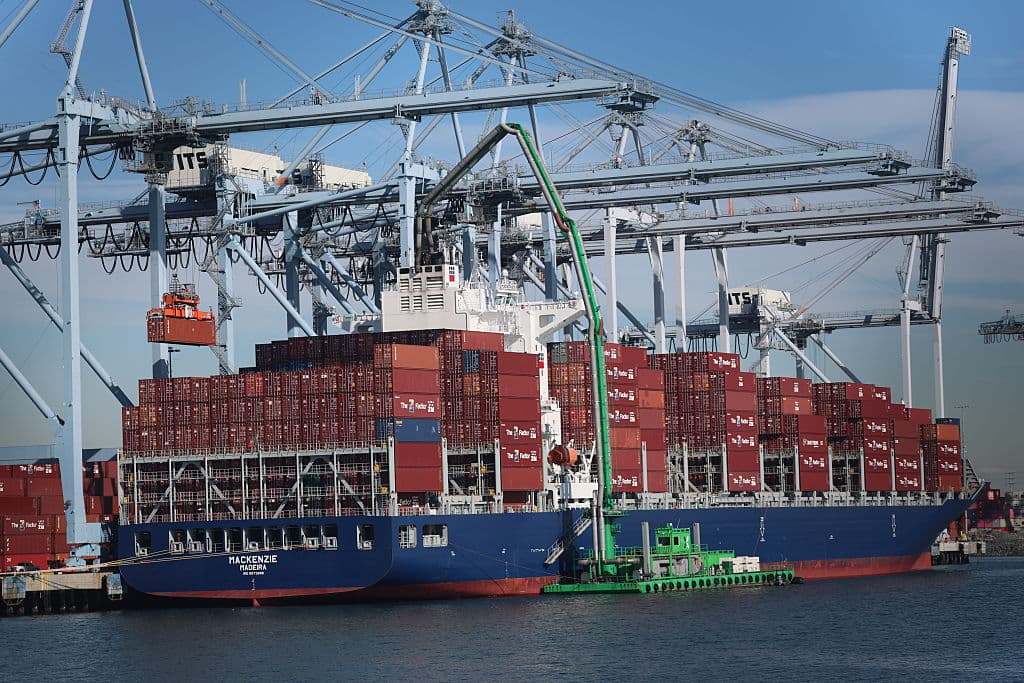

The global economy is soon to mark the first anniversary of President Donald Trump’s Liberation Day, a moment that will forever be remembered in economic and political history. By now, based on the prognostications from the chattering class, the United States was supposed to be submerged in a recession and high inflation. Instead, even with sweeping global tariffs, the nation has registered blockbuster growth and stable inflation.
Tariffs in the January Jobs Report
The Bureau of Labor Statistics published the delayed Consumer Price Index (CPI) report on February 13. While Wall Street was indifferent to the numbers, it could be viewed as a win for Main Street after years of inflation-induced misery, suffering, and unhappiness.
Last month's annual inflation rate unexpectedly slowed to 2.4%, down from 2.7% in December, the lowest since May. The consensus forecast pointed to a reading of 2.5%. Monthly inflation ticked up 0.2%, down from 0.3%, and below the market estimate.
Core inflation, which eliminates the volatile energy and food prices, eased to a five-year low of 2.5%. From December to January, the core CPI rose 0.3%, in line with economists' expectations.
Shelter was the main driver of inflation, while the rest of the marketplace remained stable. Tariff-sensitive goods were mixed, with the headline indexes for new vehicles and apparel rising just 0.1% and 0.3%, respectively. The food index edged up 0.2%, and the energy category declined 1.5%.
This leads to a key question: If tariffs ignite marketplace pressures, why has inflation risen only 2% cumulatively over the past year? Current conditions might be inserted into economic textbooks worldwide for the experts to study.
First Afraid, Then ‘Tariffied’
A day before the January CPI report, New York Federal Reserve economists published a paper titled "Who Is Paying for the 2025 U.S. Tariffs?" Researchers concluded that 86% of the tariff burden falls on US firms and consumers. Foreign exporters absorb 14% of the levies, primarily through lower average prices. In economic theory, this should lead to higher domestic costs.
“Suppose foreign exporters charge $100 for a good, and the importing country decides to levy a 25 percent tariff on it. If the foreign price remains unchanged at $100, the duty paid is $25, increasing the import price to $125. In this case, the tariff incidence falls entirely on the importer; in other words, there is 100 percent pass-through from tariffs to import prices, and therefore on U.S. consumers and firms.”
And yet, while there have been one-time price increases in pockets of the economy, aggregate levels have been stable. In a sign that the Bureau of Labor Statistics may be behind, the US Truflation CPI Index suggests the annual inflation rate is about 0.7%, far below the federal government’s estimate.
Whatever data point is used, the lack of widespread tariff inflation needs to be explained. Suffice it to say, there is no single reason as to why consumer prices have not spiraled out of control. Instead, various factors have contributed to why economists’ forecasts have not panned out.
One facet is fear. Combing through the Federal Reserve’s Beige Book – a periodic report summarizing economic conditions across the institution’s 12 districts – has repeatedly revealed firms apprehensive about passing their tariff-related costs onto consumers. US firms have sacrificed profit margins, cut expenses, or experienced lower input costs.
Although businesses keep saying they will eventually implement price hikes, they have yet to fully deploy them. But the producer price index (PPI) could serve as a pipeline inflation gauge. The 12-month headline producer inflation rate, which measures the prices businesses pay for goods and services, reached 3% in December. This could be a crystal ball for the year ahead.
Additionally, prior to Trump’s tariffs, companies accelerated their purchases of foreign imports. The move allowed them to build a vast inventory of pre-levy products. Since much of these stockpiles have been exhausted by now, what happens next remains to be seen.

Substitution effects have also played a key role in keeping the lid on price inflation. This has consisted of shoppers turning to non-tariffed items, delaying major purchases, trading down, or buying from companies that may have re-routed supply chains to markets with lower tariff rates.
The administration's disinflationary agenda could also help offset any cost pressures from higher import duties. Whether regulatory changes or tax adjustments from the One Big Beautiful Bill, savings could outweigh burdensome levies in the private sector.
Has everything already been priced in goods and services? A detailed Econofact analysis of the US tariff regime indicates that a sizable share of the tariff changes may already have been passed through to retail prices shortly after implementation.
"Our observed average price increases — at 5.4% for imported goods and 3% for domestic goods — are moderate relative to the size of announced tariff rates, particularly on Chinese products," the report stated. "We find that roughly 14 to 20 percent of the tariff changes were reflected in retail prices within six months."
Damage Done?
Tariffs have led to one-time price increases across a broad array of goods, from car seats to bananas. But they have not been embedded in the economic system. Put simply, the damage might have already been done. If this is the worst that President Trump’s trade agenda will produce, then it is safe to say that a crisis has been averted. Is deflation ahead?