

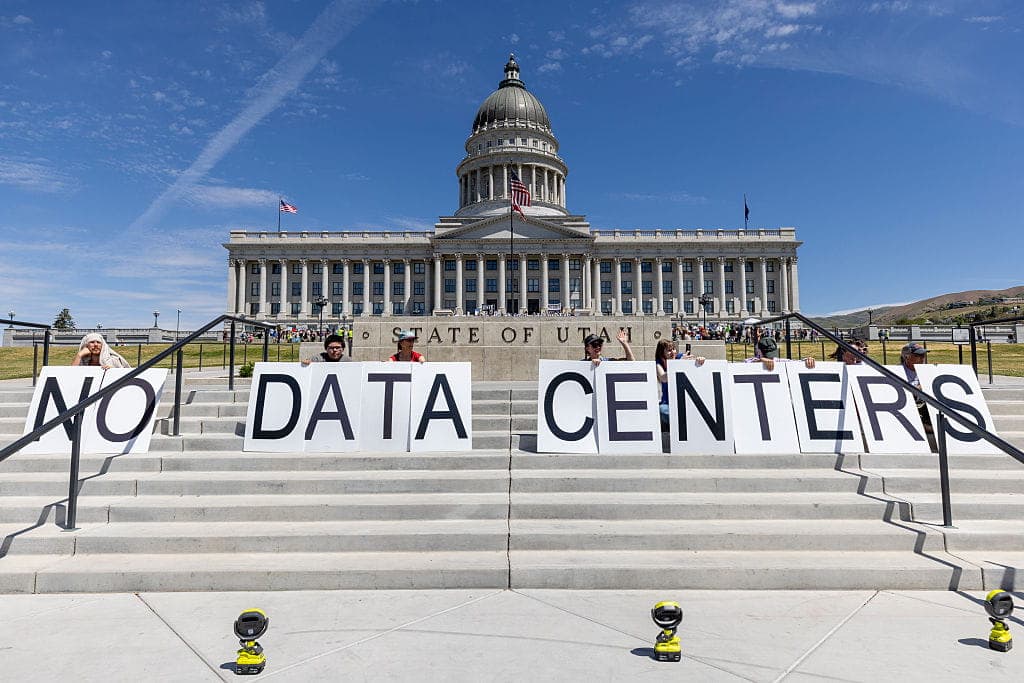

Rural Texans are so outraged over local data centers that they're crossing party lines to support candidates who oppose the massive facilities. In one Texas community, lifelong conservatives are reportedly breaking ranks and voting for Democrats who disapprove of data centers. But the outrage is not limited to one state, and it could affect the outcome of the midterms.
Data Centers Spark GOP Revolt
The Lone Star State is already home to nearly 300 operating data centers, with 170 more planned, according to an April estimate by Pew Research Center. Many Texans see these facilities as a threat to their way of life and don’t want to surrender their land and resources. These warehouse-sized facilities hold advanced servers capable of handling massive processing workloads and powering artificial intelligence. People are worried about higher electricity prices, noise pollution, decreased home values, and environmental damage. Some issues, such as water shortages, are highly contested; many say the backlash is overblown.
During a March GOP precinct meeting in Falls County, Rena Schroeder, a lifelong Republican who cast her first presidential vote for Ronald Reagan, suggested they propose a data-center ban at the next state Republican convention. She was told her proposal was unacceptable, reported The Texas Tribune, but she wouldn’t budge. “The only thing that I’m gonna revise,” Schroeder said, “is my commitment to the Republican Party. Goodbye.”

Schroeder is not alone. Schroeder is not alone. Speaking to a reporter from MS NOW, a Texan and lifelong Republican who voted for President Donald Trump said, “Red or blue, if you vote against data centers, we vote for you.” When asked if she was willing to forgo every conservative issue and vote for a Democrat if that’s what it takes to kill local data centers, she said, “Yup … my entire community is breaking rank – everybody, all of us, we’ve had enough.”
An analysis by The Tribune found that nearly 60% of data centers planned or under construction are in districts that voted for Trump and elected a Republican state representative in 2024. However, this is a bipartisan issue, with politicians on both sides of the aisle taking fire nationwide for supporting these facilities.
Party Lines Fade
In Lyon Township, Michigan, residents have launched a recall effort against all seven members of the town’s board over a proposed 1.8 million-square-foot hyperscale data center. Citizens are filling once-empty town halls to voice their opposition. Republicans and Democrats are strategizing together on social media. In one instance, a Trump supporter and a Never-Trumper teamed up to “fight an ordinance they said favored data centers,” explained The New York Times. Amid the process, countless people are becoming less sure of their politics. One Michigander said he remains conservative but “doesn’t feel Republican anymore.” At least 50 towns have reportedly passed efforts to pause data centers in Michigan, a state with three crucial House races and a tight Senate race.
This is happening across the country. More than 8,000 people signed a petition opposing a proposed data center in Montgomery County, Pennsylvania. In the eastern part, where Democratic Gov. Josh Shapiro plans to build more data centers, backlash against these facilities is threatening four Republican representatives in competitive US House races, three of which are considered “toss-ups.”
The outrage is also impacting local elections. In Festus, Missouri, four incumbent council members were recently voted out, each losing to challengers who ran on platforms opposing data centers. In Georgia last year, two Democrats proposing guardrails for data-center growth defeated Republican incumbents for seats on the Public Service Commission, the first time Georgia Democrats won in a non-federal statewide election in nearly two decades.
An Uprising With No End in Sight
Despite the nationwide pushback, AI companies are aggressively pursuing new projects. Big Tech is pouring millions into the states to build these facilities and spending a great amount on elections. In February, Meta said it intended to spend $65 million on state politicians who support the AI industry during this midterm cycle.
From Liberty Nation News, Trivia, Facts, Check Us Out
Stay informed.
Today’s news, the Constitution and American history, written for young readers.
Visit GenerationLiberty.com
News, Trivia, Facts, Check Us Out
Stay informed.
Today’s news, the Constitution and American history, written for young readers.
Visit GenerationLiberty.com
Currently, 38% of Americans live within five miles of at least one operational data center. According to Heatmap News, which tracks data-center opposition, nearly 100 projects saw local resistance in the first quarter of 2026; around 20 sites were nixed. With more than 1,000 data centers in the planning phase right now, this issue is not going away.
A May Gallup poll found that seven out of ten Americans oppose constructing data centers for AI in their local area. For numerous people, it might be the only issue that determines how they vote in local and federal elections this year. Backlash like this could decide who controls the House in 2027 and shape the road to 2028.



.jpg&w=1920&q=75)
.jpg&w=1920&q=75)
.jpg&w=1920&q=75)